Showing posts with label Vouchers. Show all posts

Monday, December 30, 2024

In Case You Missed It – December 30 2024

Here are links to last week's† articles receiving the most attention on NEIFPE's social media accounts. Keep up with what's going on, what's being discussed, and what's happening with public education.

Be sure to enter your email address in the Follow Us By Email box in the right-hand column of our blog page to be informed when our blog posts are published.
QUOTE OF THE WEEK

"There’s no reason to push children to read early. Their brains have not evolved to the point where they must read at age three or five." -- Nancy Bailey in Give the Gift of Removing Reading Pressure on Kindergartners!

LATEST TIMMS SCORES SHOW DECLINE FOR U.S.

Tom Loveless: What We Learned from the 2023 TIMSS

Was the U.S. score decline caused by the pandemic? The answer is unclear.

From Diane Ravitch
Two trends stand out.

1. Larger negative effects in math than in other subjects. The most prominent explanation is that learning math is more dependent on formal instruction in schools.

2. Gaps increased between higher and lower scoring groups along several demographic dimensions, including race, ethnicity, socioeconomic status, and the 90th and 10th percentiles (high and low achievers).Note that many of the gaps began widening before the pandemic, but Covid seemed to exacerbate the trends.

A GIFT FOR KINDERGARTENERS

Give the Gift of Removing Reading Pressure on Kindergartners!

Kindergartens should return to providing a developmentally appropriate curriculum.

From Nancy Bailey’s Education Website
This holiday season, give children the gift of reading. One of the best ways to do that is to relieve the pressure of insisting they read early. Some children might pick up reading when they’re very young, but others will learn a little later, and there’s nothing wrong with this.

However, children who are made to feel like failures at this age if they are not reading yet will have a more challenging time learning to read later.

Sadly, examples of kindergarten reading pressure can be found everywhere. A recent Business Insider report describes a mother saddened that their child had to repeat kindergarten because they couldn’t read or write!

Expecting children to read in kindergarten and putting this increased pressure on them became politically motivated with NCLB

TRUST THE EXPERTS

Unintended Consequences

Just because you attended school doesn’t mean you are an education expert or know anything about child development.

From Sheila Kennedy
Rothstein eventually concluded that lower average achievement of these pupils wasn’t due to deficits of instruction, but to the
social and economic challenges that children brought with them to school—for example, greater rates of lead poisoning that resulted in damaged cognitive function; living in more polluted neighborhoods that led to a higher incidence of asthma that kept children up at night wheezing and coming to school drowsier the next day; lack of adequate heal[th care, including dental care, that brought more children to school with distracting toothaches, and on and on...

WE NEED SOME HYGGE IN OUR CLASSROOMS

We Need Hygge Classrooms in America

It would be nice if Americans embraced contentment and connection.

From Teacher in a Strange Land Blog
In Iceland, books are exchanged as Christmas Eve presents, then you spend the rest of the night in bed reading them and eating chocolate. The tradition is part of a season called Jolabokafload, the Christmas Book flood, because Iceland, which publishes more books per capita than any other country, sells most of its books between September and November, due to people preparing for the upcoming holiday.

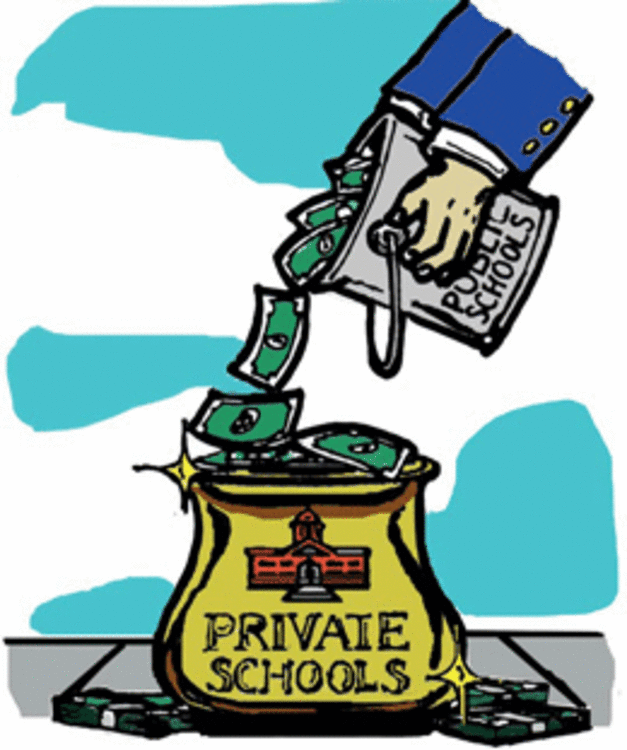
PUBLIC MONEY SHOULD GO TO PUBLIC SCHOOLS

D for effort

Republicans in the Indiana General Assembly continue to vote to raise the amount the state pays students to go to religious and other private schools...with money diverted from public schools.

From School Matters
Indiana gets a D for effort when it comes to funding public education. Keep that in mind when legislators say there’s not enough money to give schools what they need.

The rating comes from the latest “Making the Grade” report, an annual evaluation of state school funding by the Education Law Center, a New Jersey-based research organization that advocates for equitable funding. Indiana does slightly better, earning a C, for school funding adequacy and fairness.

SCHOOL COUNSELORS NEEDED

School counselors are essential, so let's treat them that way

Here's something that Indiana should spend public tax dollars on instead of diverting money to private and religious schools.

From the Fort Wayne Journal Gazette**
The 2024-25 Indiana School Counselor Survey paints a grim picture of a profession stretched far too thin. Counselors are overburdened, under-resourced, and struggling to meet their students’ growing mental health and academic needs.

Social-emotional challenges among Indiana students remain at critically high levels, with more than half of counselors reporting an increase over the past year. These issues, many of them lingering from the pandemic, are compounded by mounting academic pressures, career readiness hurdles, and a deluge of administrative tasks. Counselors are drowning in paperwork instead of sitting across from the students who need them most. The state’s student-to-counselor ratio is 351-to-1 and is well above the nationally recommended 250-to-1. This is a massive barrier to effective support.
**Note: The Fort Wayne Journal Gazette is behind a paywall. Digital access, home delivery, or both are available with a subscription. Staying informed is essential; one way to do that is to support your local newspaper. For subscription information, go to fortwayne.com/subscriptions/ [NOTE: NEIFPE has no financial ties to the Fort Wayne Journal Gazette]

†Note: NEIFPE's In Case You Missed It is posted by the end of the day every Monday except after holiday weekends or as otherwise noted.

###

Monday, December 9, 2024

In Case You Missed It – December 9, 2024

Here are links to articles from the last three weeks† receiving the most attention on NEIFPE's social media accounts. Keep up with what's going on, what's being discussed, and what's happening with public education.

Be sure to enter your email address in the Follow Us By Email box in the right-hand column of our blog page to be informed when our blog posts are published.

There are quite a few articles in this issue...presented to you with a minimum of quoting and no comments.

QUOTE OF THE WEEK

"...I want us to move beyond the last two decades of teach-to-the-test, which almost all of my students saw as a sign of disrespect, treating them like a test score. We all need to participate in cross-generational conversations on how we can do both – defeat the attempts by Ryan Walters to impose rightwing ideologies on our students, and build on their strengths and moral compass in order to prepare our kids for the 21stcentury." -- John Thompson in Will We Ever Get Free of NCLB’s Mandates and Let Teachers Teach?

POLITICS

Heather Cox Richardson: Eliminating the Department of Education?

From Diane Ravitch
Trump has promised to eliminate the U.S. Department of Education. He needs Congressional approval to do it.

Tell Your Senators to Vote "No" for Linda McMahon for Secretary of Education

From Diane Ravitch
The Network for Public Education Action strongly opposes the nomination of Linda McMahon as U.S. Secretary of Education. Ms. McMahon is unqualified and inexperienced in school governance. She has demonstrated little interest in children or schools outside of a short, politically appointed stint on the Connecticut Board of Education.

What Trump 2.0 Could Mean for Public Education

From the Texas Observer
Houston native and education expert Diane Ravitch urges a fight for "the future of Texas, and for the future of the children" under Trump's proposed reforms.

Trump’s Threatened Immigration Deportations Would Traumatize Students and Disrupt Public Schools

From Jan Resseger
...Chalkbeat‘s Kalyn Belsha explores some recent history to remind readers about what happens when massive raids disrupt public schools and terrify children and adolescents: “When immigration agents raided chicken processing plants in central Mississippi in 2019, they arrested nearly 700 undocumented workers—many of them parents of children enrolled in local schools. Teens got frantic texts to leave class and find their younger siblings. Unfamiliar faces whose names weren’t on the pick-up list showed up to take children home. School staff scrambled to make sure no child went home to an empty house, while the owner of a local gym threw together a temporary shelter for kids with nowhere else to go. In the Scott County School District, a quarter of the district’s Latino students, around 150 children, were absent from school the next day. When dozens of kids continued to miss school, staff packed onto school buses and went door to door with food, trying to reassure families that it was safe for their children to return. Academics were on hold for weeks, said Tony McGee, the district’s superintendent at the time. “We went into kind of a Mom and Dad mode and just cared for kids,” McGee said. While some children bounced back quickly, others were shaken for months. “You could tell there was still some worry on kids’ hearts.”

Public Education: The Bully and the Dream

From Teacher in a Strange Land
...If all we’re doing right now (guiltily raising hand) is re-posting that video clip of Linda McMahon getting body-slammed, we’re not helping preserve, let alone improve, public education. When our focus is on fighting bad policy, especially policy that hasn’t yet been enacted, we need to have better ideas—dreams, if you will—about what public education should look like in our back pocket.

INDIANA NEWS

Braun education panel lacks educators

From School Matters
Something is missing from the education transition council that Indiana Gov.-elect Mike Braun appointed recently. Several things, actually.

It includes no teachers.
Indiana charter group to push for property tax revenue sharing

From the Fort Wayne Journal Gazette**
A recently formed group representing Indiana’s growing public charter school sector says it’ll push lawmakers to make traditional public schools share local property tax revenue.

Indiana Charter Innovation Center President and CEO Scott Bess said his group’s request starts with the core principle underlying Indiana’s approach to funding education: money follows the student.

OHIO NEWS

Ohio’s Legislators Focus on Culture Wars & Private School Vouchers. In Next Session, Will Legislators Fully Fund Public Schools?

From Jan Resseger
As the 135th Ohio General Assembly winds down its lame-duck session at the end of 2024, there is not a lot off cheerful and exciting news for the state’s public schools.

Ohio lawmakers move to override local control and mandate mix of religion with public school time

From Ohio Capital Journal
Funny how Republicans running red states have done a 180 on indoctrination of students in public schools — as long as it’s Bible-based indoctrination. Ohio appears on the verge of following Oklahoma, Texas, Louisiana, Florida, and others in turning public schools into officially sanctioned Sunday schools with religious messages and mandates. The intensifying GOP push to incorporate more religion in public education is clearly an effort to indoctrinate students with preeminently Christian beliefs.

POST SECONDARY EDUCATION

Hechinger Report: Rural Students Lose Options, as Universities Cut Majors

From Diane Ravitch
A team of reporters at The Hechinger Report describe the damages of budget cuts at rural universities. The universities respond to declining enrollments and declining revenues by eliminating majors; students who want those majors are left in the lurch. Chemistry, science, math, foreign languages, philosophy, physics—Almost everything is on the chopping block somewhere.

LET TEACHERS TEACH

John Thompson: Will We Ever Get Free of NCLB’s Mandates and Let Teachers Teach?

From Diane Ravitch
John Thompson, historian and retired teacher in Oklahoma, wonders if the days of authentic teaching and learning will ever return. After a quarter-century of NCLB mandates, are there still teachers who remember what it was like in the pre-NCLB days. John does.
**Note: The Fort Wayne Journal Gazette is behind a paywall. Digital access, home delivery, or both are available with a subscription. Staying informed is essential; one way to do that is to support your local newspaper. For subscription information, go to fortwayne.com/subscriptions/ [NOTE: NEIFPE has no financial ties to the Fort Wayne Journal Gazette]

†Note: NEIFPE's In Case You Missed It is posted by the end of the day every Monday except after holiday weekends or as otherwise noted.

###

Monday, November 11, 2024

In Case You Missed It – November 11, 2024

Here are links to last week's† articles receiving the most attention on NEIFPE's social media accounts. Keep up with what's going on, what's being discussed, and what's happening with public education.

Be sure to enter your email address in the Follow Us By Email box in the right-hand column of our blog page to be informed when our blog posts are published.
QUOTE OF THE WEEK

"...the main tactic of privatizers remains getting friendly legislators to ignore the voting public and just go ahead and create voucher programs. Just look at Texas, where the now years-long fight by Governor Greg Abbott to get vouchers in the state has not hinged on changing the public’s mind or arguing the merits of vouchers, but on using a mountain of money to tilt elections so that he can get enough voucher-friendly legislators in place to give him vouchers." -- Peter Greene in NPE blog post, Even in a Red Wave, Voters Reject School Vouchers

VOTERS REJECT VOUCHERS

Even in a Red Wave, Voters Reject School Vouchers

When vouchers are put to the vote, Americans reject them. This year's election was no different. Voters rejected vouchers in three states.

From Peter Greene in the NPE Blog
...Colorado tried to amend the state constitution to put in place a right to school choice. The amendment was spectacularly awful, creating the potential for endless lawsuits and unmanageable demands by parents. Even the Christian Home Educators recognized that it was a spectacularly bad idea.

...In Kentucky, choice fans were miffed that the state supreme court could actually read and understand the plain language of their constitution, which says
No sum shall be raised or collected for education other than in common schools until the question of taxation is submitted to the legal voters, and the majority of the votes cast at said election shall be in favor of such taxation
So the court rejected various attempts to use public tax dollars for private school vouchers, and voucherphiles decided they’s just have to get the constitution rewritten.

Kentucky went 65% – 34% for Trump, and swept all sorts of MAGA officials back into office. Pretty much those exact numbers went the other way for the amendment, sending it down in flames.

Nebraska had perhaps the longest row to hoe, as the legislature passed a voucher law in 2023. Voters successfully petitioned to put a repeal of that law on the ballot, so the legislators repealed and replaced it themselves in an attempt to do an end run around voters. So a second petition was circulated, and repeal of the new law was placed on the ballot.

That repeal passed, and Nebraska’s voucher law is now toast.

ASSAULT ON EDUCATIONAL SPEECH

The Right’s ‘All-Out Assault on Educational Speech’ Continues Unabated

Book banning and curriculum restrictions have spread to post secondary education.

From The Progressive
A recently released report from PEN America, titled America’s Censored Classrooms 2024, tells a grim story about the right’s ongoing legislative attacks on inclusive public education.

According to the 102-year-old group, the steep rise in the number of book bans during the 2023-2024 academic year—more than 10,000 at last count—and educational gag orders to limit what topics K-12 teachers can teach and what books they can use has now spread to public colleges and universities. In the higher education sector, gag orders intersect with other worrying trends—including the dismantling of diversity, equity, and inclusion (DEI) programs and constraints on college curricula and shared faculty governance—leading to what PEN calls “an all-out assault on educational speech.”

Jeremy C. Young, director of PEN’s Freedom to Learn program, tells The Progressive that six rightwing think tanks—The Claremont Institute, The Ethics and Public Policy Center, The Goldwater Institute, The Heritage Foundation, The Manhattan Institute, and the National Association of Scholars—are largely responsible for the expansion of book bans and gag orders from K-12 to colleges and universities.

INDIANA HOUSE SEAT STAYS WITH PRIVATIZER

GOP spends big to keep rural legislative seat

[Editor's note: Republican incumbent Dave Hall has retained his seat in Indiana’s 62nd House District with 51.1% of the votes, a difference of about 800 votes.]

From School Matters
This year, Democrat Thomas Horrocks is challenging Hall. Horrocks is a church pastor and an Indiana National Guard chaplain. He has raised money and campaigned energetically, including with TV ads. On his campaign website, he lists supporting public education as one of his priorities. “This means universal pre-k, keeping public dollars in public schools, and paying teachers what they’re worth,” he says.

Hall, a farmer and the owner of a crop insurance business, seems to be a congenial and civic-minded person who takes being a legislator seriously. Unlike his fellow Jackson County Republican, Rep. Jim Lucas of Seymour, he doesn’t gratuitously threaten people or pick fights over guns and culture-war issues. His campaign website doesn’t mention education. A cute TV ad says he’ll protect public schools like his daughter’s, but he voted for the 2023 budget bill that expanded vouchers.

If Hall wins, he will owe his seat not only to the voters but to the organizations that paid for his campaign: the House Republican Campaign Committee and its deep-pocketed donors, including groups that promote vouchers and charter schools. Hall has raised over $600,000 this year, and more than half came from the HRCC.

When the time comes for tough votes on expanding “school choice,” a perennial priority for Republican leaders and their pals, you can bet he’ll be reminded of that.

LOCAL NEWS

Good news on teacher salaries -- sort of

From the Fort Wayne Journal Gazette**
An Indiana state government report on teacher salaries reveals an average pay exceeding $60,000, which might seem promising at first glance. However, this number conceals troubling realities: Our educators earn well less than the median salary for degreed workers and are paid less than their neighbors and nationally.

Released on Nov. 1, the 2023-24 Teacher Compensation Report by the Indiana Education Employment Relations Board provides a critical reference point for understanding current teacher pay. The average annual teacher salary has increased significantly, from $51,500 in 2019-20 to more than $60,000. But this figure represents a state average, masking substantial pay variability across districts, with many educators earning well less than this benchmark.

Adding to these concerns, a recent report by the National Bureau of Economic Research, published this past August, highlights a longstanding decline in interest in teaching. The share of bachelor’s and master’s graduates has sharply declined since the 1970s, when a quarter of college graduates earned education degrees.

**Note: The Fort Wayne Journal Gazette is behind a paywall. Digital access, home delivery, or both are available with a subscription. Staying informed is essential; one way to do that is to support your local newspaper. For subscription information, go to fortwayne.com/subscriptions/ [NOTE: NEIFPE has no financial ties to the Fort Wayne Journal Gazette]

†Note: NEIFPE's In Case You Missed It is posted by the end of the day every Monday except after holiday weekends or as otherwise noted.

###
Monday, October 21, 2024

In Case You Missed It – October 21, 2024

Here are links to last week's† articles receiving the most attention on NEIFPE's social media accounts. Keep up with what's going on, what's being discussed, and what's happening with public education.

Be sure to enter your email address in the Follow Us By Email box in the right-hand column of our blog page to be informed when our blog posts are published.
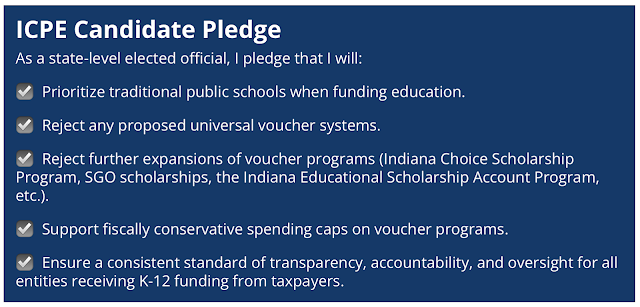
2024 Candidate pledge from the Indiana Coalition for Public Education website.

QUOTE OF THE WEEK

"[Candidate for Indiana Governor, Jennifer McCormick]...wants to place limits on the state’s private school voucher initiative: The program grew to encompass more than 70,000 children in 2023-24, a 31% increase from the year before. The state allocated $439 million in tuition grants to private parochial or non-religious schools last year — up from nearly $312 million the year before.

McCormick said the program, which might have been intended for lower-income children, is often utilized by white suburban families and is too expensive."
-- Quoted in Diane Ravitch's blog, Indiana: Vote for Jennifer McCormick for Governor

ELECT PRO-PUBLIC EDUCATION CANDIDATES

Vic’s Statehouse Notes #389 – Candidate Pledge

Ask your local candidates to sign the Public Education Pledge from the Indiana Coaltion for Public Education.

From Vic Smith, Indiana Coalition for Public Education
This election could determine the survival of public education in Indiana. The plan to give ESAs to all parents in a “universal voucher” system has already been presented by Senator Mishler. The disastrous consequences of universal ESAs were detailed in the previous Statehouse Notes #388.

To survive, public education must have strong support from more legislators. This fact is the focus of a recent opinion piece written by ICPE board member, Dr. Tony Lux.

A “Candidate Pledge” to support public education is found on the website of the Indiana Coalition for Public Education.

JENNIFER MCCORMICK FOR GOVERNOR

Indiana: Vote for Jennifer McCormick for Governor

Jennifer McCormick wants to protect Indiana's public schools.

From Diane Ravitch
Jennifer McCormick was the last elected state superintendent of schools. She switched parties because of the Republicans’ hostility to public schools.

She is running for Governor of Indiana against Senator Mike Braun, who is a far-right Republican. Braun and his running mate, an evangelical extremist, want to get rid of public schools.

The 74 reports:
U.S. Sen. Mike Braun, a conservative Republican, is still ahead in the state’s gubernatorial race but his lead among Indiana voters over Democrat Jennifer McCormick has shrunk in recent weeks.

Polling released this week by the Democratic Governors Association shows Braun just three points in front of McCormick, 44% to 41%. That’s a dropoff from the Sept. 17 results of an Emerson College Polling/The Hill voter survey that had Braun with roughly 45% of the vote and McCormick with 34. Libertarian candidate Donald Rainwater also picked up more support but less dramatically so, going from 5.8% to 8%.

Indiana has not elected a Democratic governor since 2000 and Republican presidential candidate Donald Trump holds a comfortable 14 percentage point lead, 57% to 43%, over Democrat Kamala Harris, according to an ActiVote poll released Tuesday.

PUBLIC DOLLARS GOING TO RELIGIOUS SCHOOLS

Only One True God: How Religious Schools Use Taxpayer Dollars to Promote Their Extremist Ideology

How our tax dollars are used...

From Thom Hartmann in Milwaukee Independent
Five Republican-controlled states are in the process of letting vouchers ghettoize their entire public-school systems. As The Washington Post noted:
“Billions in taxpayer dollars are being used to pay tuition at religious schools throughout the country, as state voucher programs expand dramatically and the line separating public education and religion fades.”
Meanwhile, the Speaker of the House of Representatives, Mike Johnson, flies an “Appeal to Heaven” flag outside his official congressional office that, since 2013, has been the semi-official logo of a militant arm of charismatic Christianity involved with January 6th. Supreme Court Justice Sam Alito flew a similar flag outside his summer home.

Another man flying that flag is outspoken Catholic evangelist Leonard Leo, who now controls over a billion dollars and helped run the process that selected Trump’s picks for the Supreme Court as well as hundreds of federal bench nominees. As ProPublica pointed out in a story about the man that remade the American judicial system:
“Leo is a major supporter of the [Catholic Information Center], and its unabashed projection of political power aligns with the central role of religion in Leo’s political project.”

LOCAL NEWS

Fort Wayne Community Schools seeks buyer for vacant southwest parcel

From the Fort Wayne Journal Gazette**
Fort Wayne Community Schools is seeking potential buyers for land it has owned for more than 20 years on the city’s southwest side.

The board agreed Monday to sell the vacant property at the northwest corner of Sandpoint Road and Ardmore Avenue to the person with the highest and best qualified offer.

The district doesn’t anticipate any future need for the site, which is smaller than an acre and requires ongoing maintenance, officials said.

Online property records indicate the district bought the land for $85,000 in March 2003. At that time, the tract was immediately north of Elmhurst High School, which closed at the end of the 2009-10 academic year. FWCS sold that site for $600,000 seven years ago to Hanson Aggregates Midwest, which operates nearby Ardmore Quarry.

Dolly Parton’s Imagination Library coming to Allen County; ACPL fundraising goal met

From WANE.com
After just a few months, a campaign to bring Dolly Parton’s Imagination Library to local kids has brought in enough funds to move forward with the reading program.

The Allen County Public Library announced Monday it has met its $100,000 fundraising goal for the campaign, which was launched in June. That means the Imagination Library could be implemented in the coming months.

The country music icon’s program provides free books to children up to age 5, encouraging literacy starting at a young age. Kids around the globe who are registered in the program get books in the mail each month.

There are already over 1,500 children on the waiting list for Allen County’s program. Families can join the list on the Imagination Library website.

Indiana marching bands are heading to the 2024 BOA Super Regional. Find out who'll compete

From IndyStar
THE LATEST: See who made finals at the Indianapolis Super Regional here.

For the next few weeks, it's marching band season at Lucas Oil Stadium (except when it's Taylor Swift season, that is).

Marching bands in Indiana competed last week for a spot in the ISSMA Semi-State competition, which takes place Oct. 26. This week, there's a two-day Bands of America Super Regional bringing high school performers from around the region (and a few from beyond) to the stadium.

More than 110 bands also will come to downtown Indy in mid-November for the 2024 Bands of America Grand National Championships.

**Note: The Fort Wayne Journal Gazette is behind a paywall. Digital access, home delivery, or both are available with a subscription. Staying informed is essential; one way to do that is to support your local newspaper. For subscription information, go to fortwayne.com/subscriptions/ [NOTE: NEIFPE has no financial ties to the Fort Wayne Journal Gazette]

†Note: NEIFPE's In Case You Missed It is posted by the end of the day every Monday except after holiday weekends or as otherwise noted.

###

Monday, October 14, 2024

In Case You Missed It – October 14, 2024

Here are links to last week's† articles receiving the most attention on NEIFPE's social media accounts. Keep up with what's going on, what's being discussed, and what's happening with public education.

Be sure to enter your email address in the Follow Us By Email box in the right-hand column of our blog page to be informed when our blog posts are published.
QUOTE OF THE WEEK

"...Ninety-eight percent of Indiana’s voucher schools are faith-based, with restrictive admissions policies that prove “school choice” is, in practice, the “school’s choice.”

Last year, 36% of new state tax funding for K-12 education flowed to voucher schools educating about 7% of Indiana students. Public schools, including charter schools, educated 93% of students but received only 64% of the new funding, according to legislative budget estimates at the time."
-- by Karen Francisco in the Colorado Sun

PRIVATE SCHOOLS' CHOICE

Colorado families already enjoy school choice. Amendment 80 would open door to school vouchers.

Private schools choose their students.

From Retired FW Journal Gazette Editorial Page Editor, Karen Francisco, in the Colorado Sun.
In Indiana, I watched a fledgling school choice movement grow from a handful of public charter schools to a voucher entitlement program expected to cost state taxpayers $600 million this year.

The money diverted from public schools is not going to students who live in poverty. An investigation by the University of Notre Dame’s Gallivan Program for Journalism, Ethics and Democracy found the average Indiana voucher recipient is a white female who has never attended public school and comes from a family earning more than $99,000 a year. A family of four earning as much as $220,000 a year now qualifies for vouchers, in a state where the median household income is a paltry $66,800.

None of this comes as a surprise. Indiana’s near-universal voucher program was always the end game for former governors Mitch Daniels and Mike Pence, the legislature’s Republican super-majority and a nationwide network of wealthy donors that included Betsy DeVos, Donald Trump’s former secretary of education.

Emails obtained by The Associated Press under open records law revealed private meetings involving politicians and some of Indiana’s wealthiest powerbrokers — strategy sessions held over cocktails at high-end restaurants to plot out the voucher bill’s passage. A black-tie event at an Indianapolis hotel celebrated the misnamed “Indiana Choice Scholarship Program” — not a scholarship, but a handout to families already sending their children to private and parochial schools.

2024 ELECTION AND EDUCATION

Read the following articles for information about the Harris/Walz and Trump/Vance federal education plans.

Only a Harris-Walz Administration Would Protect Equity and Inclusion in the Public Schools

From Jan Resseger
In 1899, on the first page of The School and Society, John Dewey defined educational equity as essential for the public schools : “What the best and wisest parent wants for his own child, that must the community want for all of its children. Any other ideal for our schools is narrow and unlovely; acted upon, it destroys our democracy. All that society has accomplished for itself is put through the agency of the school at the disposal of is future members. All its better thoughts of itself it hopes to realize through the new possibilities thus opened to its future self. Here individualism and socialism are at one. Only by being true to the full growth of all the individuals who make it up, can society by any chance be true to itself.”

Certainly, John Dewey didn’t fully anticipate the ugly conversation we are having today—where an attack on Dewey’s principle of equity and on public schooling itself has been mounted by well funded billionaires in philanthropies like the Lynde and Harry Bradley Foundation and Americans for Prosperity, well supplied with ideology and policy developed by the Heritage Foundation and other so-called think tanks, and spouted by billionaire-funded proxies like Moms for Liberty and Parents Defending Education. The ethos underneath the wave of school vouchers passed by far-right state legislators as well as the specific educational policies promoted in the Heritage Foundation’s Project 2025 includes individualistic consumerism and white ethno-nationalism. There is a lot of money being invested today to help us all forget about Dewey’s vision.

One of the most troubling aspects of today’s far right attack on public schooling is that it appears to be a another in a long a series of political reactions against the principle of equity in our public schools. Since the Civil War, according to constitutional scholar Derek Black in his powerful book, Schoolhouse Burning, our society has struggled to realize our long declared principle that all children, no matter their race, gender, or immigrant status have an equal right to education. Black writes that after the Civil War in order to join the union, states were required to guarantee in their state constitutions that no child would be denied the opportunity for education...”

If Trump wins, count on continued culture wars, school vouchers, and a fixation on ending the federal Department of Education

From The Hechinger Report, by Josh Cowen
...With the former president and his allies still denying that he lost the 2020 election, with Trump and his running mate embracing unfounded stories about Haitian immigrants eating household pets and with Trump’s obsession with the size of his cheering crowds, any analytical projection about his future agenda is all but impossible. With such an absence of facts or evidence-based policy designs, we must turn to past actions, current rhetoric and the priorities of Trump’s political alliances for a hint of what could come.

On that basis, we could expect more debates about bathrooms and women’s sports, more inexplicable musings about whether slavery had benefits for enslaved Americans, more spending of scarce resources to put Bibles in public schools and more singling out of kids because of their immigration status.

Many Republican proposals have been well-covered, starting with Project 2025 — the policy agenda assembled by the conservative Heritage Foundation for a new Trump term. Although Trump denies that controversial document speaks for his candidacy, more than 140 former members of the first Trump team had a hand in its crafting.

The key education points in the platform Trump does claim as his own — the so-called Agenda47 and the GOP party platform — strike the same notes of emphasis as those in Project 2025. Indeed, the one-page education “chapter” in the 16-page party platform is all but a summary of its much larger Project 2025 counterpart.

Trump Describes His Plans for Education

From Diane Ravitch
When Donald Trump appeared recently in Milwaukee, he described his plan for the future of the Department of Education. It’s not quite the same as the scenario in Project 2025, which envisions the total elimination of the U.S. Department of Education. Trump imagines it as a “department” with only two employees: A Cabinet Secretary and a secretary.

The severely shrunken Department would focus solely on the three Rs and would somehow mysteriously have the power and personnel to prevent public schools across the nation from teaching anything connected to “woke.” That is, anything related to race, gender, or social justice. How this fictional Department would impose bans on curriculum when federal law prohibits any federal interference in curriculum is not explained. Actually, it’s nonsense.

Ellie Quinlan Houghtaling writes in The New Republic about Trump’s vision for the federal role in education.
†Note: NEIFPE's In Case You Missed It is posted by the end of the day every Monday except after holiday weekends or as otherwise noted.

###

Monday, October 7, 2024

In Case You Missed It – October 7, 2024

Here are links to last week's† articles receiving the most attention on NEIFPE's social media accounts. Keep up with what's going on, what's being discussed, and what's happening with public education.

Be sure to enter your email address in the Follow Us By Email box in the right-hand column of our blog page to be informed when our blog posts are published.

QUOTE OF THE WEEK

"I think that teacher shortages have existed in the United States for a long time. The pandemic has certainly made the teacher shortage worse in many ways, right? In particular, what we’re seeing is that enrollments and completion in teacher preparation programs have decreased 30 to 35 percent over the last 10 years, so the number of people who are enrolled to become teachers have just decreased substantially over the last 10 years." -- Tuan Nguyen, associate professor of Education at the University of Missouri in Teacher shortages improve, but not everywhere

TEACHER PAY

Yes, What We Pay Teachers Matters

Who is going to teach your children and grandchildren when there are no more teachers? Why would someone choose teaching as a career?

From Nobody Wants This Substack by Anne Lutz Fernandez
Public school teachers once took home salaries in line with workers in similar professions. Through the eighties and into the nineties, they paid a small penalty for choosing to teach; in 1993 the average salary of teachers was about 5% lower than that of others with college degrees. A new report by economist Sylvia Allegretto at the Economic Policy Institute reveals that three decades later, that penalty has grown to nearly 27%—an all-time high.

This penalty has worsened as teacher salaries began a prolonged stagnation.

There are those on the right who argue that this gap isn’t all that meaningful. A recent piece in Reason tries to downplay the impact of the teacher pay penalty by pointing out that averages obscure state-by-state differences. It’s hard to see how this helps their case, though, when teachers pay a penalty in every state and when more than a dozen states across various regions—New Hampshire and Colorado, Oklahoma and Oregon, Georgia and Arizona among them—pay penalties worse than the national average.

Opponents of raises for teachers frequently claim that teachers’ benefits balance out their low pay, but Allegretto’s analysis shows they don’t. When total compensation packages are accounted for, the teacher pay gap is reduced, but only to 16.7%.

Then there’s the argument that teachers aren’t motivated by money...

SCARING THE PUBLIC ABOUT EDUCATION

Cynical Politicians Try to Frighten Us with Inaccurate Stories about Teachers and Public Schools

Attacks on public education continues during this election season. Lies abound.

From Jan Resseger
In the current polarized political season, the press is filled with articles spawned by desperate politicians looking to frighten voters with stories about the collapse of our society. In this narrative of collapse, attacks on the public schools loom large.

The Wall Street Journal‘s Matt Barnum and Melissa Korn quote Donald Trump: “Our public schools have been taken over by the radical left maniacs… We will cut federal funding for any school or program pushing critical race theory.” “The former president has said he would deploy federal powers to pressure schools and universities that he considers to be too liberal. One strategy that he has described would launch civil-rights investigations of schools that have supported transgender rights and racial diversity programs.”

It doesn’t seem to matter in today’s political environment that the extremist political rhetoric about what’s happening in public schools has been shown to be inaccurate. Here is Education Week‘s Sarah Schwartz reporting the response of the American Historical Association: “The longstanding battle over how to teach America’s past has been particularly contentious over the past few years. Conservative commentators have accused history teachers of rampant left-wing bias, ‘indoctrinating’ students into hating their country and rejecting its founding ideals… But this portrait of American classrooms as ideological incubators is largely a fiction… Instead, the research, from the American Historical Association, finds that teachers overwhelmingly say they aim to develop students’ historical thinking skills—teaching them how to think, not what to think—and value presenting multiple sides of every story… The finding echoes history teachers’ responses to attacks on their work…. (I)n interviews with AHA researchers, teachers explained that it was important for them to remain neutral and nonpartisan. ‘I am going to teach the good, the bad, and the ugly. I’m going to tell it like it is and how it happened.’ one teacher from Texas told the researchers. Another, from Illinois, said they didn’t want ‘students knowing my views.'”

INDIANA'S NEXT GOVERNOR

Gubernatorial candidates far apart on education

Mike Braun, Republican candidate for Governor of Indiana, proposes to continue the same right-wing anti-public education plan that has damaged the state's public schools since 2011. A vote for Jennifer McCormick is a vote for Public Education.

From School Matters
The two major-party candidates for governor of Indiana have released their education agendas, and they couldn’t be any more different.

Republican Mike Braun wants to further expand Indiana’s already radical school choice programs, protect “parent rights” and double down on the culture wars. Democrat Jennifer McCormick wants to strengthen local public schools, increase support for preschool and hold accountable all schools that receive state funding.

Both say they want to raise pay and benefits for teachers – a worthwhile goal but likely a tough sell with a legislature intent on cutting taxes.

Their most substantive differences are over funding private schools. Braun wants to expand the state’s nearly half-billion-dollar voucher program to include the wealthiest 3% of Hoosier families. He would also double funding for the “education scholarship account” program, which pays for tuition and services for students with disabilities and their siblings.

VOUCHERS ARE DRAINING INDIANA'S PUBLIC SCHOOLS

Vouchers nearly universal at half of Indiana private schools that take them, data shows

Indiana started with a small voucher program, and expanded it year by year until almost every child in the state is now eligible for a voucher. Voucher advocates in Indiana hope that the only remaining limits are soon removed so that all students in the state, rich and poor alike, will qualify for a voucher.

Most of the students who use vouchers were already enrolled in private schools. The cost of the voucher program is near $500 million for about 70,000 students. The public schools of Indiana enroll one million students.

Indiana's Constitution requires the legislature to fund a single public school system.

"Knowledge and learning, generally diffused throughout a community, being essential to the preservation of a free government; it shall be the duty of the General Assembly...to provide, by law, for a general and uniform system of Common Schools, wherein tuition shall be without charge, and equally open to all."

From Chalkbeat Indiana
...critics like Fuentes-Rohwer of the Indiana Coalition for Public Education say the $439 million price tag for the program in 2023-24 represented a costly diversion of public resources from public schools that the state is constitutionally obligated to fund.

According to the state’s 2023-24 voucher report, if all 70,000 students receiving vouchers had attended public schools, the state would have added over $500 million in public education funding. But most voucher students receiving vouchers have never attended a public school.

“There are so many things you have to go through as a public school system to be transparent,” Fuentes-Rohwer said. “We are very concerned that funding leaves public schools that have the obligation to educate everyone.”

†Note: NEIFPE's In Case You Missed It is posted by the end of the day every Monday except after holiday weekends or as otherwise noted.

###

Monday, September 30, 2024

In Case You Missed It – September 30, 2024

Here are links to last week's† articles receiving the most attention on NEIFPE's social media accounts. Keep up with what's going on, what's being discussed, and what's happening with public education.

Be sure to enter your email address in the Follow Us By Email box in the right-hand column of our blog page to be informed when our blog posts are published.
QUOTE OF THE WEEK

"When lawmakers consider expanding or creating private school voucher programs, their projections often dramatically underestimate the actual costs. They sell a false promise that vouchers will save money, do not budget adequate funds, and then wind up with million dollar shortfalls, necessitating cuts from public education and even tax increases… First, it costs less than the average expenditure to educate some students...The students who are most expensive to educate...tend to remain in public schools, because they cannot find a private voucher school willing to accept them. Yet, because of the voucher program, the state now pays tuition for private school students who never attended public schools...This all adds up to more, not less spending." -- from the National Coalition for Public Education, quoted in Voucher Programs Prove Again and Again What We Already Know


THE COST OF VOUCHERS

Voucher Programs Prove Again and Again What We Already Know

Voucher costs in Indiana...two-thirds of which go to students who never attended public schools and who can afford the cost of a private education...are approaching half a billion dollars a year. That money goes to mostly religious schools even though the Indiana Constitution states (in Article 1, Section 6) that...

"No money shall be drawn from the treasury, for the benefit of any religious or theological institution."

Note also that the state allows voucher accepting schools to reject students on the basis of "religion, disability, sexual orientation, gender identity, or academic ability."

From Jan Resseger
As we all know, state legislators across the country originally justified passing small, experimental voucher programs as a way to help poor kids escape from their so-called “failing” public schools. A year ago, at the end of The School Voucher Illusion: Exposing the Pretense of Equity, an authoritative collection of essays by experts on school vouchers, here is what the editors conclude instead:

“As currently structured, voucher policies in the United States are unlikely to help the students they claim to support. Instead, these policies have often served as a facade for the far less popular reality of funding relatively advantaged (and largely White) families, many of whom already attended—or would attend—private schools without subsidies. Although vouchers are presented as helping parents choose schools, often the arrangements permit the private schools to do the choosing…
”

In states like Ohio, where the legislature made vouchers universal by raising the income eligibility level to 450 percent of the federal family poverty level (with partial vouchers for even wealthier families), the state simply started paying the private school tuition bills that families had been undertaking for generations. In other states like Arizona, the state has been awarding Education Savings Account vouchers for the private educational expenses of children who are not enrolled in public schools, whether to pay for private school tuition vouchers or homeschooling costs...Here is the primary fiscal problem of all these programs, according to Josh Cowen, a professor of education policy at Michigan State University: “It’s not that there is a mass exodus from public to private schools… (W)hat these states are doing is obligating themselves to expenditures that were previously borne by the private sector.”

Indiana is a classic example of a state that has made its old fashioned private school tuition voucher program universally available. This week for Chalkbeat Indiana, Aleksandra Appleton and Mia Hollie report: “Voucher use has soared in Indiana since lawmakers made nearly every student in the state eligible, with more than 90% of students at more than half of all participating schools using a voucher during the 2023-24 school year…. That was true in just 11% of private schools before lawmakers made the Indiana Choice Scholarship available to nearly every student in Indiana by relaxing income eligibility and removing other requirements to participate…. Since lawmakers approved the expansion last year, the number of schools where 100% of students receive a voucher rose from just one in 2022-23 to 28 in 2023-24. Last year, in 178 of the 349 private schools that accept vouchers, more than 90% of students enrolled use a voucher to pay for tuition.” The program cost the state of Indiana $439 million for the 2023-24 school year.

Peter Greene: Why Sex Scandals Matter

From Diane Ravitch
...How could someone who had inveighed against “the woke agenda” and urged the adoption of vouchers to escape that agenda have done what the rumors said? I didn’t think I would touch it with a ten-foot pole. I don’t care what others do in their private lives. I believe in Tim Walz’s credo: “Mind your own damn business.” But I was troubled by the hypocrisy.

Corey worked for Betsy DeVos and was her leading salesman for vouchers. DeVos and her family are rabidly anti-LGBT. For years, they have funded anti-LGBT organizations like the Family Research Council, Focus on the Family, and Alliance Defending Freedom. Yet the rumor was that Corey had performed in gay porn, and there were many videos online to prove it.

One of the alleged virtues of vouchers was that they enable students to escape pedophile teachers and to attend schools that ban LGBT students. I couldn’t make sense of these two lives.

Peter Greene wrote about Corey’s apparent double life.
NEWS FROM THE NETWORK FOR PUBLIC EDUCATION (NPE)

Network for Public Education launches the National Center for Charter School Accountability

The National Center for Charter School Accountability provides research and recommendations on increasing transparency and accountability for charter schools.

From The Network for Public Education and Diane Ravitch
Having spent years covering charter scandals and seeking accountability for charters, the Network for Public Education realized that it could not compete with the high-powered corporate public relations firms representing the charter school industry. So, we decided, the only way to get accountability is to do it ourselves.

So NPE established the National Center on Charter School Accountability, which will produce reviews of charter school performance.

Network for Public Education 2025 National Conference

From The Network for Public Education
Registration is now open for NPE/NPE Action’s 2025 national conference, Public Schools: Where All Students Are Welcome. We can’t wait to see you in Columbus, Ohio, on April 5-6!

Stay tuned for more info about keynote speakers and session topics.

BANNED BOOKS WEEK

Banned books week is over...but book banning continues.

It's Banned Books Week

NOTE: A Facebook account is required to access this article.

From Michael B. Shaffer on Facebook
So here we are in the third day of Banned Books Week 2024, and I want to give a huge shout-out to all of the great teachers in Indiana who have resisted the mandate to clear their shelves of books that one person might find objectionable, in favor of keeping the books that speak to the hearts of kids. What those who want to restrict access to the kinds of books students want, do not realize is that if we are serious about literacy, we must have the books that mean something, books that students want to read, books that students will read!

When we ban books, or sit still while it happens, we are not only giving up a precious freedom, we are also depriving our students the ability to do what my friend Alan Boyko, the retired President of Scholastic Book Fairs, used to say that students need the ability to "find themselves in a book, and then lose themselves in that book."

Banned Books Week

From American Library Association
In a time of deep political divides, library staff across the country are facing an overwhelming number of book ban attempts. In 2023 alone, the American Library Association's Office for Intellectual Freedom tracked 1,247 efforts to censor books and other resources in libraries—an increase of 65% from the year before. In total, 4,240 unique book titles were targeted, many of them representing LGBTQIA+ and BIPOC voices and experiences.

As we gear up for Banned Books Week 2024 (September 22-28), with the theme "Freed Between the Lines," we’re reminded how much is at stake. The freedom to explore new ideas and different perspectives is under threat, and book bans don’t just restrict access to stories—they undermine our rights. Now is the time to come together, celebrate the right to read, and find freedom in the pages of a book. Let’s be "Freed Between the Lines."

LOCAL NEWS

Wells County school district scores Red Wagon status

From the Fort Wayne Journal Gazette**
The Bluffton-Harrison Metropolitan School District has once again earned Red Wagon Corporation status for its fundraising efforts for Riley Hospital for Children, a news release said.

Districts receive this designation when their fundraising equals $1 per student per building in an academic year, the release said. State enrollment data shows Bluffton-Harrison had about 1,800 students last year – the year its recognition honors.

The Wells County school system has contributed more than $300,000 to the Indianapolis-based children’s hospital since 1993, the release said. It indicated each school annually hosts special events – including dress-up days, boat races and an auction – to support the cause.

Note: The Fort Wayne Journal Gazette is behind a paywall. Digital access, home delivery, or both are available with a subscription. Staying informed is essential; one way to do that is to support your local newspaper. For subscription information, go to fortwayne.com/subscriptions/ [NOTE: NEIFPE has no financial ties to the Fort Wayne Journal Gazette]

†Note: NEIFPE's In Case You Missed It is posted by the end of the day every Monday except after holiday weekends or as otherwise noted.

###

Monday, September 23, 2024

In Case You Missed It – September 23, 2024

Here are links to last week's† articles receiving the most attention on NEIFPE's social media accounts. Keep up with what's going on, what's being discussed, and what's happening with public education.

Be sure to enter your email address in the Follow Us By Email box in the right-hand column of our blog page to be informed when our blog posts are published.
QUOTE OF THE WEEK

"...the teacher pay penalty is one more symptom of two issues that are fundamental to so many of our education debates-- the desire to avoid paying one cent more than we absolutely have to for public school funding, and the desire not to pay taxes to educate Those Peoples' Children. Both of those desires are getting full expression in the privatization movement." -- Peter Greene in Does Teacher Pay Matter?

TEACHER PAY

Does Teacher Pay Matter?

It does. But teacher pay alone is not enough.

From Curmudgucation
...the teacher pay penalty-- the gap between teacher pay and pay for similarly-educated professionals-- has been growing over the last three decades to reach an all-time high. The gappage appears to have accelerated in the mid-90s.

Some, like the folks at Reason magazine...argue that it's not so bad because blah blah blah shuffling numbers around. But considering averages and other benefits does not improve the picture.

Fernandez also notes the other perennial argument against paying teachers well-- teachers don't care about money and they aren't motivated by it and boy do my old fart hackles raise at every similar argument posted by someone who also posts that damned stupid "Teachers do it for the outcome, not the income" meme.

Teaching is not supposed to be some act of self-sacrifice, immolating yourself so that you can illuminate the lives of students. For one thing, it's not sustainable. It's not even functional, because (as they don't tell you in teacher school), you can give every last atom of yourself and it won't be enough. You will burn out early, and--bitterest of ironies--you won't even be very good at it, because what can a person who has no life of their own teach students about life?

Don't get me wrong-- teaching is absolutely a noble and supremely worthwhile profession of service. But that doesn't mean teachers shouldn't be paid well.

DON'T ELIMINATE THE USDOE

Eliminating the Education Dept. Would Destroy Public Schools

Carol Corbett Burris is the Executive Director of the Network for Public Education.

From Carol Burris in The Daily Courier (Connellsville, PA)
Since President Jimmy Carter created the modern Department of Education in 1979, the department has faced continuous calls for its abolition. This threat has persisted through Republican administrations, from Ronald Reagan to Donald Trump.

Never following through on their campaign promises to abolish it, some presidents have often used the department to push agendas hostile to public schools. Reagan’s department brought exaggerated claims of doom and gloom in A Nation at Risk, denigrating our public schools with a still-existing narrative. And Trump’s secretary of education, Betsy DeVos, did little to hide her disdain for public schools, calling for abolishing the department she ran.

However, no matter how often presidents promise to ax it, ending the department would require an act of Congress. While there is little reason to believe that Congress would agree, given the volatility of government, one can never be sure. At the least, the promise to abolish the department is a rallying cry and a dominant feature of the right-wing agenda to end what it calls “government schools.”

That right-wing agenda, reflected in Project 2025 and to a more limited extent in the Republican platform, is to eliminate democratically governed public schools. It emanates from the vision of Milton Friedman, who believed that public school systems should be replaced by a patchwork of private, home school, religious and semi-public schools like charter schools. Parents would receive funds in a “savings account” to shop among them. Proposers of this voucher-like funding scheme know that public school systems could not survive without reliable systemic funding streams. The remnant of public schools would serve the children no private or charter school wants.
PRIVATIZATION

Why have vouchers "failed to improve test scores or educational outcomes?" Because the most pressing problem in the United States when it comes to education is child poverty.

“…we are likely to find that the problems of housing and education, instead of preceding the elimination of poverty, will themselves be affected if poverty is first abolished.” – Martin Luther King Jr., The Southern Christian Leadership Conference Presidential Address, 8/16/1967

Public School Successes

From Sheila Kennedy
...Some twenty or so years ago, privatization enthusiasts had a standard answer for every perceived government malfunction: let the private sector do it! This approach had multiple, significant drawbacks, and as those drawbacks became too obvious and costly to ignore, the early enthusiasm faded–except in education, where the “market can solve all problems” ideologues were joined by rightwing activists pursuing a vendetta against teachers’ unions, and by religious folks who chafed at separation of church and state and wanted a First Amendment “work-around.”

“How do you improve the performance of the nation’s public schools?” was–and remains– a fair question. Urban school districts, in particular, face multiple challenges, and when the question of how to meet those challenges became an everyday topic following publication of A Nation at Risk, political figures offered two wildly competing suggestions: “the market can solve everything” ideologues insisted that competition from private schools would incentivize public school improvement; supporters of public education lobbied for additional resources, to be deployed in line with reforms suggested by new academic research.

As we know, vouchers won the political debate. It was a disarmingly simple fix, championed by people who not-so-coincidentally stood to gain from it. Unfortunately, however, despite the promises, vouchers have failed to improve test scores or educational outcomes...

The fight over vouchers is an existential battle for America’s public schools

From Linda Blackford in The Charlotte Observer
Advocates of “school choice,” or using public funds to pay for private school, often call it the civil rights issue of our time.

That’s a special kind of gaslighting, not only because numerous studies have shown how little academic progress students make with school vouchers, but also because the school choice movement was actually born out of the horror that parents and politicians had toward the 1954 Brown v. Board decision that would end legal segregation in schools.

That resistance was bolstered by Nobel prize-winning economist Milton Friedman’s book “The Role of Government in Education,” which objected to any government oversight of any kind, and first suggested some kind of tax code changes to subsidize private education.

“It was this idea — what became school vouchers — that allowed segregationists to frame a racist response to the Court’s desegregation orders as an issue of markets and what we would call today parental choice,” writes Josh Cowen in his timely new book, “The Privateers: How Billionaires Created a Culture War and Sold School Vouchers.”

The book is a fascinating history of how the school choice movement began in segregation, then caught steam as a way to help poor and minority students in failing systems.

WHAT DO PARENTS KNOW?

What Do Parents Know About Public Education?

The most important facet of education is the relationship between the student and the teacher. The second most important is the relationship between the teacher and the student's parents/guardians. Communication is important.

From Nancy Flanagan in Teacher in a Strange Land
Kappan recently took a look at American adults’ knowledge of public schools:

Our findings shed light on a key question: What do adults know about U.S. education? Specifically, what do they know about what is taught, who makes decisions, the role of parents, and the belief systems driving education policy? Our results have important implications for how we might support children and improve the education system.

No kidding, Sherlock.

The survey results would come as no surprise to veteran public school educators: Half of adults don’t know what is/is not taught in their local school. Most are unsure about who’s making curricular decisions. Most are unclear on the impact of privatization on their public schools. Some of the surveyed issues (Critical Race Theory and learning loss) revealed a complete lack of understanding.

Least surprising finding: Adults’ perceptions of what’s happening in public schools mainly come from their own personal experiences (and this includes people with no K-12 children in the home). The percentage of people who read books or articles, watch cable news or videos, or listen to podcasts about education is small. People who get their education news from newspapers? Fifteen percent. Second highest source of ed news? Social media.

That’s a lot of guesswork, memes and faulty memories.

FORT WAYNE AND INDIANA

The challenge of chronic absenteeism

From the Fort Wayne Journal Gazette**
Indiana’s battle against chronic absenteeism mirrors a broader national trend that has proven difficult to reverse in the post-pandemic era. Chronic absenteeism is the rate of students absent from school for any reason for at least 10% of the school year.

While the Indiana Department of Education noted earlier this month that the state made progress last school year, with the absenteeism rate falling to 17.8%, the improvement still leaves more than 1 in 6 students habitually missing school.

Allen County’s chronic absentee rates are mixed. Southwest Allen County Schools, for example, posted an impressive absenteeism rate of less than 1%, the lowest the district has seen in more than a decade. By contrast, Fort Wayne Community Schools and East Allen County Schools struggled with rates higher than 20%. However, FWCS did see modest improvement.

Core change: With deadline looming, state must move rapidly on new diploma requirements

By Indiana State Representatives Phil GiaQuinta and Kyle Miller in the Fort Wayne Journal Gazette**
Indiana is in the middle of redesigning its high school diploma requirements. Given the importance of getting this right, the Indiana State Board of Education and Department of Education are required to engage in a public comment period to hear from Hoosiers about their feedback on the proposal.

When the first draft came out earlier this year, there was widespread outcry from parents, educators and our state universities about how the proposal focused too much on nebulous work-based learning and external internship requirements and would not adequately prepare students to meet admissions requirements to Purdue, Indiana University and other in-state institutions.

Thankfully, the department of education and board of education heard our concerns, and the second draft, which has been unveiled but not yet fleshed out in the form of a draft agency “rule,” is a marked improvement. However, we believe it can improve more.

That’s why we hosted a town hall on the redesign this week and invited local education leaders to join us to discuss the plan’s promises, pitfalls and remaining questions.


JOIN US

An Evening with Jennifer McCormick

NEIFPE is proud to co-sponsor this event featuring Jennifer McCormick, candidate for Governor of Indiana. We hope you can attend.

Click HERE to register for the September 25th event:


**Note: The Fort Wayne Journal Gazette is behind a paywall. Digital access, home delivery, or both are available with a subscription. Staying informed is essential; one way to do that is to support your local newspaper. For subscription information, go to fortwayne.com/subscriptions/ [NOTE: NEIFPE has no financial ties to the Fort Wayne Journal Gazette]

†Note: NEIFPE's In Case You Missed It is posted by the end of the day every Monday except after holiday weekends or as otherwise noted.

###