Showing posts with label Privatization. Show all posts

Monday, December 30, 2024

In Case You Missed It – December 30 2024

Here are links to last week's articles receiving the most attention on NEIFPE's social media accounts. Keep up with what's going on, what's being discussed, and what's happening with public education.

Be sure to enter your email address in the Follow Us By Email box in the right-hand column of our blog page to be informed when our blog posts are published.
QUOTE OF THE WEEK

"There’s no reason to push children to read early. Their brains have not evolved to the point where they must read at age three or five." -- Nancy Bailey in Give the Gift of Removing Reading Pressure on Kindergartners!

LATEST TIMMS SCORES SHOW DECLINE FOR U.S.

Tom Loveless: What We Learned from the 2023 TIMSS

Was the U.S. score decline caused by the pandemic? The answer is unclear.

From Diane Ravitch
Two trends stand out.

1. Larger negative effects in math than in other subjects. The most prominent explanation is that learning math is more dependent on formal instruction in schools.

2. Gaps increased between higher and lower scoring groups along several demographic dimensions, including race, ethnicity, socioeconomic status, and the 90th and 10th percentiles (high and low achievers).Note that many of the gaps began widening before the pandemic, but Covid seemed to exacerbate the trends.

A GIFT FOR KINDERGARTENERS

Give the Gift of Removing Reading Pressure on Kindergartners!

Kindergartens should return to providing a developmentally appropriate curriculum.

From Nancy Bailey’s Education Website
This holiday season, give children the gift of reading. One of the best ways to do that is to relieve the pressure of insisting they read early. Some children might pick up reading when they’re very young, but others will learn a little later, and there’s nothing wrong with this.

However, children who are made to feel like failures at this age if they are not reading yet will have a more challenging time learning to read later.

Sadly, examples of kindergarten reading pressure can be found everywhere. A recent Business Insider report describes a mother saddened that their child had to repeat kindergarten because they couldn’t read or write!

Expecting children to read in kindergarten and putting this increased pressure on them became politically motivated with NCLB

TRUST THE EXPERTS

Unintended Consequences

Just because you attended school doesn’t mean you are an education expert or know anything about child development.

From Sheila Kennedy
Rothstein eventually concluded that lower average achievement of these pupils wasn’t due to deficits of instruction, but to the
social and economic challenges that children brought with them to school—for example, greater rates of lead poisoning that resulted in damaged cognitive function; living in more polluted neighborhoods that led to a higher incidence of asthma that kept children up at night wheezing and coming to school drowsier the next day; lack of adequate heal[th care, including dental care, that brought more children to school with distracting toothaches, and on and on...

WE NEED SOME HYGGE IN OUR CLASSROOMS

We Need Hygge Classrooms in America

It would be nice if Americans embraced contentment and connection.

From Teacher in a Strange Land Blog
In Iceland, books are exchanged as Christmas Eve presents, then you spend the rest of the night in bed reading them and eating chocolate. The tradition is part of a season called Jolabokafload, the Christmas Book flood, because Iceland, which publishes more books per capita than any other country, sells most of its books between September and November, due to people preparing for the upcoming holiday.

PUBLIC MONEY SHOULD GO TO PUBLIC SCHOOLS

D for effort

Republicans in the Indiana General Assembly continue to vote to raise the amount the state pays students to go to religious and other private schools...with money diverted from public schools.

From School Matters
Indiana gets a D for effort when it comes to funding public education. Keep that in mind when legislators say there’s not enough money to give schools what they need.

The rating comes from the latest “Making the Grade” report, an annual evaluation of state school funding by the Education Law Center, a New Jersey-based research organization that advocates for equitable funding. Indiana does slightly better, earning a C, for school funding adequacy and fairness.

SCHOOL COUNSELORS NEEDED

School counselors are essential, so let's treat them that way

Here's something that Indiana should spend public tax dollars on instead of diverting money to private and religious schools.

From the Fort Wayne Journal Gazette**
The 2024-25 Indiana School Counselor Survey paints a grim picture of a profession stretched far too thin. Counselors are overburdened, under-resourced, and struggling to meet their students’ growing mental health and academic needs.

Social-emotional challenges among Indiana students remain at critically high levels, with more than half of counselors reporting an increase over the past year. These issues, many of them lingering from the pandemic, are compounded by mounting academic pressures, career readiness hurdles, and a deluge of administrative tasks. Counselors are drowning in paperwork instead of sitting across from the students who need them most. The state’s student-to-counselor ratio is 351-to-1 and is well above the nationally recommended 250-to-1. This is a massive barrier to effective support.
**Note: The Fort Wayne Journal Gazette is behind a paywall. Digital access, home delivery, or both are available with a subscription. Staying informed is essential; one way to do that is to support your local newspaper. For subscription information, go to fortwayne.com/subscriptions/ [NOTE: NEIFPE has no financial ties to the Fort Wayne Journal Gazette]

Note: NEIFPE's In Case You Missed It is posted by the end of the day every Monday except after holiday weekends or as otherwise noted.

###

Monday, October 28, 2024

In Case You Missed It – October 28, 2024

Here are links to last week's articles receiving the most attention on NEIFPE's social media accounts. Keep up with what's going on, what's being discussed, and what's happening with public education.

Be sure to enter your email address in the Follow Us By Email box in the right-hand column of our blog page to be informed when our blog posts are published.

QUOTE OF THE WEEK

"Indiana Republicans have expanded school choice so aggressively since 2011 that you’d think there would be almost nothing left to do. We know there will be a push to make the voucher program “universal,” extending public funding for private school tuition to the wealthiest 3% of Hoosier families – a top priority for GOP gubernatorial candidate Mike Braun. But legislators may have other tricks up their sleeves. The 2025 legislative session stars in January, so we’ll find out soon." -- Steve Hinnefeld in School Matters blog, ‘School choice’ backers bankroll Indiana GOP

WHO PAID FOR INDIANA'S REPUBLICAN SUPERMAJORITY?

‘School choice’ backers bankroll Indiana GOP

The "Hoosiers" behind school "choice" funding are not all from Indiana.

From School Matters
Why is “expanding school choice” always at the top of Indiana Republican’s policy agenda even though few Hoosiers are clamoring for it? The old saying holds true: Follow the money.

Hoosiers for Quality Education, which advocates for private school vouchers and charter schools, is one of the top contributors to Republican legislative candidates’ campaigns. It gave GOP candidates and committees nearly $250,000 in the past six months.

The group gave $150,000 to the House Republican Campaign Committee, far more than any other PAC. (Indiana Realtors were in second with $40,000). It also gave generously, as much as $10,000, to individual candidates.

While the group calls itself “Hoosiers,” nearly all its money comes from out of state. This year, it got $375,000 from Walmart heir Jim Walton of Bentonville, Arkansas. In the past five years, Jim Walton and his sister, Alice Walton, have given the group over $1.2 million.

Hoosiers for Quality Education, the political arm of a nonprofit called the Institute for Quality Education, gave far more to Republican legislative candidates than groups that are often thought of as GOP cash cows, like the Indiana Chamber of Commerce, the Insurance PAC and the Builders’ Association. Only the Realtors gave significantly more, and some of its contributions went to Democrats.

And it’s not the only group that’s pushing school choice at the Statehouse. Hoosiers for Great Public Schools, organized by former Democratic Indianapolis Mayor Bart Peterson, spent $151,000, nearly all of it in contributions. Reed Hastings, co-founder of Netflix, has bankrolled the group with $1.2 million since 2020.

Hoosiers for Quality Education and Hoosiers for Great Public Schools donate exclusively to Republican candidates...

EDUCATION TOPICS - PRESIDENTIAL ELECTION

Support public education in this year's election.

Children and the Presidency: X-Rated or Fine for Prime Time?

From Nancy Bailey's Education Website
As the election approaches, the stakes of how and what children learn, what they see and hear from both Presidential candidates, couldn’t be more different and critical for the future of America’s children. Breaking it down for kids, one candidate is X-rated, and the other is fine for prime time!

For years, former President Trump’s behavior has created problems in how parents and teachers teach children good behavior and respect for one another. His vulgar ramblings often have nothing to do with policy.

The other candidate, VP Kamala Harris, reaches out to voters even if one has some policy differences and speaks respectfully. The TV can be left on when children are in the room. She appears to genuinely care about people.

There have been concerns about how Trump’s behavior affects America’s children and schools.

Anti-Public Schools

Trump said he’d defund public schools, democratic schools owned by Americans, if school officials don’t do as he says. How must this sound to a child who likes attending their public school?

His claims are often outlandish. He has accused teachers of doing sex change operations!

Has Donald Trump ever visited any public schools?


Kamala Harris Is the Right Choice. She Would Be an Education President

From Jan Resseger
Trump’s Election Would Endanger the Public Schools

First Focus on Children’s education policy director, Lily Klam defines core principles that have long been understood as the foundation of the institution of public schooling: “The purpose of public education has always been to give the nation’s children the knowledge, skills, tools, and development they need to thrive as individuals and as citizens of our democracy.” Klam describes the federal government’s role: providing “strong federal oversight of education to ensure that all children—including those from low-income families, those with disabilities, those experiencing homelessness, English language learners, and other underserved student groups—have the same access to the resources they need to thrive, regardless of their family status, the state in which they live, or other disparities. In addition to serving the needs of students across diverse parts of the country, our federal education infrastructure also houses the Office for Civil Rights, making it the nexus of student protection.”

Trump has already declared his support for several of the dangerous policies described in Project 2025, a proposal developed by the Heritage Foundation and many former Trump administration officials. If Trump is elected and follows through on his education promises, Klam fears the implications: “One of the (Project 2025) agenda’s most alarming proposals advocates for giving all parents ‘the option to direct his or her child’s share of education funding through an education savings account (ESA)’… (T)axpayer dollars will be used to subsidize the private, oftentimes religious, education of wealthy students, at the expense of the nearly 90% of U.S. students who attend public schools. It’s hard to overstate the destruction that this plan would inflict on the U.S. public education system. Directing each child’s education funding share to an ESA would rob public schools across the country of the funding they need to operate and would force tens of thousands of them to shut down or drastically reduce education services to children. This scenario has already played out in many states that have enacted school voucher and privatization schemes. Executed at the national level, these schemes would radically exacerbate existing inequities, cause extreme teacher shortages and layoffs, and create huge disparities in access to a quality education… The largest federal education (funding) streams, including Title I and IDEA, were created to ensure greater equity for students with disabilities and students in low-income families. The Project 2025 agenda is designed to do the exact opposite: Use government funds to create more inequity in education, especially for the most underserved students.”

STATE POLICIES MATTER

Policies Matter

Down ballot races matter, too. State and local elected officials have an impact on education.

From Sheila Kennedy
[An] article...from the American Prospect—focuses on educational vouchers, a policy choice I frequently discuss. The article warns that Red state expansion of universal school vouchers is likely to have profound impact on the lives of young people.
As states race to pay for families to send their kids to private schools, blowing up state budgets in the process, the schools attended by the vast majority of kids will be left with far fewer resources, blunting their prospects. By design, funds are being shifted away from students in poor and rural areas and into the pockets of affluent parents, entrenching inequality in the process.
Among the other detriments of these programs is an almost-total lack of oversight. In Arizona, for example, parents are allowed to direct education funds, not just to the school of their choice, but to anything they might call “education.”

ANOTHER CHARTER CLOSES ABRUPTLY

D.C.: Celebrated Charter School Closes Its Doors Abruptly

Choose public schools for stability.

From Diane Ravitch
A charter school in D.C. that opened in 2003 and had a reputation built on its services to students with disabilities suddenly closed, with minimal notice to students, teachers, and parents.

Its finances had been shaky for a long time, and its enrollment had declined. Yet no one anticipated its sudden closure.

As it happens, the Network for Public Education reported only days ago on the frequency of charter school closures. Its report is called Doomed to Fail. It’s sad but true that charter schools have an unusually high record of transience. Parents can’t be sure that the charter school they chose will keep its doors open for more than a year, or three, or five.

Note: NEIFPE's In Case You Missed It is posted by the end of the day every Monday except after holiday weekends or as otherwise noted.

Monday, October 7, 2024

In Case You Missed It – October 7, 2024

Here are links to last week's articles receiving the most attention on NEIFPE's social media accounts. Keep up with what's going on, what's being discussed, and what's happening with public education.

Be sure to enter your email address in the Follow Us By Email box in the right-hand column of our blog page to be informed when our blog posts are published.

QUOTE OF THE WEEK

"I think that teacher shortages have existed in the United States for a long time. The pandemic has certainly made the teacher shortage worse in many ways, right? In particular, what we’re seeing is that enrollments and completion in teacher preparation programs have decreased 30 to 35 percent over the last 10 years, so the number of people who are enrolled to become teachers have just decreased substantially over the last 10 years." -- Tuan Nguyen, associate professor of Education at the University of Missouri in Teacher shortages improve, but not everywhere

TEACHER PAY

Yes, What We Pay Teachers Matters

Who is going to teach your children and grandchildren when there are no more teachers? Why would someone choose teaching as a career?

From Nobody Wants This Substack by Anne Lutz Fernandez
Public school teachers once took home salaries in line with workers in similar professions. Through the eighties and into the nineties, they paid a small penalty for choosing to teach; in 1993 the average salary of teachers was about 5% lower than that of others with college degrees. A new report by economist Sylvia Allegretto at the Economic Policy Institute reveals that three decades later, that penalty has grown to nearly 27%—an all-time high.

This penalty has worsened as teacher salaries began a prolonged stagnation.

There are those on the right who argue that this gap isn’t all that meaningful. A recent piece in Reason tries to downplay the impact of the teacher pay penalty by pointing out that averages obscure state-by-state differences. It’s hard to see how this helps their case, though, when teachers pay a penalty in every state and when more than a dozen states across various regions—New Hampshire and Colorado, Oklahoma and Oregon, Georgia and Arizona among them—pay penalties worse than the national average.

Opponents of raises for teachers frequently claim that teachers’ benefits balance out their low pay, but Allegretto’s analysis shows they don’t. When total compensation packages are accounted for, the teacher pay gap is reduced, but only to 16.7%.

Then there’s the argument that teachers aren’t motivated by money...

SCARING THE PUBLIC ABOUT EDUCATION

Cynical Politicians Try to Frighten Us with Inaccurate Stories about Teachers and Public Schools

Attacks on public education continues during this election season. Lies abound.

From Jan Resseger
In the current polarized political season, the press is filled with articles spawned by desperate politicians looking to frighten voters with stories about the collapse of our society. In this narrative of collapse, attacks on the public schools loom large.

The Wall Street Journal‘s Matt Barnum and Melissa Korn quote Donald Trump: “Our public schools have been taken over by the radical left maniacs… We will cut federal funding for any school or program pushing critical race theory.” “The former president has said he would deploy federal powers to pressure schools and universities that he considers to be too liberal. One strategy that he has described would launch civil-rights investigations of schools that have supported transgender rights and racial diversity programs.”

It doesn’t seem to matter in today’s political environment that the extremist political rhetoric about what’s happening in public schools has been shown to be inaccurate. Here is Education Week‘s Sarah Schwartz reporting the response of the American Historical Association: “The longstanding battle over how to teach America’s past has been particularly contentious over the past few years. Conservative commentators have accused history teachers of rampant left-wing bias, ‘indoctrinating’ students into hating their country and rejecting its founding ideals… But this portrait of American classrooms as ideological incubators is largely a fiction… Instead, the research, from the American Historical Association, finds that teachers overwhelmingly say they aim to develop students’ historical thinking skills—teaching them how to think, not what to think—and value presenting multiple sides of every story… The finding echoes history teachers’ responses to attacks on their work…. (I)n interviews with AHA researchers, teachers explained that it was important for them to remain neutral and nonpartisan. ‘I am going to teach the good, the bad, and the ugly. I’m going to tell it like it is and how it happened.’ one teacher from Texas told the researchers. Another, from Illinois, said they didn’t want ‘students knowing my views.'”

INDIANA'S NEXT GOVERNOR

Gubernatorial candidates far apart on education

Mike Braun, Republican candidate for Governor of Indiana, proposes to continue the same right-wing anti-public education plan that has damaged the state's public schools since 2011. A vote for Jennifer McCormick is a vote for Public Education.

From School Matters
The two major-party candidates for governor of Indiana have released their education agendas, and they couldn’t be any more different.

Republican Mike Braun wants to further expand Indiana’s already radical school choice programs, protect “parent rights” and double down on the culture wars. Democrat Jennifer McCormick wants to strengthen local public schools, increase support for preschool and hold accountable all schools that receive state funding.

Both say they want to raise pay and benefits for teachers – a worthwhile goal but likely a tough sell with a legislature intent on cutting taxes.

Their most substantive differences are over funding private schools. Braun wants to expand the state’s nearly half-billion-dollar voucher program to include the wealthiest 3% of Hoosier families. He would also double funding for the “education scholarship account” program, which pays for tuition and services for students with disabilities and their siblings.

VOUCHERS ARE DRAINING INDIANA'S PUBLIC SCHOOLS

Vouchers nearly universal at half of Indiana private schools that take them, data shows

Indiana started with a small voucher program, and expanded it year by year until almost every child in the state is now eligible for a voucher. Voucher advocates in Indiana hope that the only remaining limits are soon removed so that all students in the state, rich and poor alike, will qualify for a voucher.

Most of the students who use vouchers were already enrolled in private schools. The cost of the voucher program is near $500 million for about 70,000 students. The public schools of Indiana enroll one million students.

Indiana's Constitution requires the legislature to fund a single public school system.

"Knowledge and learning, generally diffused throughout a community, being essential to the preservation of a free government; it shall be the duty of the General Assembly...to provide, by law, for a general and uniform system of Common Schools, wherein tuition shall be without charge, and equally open to all."

From Chalkbeat Indiana
...critics like Fuentes-Rohwer of the Indiana Coalition for Public Education say the $439 million price tag for the program in 2023-24 represented a costly diversion of public resources from public schools that the state is constitutionally obligated to fund.

According to the state’s 2023-24 voucher report, if all 70,000 students receiving vouchers had attended public schools, the state would have added over $500 million in public education funding. But most voucher students receiving vouchers have never attended a public school.

“There are so many things you have to go through as a public school system to be transparent,” Fuentes-Rohwer said. “We are very concerned that funding leaves public schools that have the obligation to educate everyone.”

Note: NEIFPE's In Case You Missed It is posted by the end of the day every Monday except after holiday weekends or as otherwise noted.

###

Monday, September 23, 2024

In Case You Missed It – September 23, 2024

Here are links to last week's articles receiving the most attention on NEIFPE's social media accounts. Keep up with what's going on, what's being discussed, and what's happening with public education.

Be sure to enter your email address in the Follow Us By Email box in the right-hand column of our blog page to be informed when our blog posts are published.
QUOTE OF THE WEEK

"...the teacher pay penalty is one more symptom of two issues that are fundamental to so many of our education debates-- the desire to avoid paying one cent more than we absolutely have to for public school funding, and the desire not to pay taxes to educate Those Peoples' Children. Both of those desires are getting full expression in the privatization movement." -- Peter Greene in Does Teacher Pay Matter?

TEACHER PAY

Does Teacher Pay Matter?

It does. But teacher pay alone is not enough.

From Curmudgucation
...the teacher pay penalty-- the gap between teacher pay and pay for similarly-educated professionals-- has been growing over the last three decades to reach an all-time high. The gappage appears to have accelerated in the mid-90s.

Some, like the folks at Reason magazine...argue that it's not so bad because blah blah blah shuffling numbers around. But considering averages and other benefits does not improve the picture.

Fernandez also notes the other perennial argument against paying teachers well-- teachers don't care about money and they aren't motivated by it and boy do my old fart hackles raise at every similar argument posted by someone who also posts that damned stupid "Teachers do it for the outcome, not the income" meme.

Teaching is not supposed to be some act of self-sacrifice, immolating yourself so that you can illuminate the lives of students. For one thing, it's not sustainable. It's not even functional, because (as they don't tell you in teacher school), you can give every last atom of yourself and it won't be enough. You will burn out early, and--bitterest of ironies--you won't even be very good at it, because what can a person who has no life of their own teach students about life?

Don't get me wrong-- teaching is absolutely a noble and supremely worthwhile profession of service. But that doesn't mean teachers shouldn't be paid well.

DON'T ELIMINATE THE USDOE

Eliminating the Education Dept. Would Destroy Public Schools

Carol Corbett Burris is the Executive Director of the Network for Public Education.

From Carol Burris in The Daily Courier (Connellsville, PA)
Since President Jimmy Carter created the modern Department of Education in 1979, the department has faced continuous calls for its abolition. This threat has persisted through Republican administrations, from Ronald Reagan to Donald Trump.

Never following through on their campaign promises to abolish it, some presidents have often used the department to push agendas hostile to public schools. Reagan’s department brought exaggerated claims of doom and gloom in A Nation at Risk, denigrating our public schools with a still-existing narrative. And Trump’s secretary of education, Betsy DeVos, did little to hide her disdain for public schools, calling for abolishing the department she ran.

However, no matter how often presidents promise to ax it, ending the department would require an act of Congress. While there is little reason to believe that Congress would agree, given the volatility of government, one can never be sure. At the least, the promise to abolish the department is a rallying cry and a dominant feature of the right-wing agenda to end what it calls “government schools.”

That right-wing agenda, reflected in Project 2025 and to a more limited extent in the Republican platform, is to eliminate democratically governed public schools. It emanates from the vision of Milton Friedman, who believed that public school systems should be replaced by a patchwork of private, home school, religious and semi-public schools like charter schools. Parents would receive funds in a “savings account” to shop among them. Proposers of this voucher-like funding scheme know that public school systems could not survive without reliable systemic funding streams. The remnant of public schools would serve the children no private or charter school wants.
PRIVATIZATION

Why have vouchers "failed to improve test scores or educational outcomes?" Because the most pressing problem in the United States when it comes to education is child poverty.

“…we are likely to find that the problems of housing and education, instead of preceding the elimination of poverty, will themselves be affected if poverty is first abolished.” – Martin Luther King Jr., The Southern Christian Leadership Conference Presidential Address, 8/16/1967

Public School Successes

From Sheila Kennedy
...Some twenty or so years ago, privatization enthusiasts had a standard answer for every perceived government malfunction: let the private sector do it! This approach had multiple, significant drawbacks, and as those drawbacks became too obvious and costly to ignore, the early enthusiasm faded–except in education, where the “market can solve all problems” ideologues were joined by rightwing activists pursuing a vendetta against teachers’ unions, and by religious folks who chafed at separation of church and state and wanted a First Amendment “work-around.”

“How do you improve the performance of the nation’s public schools?” was–and remains– a fair question. Urban school districts, in particular, face multiple challenges, and when the question of how to meet those challenges became an everyday topic following publication of A Nation at Risk, political figures offered two wildly competing suggestions: “the market can solve everything” ideologues insisted that competition from private schools would incentivize public school improvement; supporters of public education lobbied for additional resources, to be deployed in line with reforms suggested by new academic research.

As we know, vouchers won the political debate. It was a disarmingly simple fix, championed by people who not-so-coincidentally stood to gain from it. Unfortunately, however, despite the promises, vouchers have failed to improve test scores or educational outcomes...

The fight over vouchers is an existential battle for America’s public schools

From Linda Blackford in The Charlotte Observer
Advocates of “school choice,” or using public funds to pay for private school, often call it the civil rights issue of our time.

That’s a special kind of gaslighting, not only because numerous studies have shown how little academic progress students make with school vouchers, but also because the school choice movement was actually born out of the horror that parents and politicians had toward the 1954 Brown v. Board decision that would end legal segregation in schools.

That resistance was bolstered by Nobel prize-winning economist Milton Friedman’s book “The Role of Government in Education,” which objected to any government oversight of any kind, and first suggested some kind of tax code changes to subsidize private education.

“It was this idea — what became school vouchers — that allowed segregationists to frame a racist response to the Court’s desegregation orders as an issue of markets and what we would call today parental choice,” writes Josh Cowen in his timely new book, “The Privateers: How Billionaires Created a Culture War and Sold School Vouchers.”

The book is a fascinating history of how the school choice movement began in segregation, then caught steam as a way to help poor and minority students in failing systems.

WHAT DO PARENTS KNOW?

What Do Parents Know About Public Education?

The most important facet of education is the relationship between the student and the teacher. The second most important is the relationship between the teacher and the student's parents/guardians. Communication is important.

From Nancy Flanagan in Teacher in a Strange Land
Kappan recently took a look at American adults’ knowledge of public schools:

Our findings shed light on a key question: What do adults know about U.S. education? Specifically, what do they know about what is taught, who makes decisions, the role of parents, and the belief systems driving education policy? Our results have important implications for how we might support children and improve the education system.

No kidding, Sherlock.

The survey results would come as no surprise to veteran public school educators: Half of adults don’t know what is/is not taught in their local school. Most are unsure about who’s making curricular decisions. Most are unclear on the impact of privatization on their public schools. Some of the surveyed issues (Critical Race Theory and learning loss) revealed a complete lack of understanding.

Least surprising finding: Adults’ perceptions of what’s happening in public schools mainly come from their own personal experiences (and this includes people with no K-12 children in the home). The percentage of people who read books or articles, watch cable news or videos, or listen to podcasts about education is small. People who get their education news from newspapers? Fifteen percent. Second highest source of ed news? Social media.

That’s a lot of guesswork, memes and faulty memories.

FORT WAYNE AND INDIANA

The challenge of chronic absenteeism

From the Fort Wayne Journal Gazette**
Indiana’s battle against chronic absenteeism mirrors a broader national trend that has proven difficult to reverse in the post-pandemic era. Chronic absenteeism is the rate of students absent from school for any reason for at least 10% of the school year.

While the Indiana Department of Education noted earlier this month that the state made progress last school year, with the absenteeism rate falling to 17.8%, the improvement still leaves more than 1 in 6 students habitually missing school.

Allen County’s chronic absentee rates are mixed. Southwest Allen County Schools, for example, posted an impressive absenteeism rate of less than 1%, the lowest the district has seen in more than a decade. By contrast, Fort Wayne Community Schools and East Allen County Schools struggled with rates higher than 20%. However, FWCS did see modest improvement.

Core change: With deadline looming, state must move rapidly on new diploma requirements

By Indiana State Representatives Phil GiaQuinta and Kyle Miller in the Fort Wayne Journal Gazette**
Indiana is in the middle of redesigning its high school diploma requirements. Given the importance of getting this right, the Indiana State Board of Education and Department of Education are required to engage in a public comment period to hear from Hoosiers about their feedback on the proposal.

When the first draft came out earlier this year, there was widespread outcry from parents, educators and our state universities about how the proposal focused too much on nebulous work-based learning and external internship requirements and would not adequately prepare students to meet admissions requirements to Purdue, Indiana University and other in-state institutions.

Thankfully, the department of education and board of education heard our concerns, and the second draft, which has been unveiled but not yet fleshed out in the form of a draft agency “rule,” is a marked improvement. However, we believe it can improve more.

That’s why we hosted a town hall on the redesign this week and invited local education leaders to join us to discuss the plan’s promises, pitfalls and remaining questions.


JOIN US

An Evening with Jennifer McCormick

NEIFPE is proud to co-sponsor this event featuring Jennifer McCormick, candidate for Governor of Indiana. We hope you can attend.

Click HERE to register for the September 25th event:


**Note: The Fort Wayne Journal Gazette is behind a paywall. Digital access, home delivery, or both are available with a subscription. Staying informed is essential; one way to do that is to support your local newspaper. For subscription information, go to fortwayne.com/subscriptions/ [NOTE: NEIFPE has no financial ties to the Fort Wayne Journal Gazette]

Note: NEIFPE's In Case You Missed It is posted by the end of the day every Monday except after holiday weekends or as otherwise noted.

###

Monday, August 26, 2024

In Case You Missed It – August 26, 2024

Here are links to last week's articles receiving the most attention on NEIFPE's social media accounts. Keep up with what's going on, what's being discussed, and what's happening with public education.

Be sure to enter your email address in the Follow Us By Email box in the right-hand column of our blog page to be informed when our blog posts are published.

NOTE: NEIFPE's "In Case You Missed It" will not be published next week. We'll be back with more updates on September 9, 2024. Thanks for supporting Public Education.

QUOTE OF THE WEEK

"Privatization is a kind of reverse social contract: it dissolves the bonds that tie us together into free communities and democratic republics. It puts us back in the state of nature where we possess a natural right to get whatever we can on our own, but at the same time lose any real ability to secure that to which we have a right. Private choices rest on individual power… personal skills… and personal luck. Public choices rest on civic rights and common responsibilities, and presume equal rights for all." -- The late political theorist, Benjamin Barber, quoted by Jan Resseger in Parents’ Rights Activists, Privatizers, and Project 2025 Conspire Against Public Schooling

REJECT PROJECT 2025

Part 2: Parents’ Rights Activists, Privatizers, and Project 2025 Conspire Against Public Schooling

We must protect our vulnerable students and reject Project 2025 (no matter what it's called now) and the people who support it.

From Jan Resseger
...Project 2025 would:
  • promote universal school choice (universal private school tuition vouchers);
  • eliminate the Head Start program that serves preschoolers in poverty;
  • discontinue Title I, that provides federal funding to schools serving low-income children;
  • rescind federal civil rights protections for LGBTQ+ students;
  • undercut the federal capacity to enforce civil rights law; and
  • “reduce federal funding for students with disabilities and remove guardrails designed to ensure these children are adequately served by schools.”
Five of these Project 2025 proposals threaten hard won political victories for justice accomplished since 1960. All of these protections for vulnerable groups of children are threatened today by political efforts to elevate the rights of particular parents to protect their children from “woke” policies or from peers the parents consider undesirable in public schools. The sixth—universal school privatization—would, of course, also create the opportunity for parents to remove their children, at public expense, to private educational institutions that can insulate those children from experiences and peers that threaten their parents’ values. In his commentary, Harris elaborates on the ways publicly funded school privatization permits schools to discriminate: “While private schools cannot legally discriminate based on race because of the Civil Rights Act, they can discriminate on most other dimensions, including religion, gender, gender identity, sexual orientation, class, income, and disability status. Moreover, the protections against racial discrimination are stronger in public schools, with additional avenues for recourse available to public school students through the U.S. Department of Education’s Office for Civil rights.”

A GOOD DAY FOR FLORIDA

Florida: Moms 4 Liberty Lose Key School Board Races!

Make sure you're registered to vote...make sure your driver's license (or other identification) hasn't expired. Be ready to vote for those who support public schools.

From Diane Ravitch
The extremist culture warriors in Florida flopped at the ballot box on Tuesday. Not even Governor DeSantis’s endorsement helped them in their crusade to ban books, censor history, and sugarcoat what children may learn.

DeSantis quite deliberately set out to take control of Florida’s education system, including its schools and public colleges. He believes that as Governor, he is authorized to shape the curriculum to match his extremist agenda. He has poured billions into charter schools and vouchers for all, no income limits. He has grabbed control of the boards that oversee public colleges, and he has handpicked college presidents from his circle of cronies. The state’s sycophant legislature gives him whatever he wants, including the elimination of tenure in higher education and the ideological takeover of the state’s highly regarded progressive college, New College, which has been transformed into a conservative outpost that values athletics more than philosophy and that abhors gender studies and other “woke” courses.

Scott Maxwell of the Orlando Sentinel wrote about the voters’ rebuff to “Moms for Censorship,” err, “Moms for Thought Control, err, “Moms for Liberty.” Voters in most school districts rejected the right wingers endorsed by DeSantis.

Folks, this was a good day for the students and teachers of Florida.
INDIANA AND LOCAL NEWS

Vic’s Statehouse Notes #387 – Indiana Governor must prioritize public education

Jennifer McCormick will support public schools in Indiana.

From Vic Smith at Indiana Coalition for Public Education
Our public education students and schools need a Governor who will protect their funding.

Candidate Mike Braun has proposed a cut in property taxes which solves the property tax problem on the backs of public school funding and local government funding. Under current law, public schools fund vital services with property tax money: bus transportation, maintenance and repairs, debt service for new buildings and referendum funding.

Mike Braun could have presented a plan that replaced the money that would be cut from schools with state sales or income taxes, but he didn’t. He didn’t even release a fiscal analysis showing the amount public schools would lose.

This has happened before. When property tax caps were put into the Indiana Constitution, public schools and local government lost funding. “Replace, don’t erase” was the rallying cry to resist the loss of public school funding. Replacement of lost funding is again the issue that leaves public schools wondering how to maintain current programs for public school students.

Mike Braun is not protecting public education students, but Jennifer McCormick’s new property tax plan issued August 15th aims to do so, offering “targeted relief to those who need it most without cutting essential police, fire and school services to Hoosiers,” according to a fact sheet released by her campaign team about the complex plan. She also found a way to provide a fiscal estimate of her plan, which Mike Braun did not do.

It Wasn’t Always Like This in Indiana...

After second draft released, questions linger over Indiana’s proposed diploma changes

The new high school graduation requirements must be approved by the end of the year, but so far, some details are still up in the air.

From Indiana Capital Chronicle
A revamped high school diploma model proposed by Indiana education officials appears to have earned approval from the state’s higher education institutions and several school advocacy groups, but others around the state — including parents, teachers, business owners and lawmakers — say they still have questions about the plan.

Many said their support hinges on unreleased — or uncertain — details about post-graduation outcomes, financial impact, and the feasibility of widespread work-based learning.

“While parts of the proposal appear to be a step in the right direction, this updated diploma proposal remains a major change that high school students, educators and counselors must adjust to,” said Rep. Cherrish Pryor, D-Indianapolis, in a Tuesday statement.

“There are still many unanswered questions about the work-based learning requirements,” Pryor continued. “For example, who will pay for student transportation? How will school counselors handle the increase in workload in the midst of a counselor shortage? At the end of the day, this is an unfunded mandate that will unfairly burden our chronically underfunded public schools.”

Northwest Allen County Schools lands 'strategic' 35 acres

From the Fort Wayne Journal Gazette**
The Northwest Allen County Schools board agreed Monday to buy about 35 acres of land near Carroll High School for $1.2 million without knowing how the district might use it.

“The fact that that’s connected to the high school gives you a lot of options,” said Brandon Basham, chief financial officer.

The sellers are the Barrett family, who have previously sold land to NACS. Basham told the board the parents always wanted their children to sell the land to the school if they didn’t want it, and the children are honoring those wishes.

The purchase price – $1,222,000 – is the average of two appraisals.

“The Barrett family could have a lot of options for that land, so we really appreciate what they’re doing for the school district,” Basham said.

He added that NACS has been preparing for this potential land purchase for a while.


JOIN US

An Evening with Jennifer McCormick

NEIFPE is proud to co-sponsor this event featuring Jennifer McCormick, candidate for Governor of Indiana. We hope you can attend.

Click HERE to register for the September 25th event:


**Note: The Fort Wayne Journal Gazette is behind a paywall. Digital access, home delivery, or both are available with a subscription. Staying informed is essential; one way to do that is to support your local newspaper. For subscription information, go to fortwayne.com/subscriptions/ [NOTE: NEIFPE has no financial ties to the Fort Wayne Journal Gazette]

Note: NEIFPE's In Case You Missed It is posted by the end of the day every Monday except after holiday weekends or as otherwise noted.

###

Monday, August 12, 2024

In Case You Missed It – August 12, 2024

Here are links to last week's articles receiving the most attention on NEIFPE's social media accounts. Keep up with what's going on, what's being discussed, and what's happening with public education.

Be sure to enter your email address in the Follow Us By Email box in the right-hand column of our blog page to be informed when our blog posts are published.


QUOTE OF THE WEEK

"Education is a human right, and public schools, open to all, are the guardians of this right. What privatizers call choice does not really exist." -- From the Hechinger Report, They call it ‘school choice,’ but you may not end up with much of a choice at all

PRIVATIZATION

Vouchers

Time to Rein in Vouchers

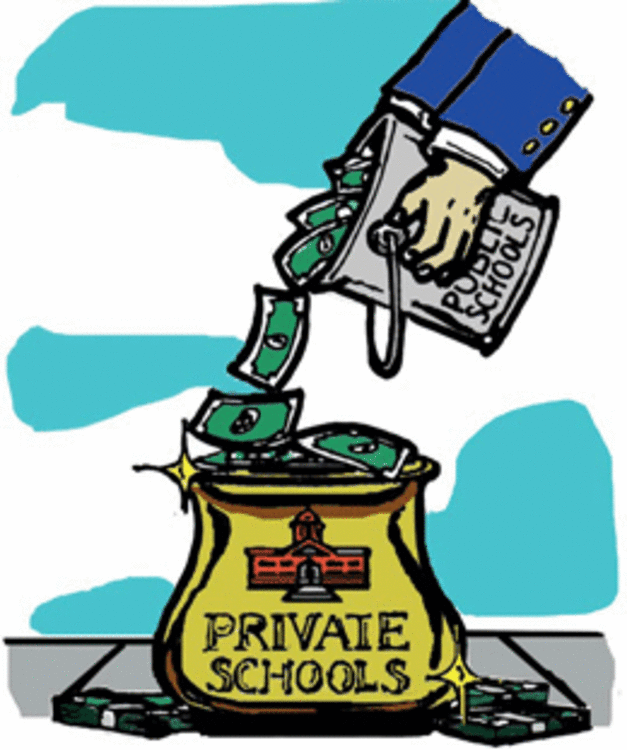
Money for private schools is drained from public education.

From School Finance 101
...It would certainly be foolish to spend additional taxpayer dollars on programs that exacerbate inequality and lead to lower outcomes, especially where more efficient and more equitable alternatives exist. For example, Rauscher and Shen (2022) found that investing new school spending in higher poverty public school settings has substantially greater effect than investing the same dollar in lower poverty settings. Jackson and Mackevicius (2023) found the same across several studies. But, more recently adopted and expanded voucher programs, drive public expenditures to higher income families whose children already attend private schools, and on average, lead to lower (and less equitable) outcomes:
  • Not only are most participants in these programs already enrolled in private school but they tend to be from the highest income brackets. That is, the universal vouchers are exacerbating inequity rather than improve equity.
  • Further, subsidies are often going to schools that engage in discriminatory admissions of students, creating inequality of access.
  • To the extent that researchers have studied and measured the academic outcomes of these programs, they have been dismal, yielding more damage to student outcomes in reading and math than major national disasters or the recent global pandemic.
Why is this all occurring unchecked? Precisely because it is unchecked...

They call it ‘school choice,’ but you may not end up with much of a choice at all

Indiana’s voucher program began in 2011 and has expanded since then…it’s not just Arizona…

From the Hechinger Report
Private schools have the power to choose, not parents...

Over the years, the state incrementally made more students eligible, until full expansion was finally achieved in 2022. For some students, the amount of voucher money they qualify for is only a few thousand dollars, nowhere near enough to cover tuition at a private school. Often, their parents can’t afford to supplement the balance. However, my son, who is autistic, qualified for enough to cover full tuition...

Once a private school admits your child, they can rescind admission without cause. Private schools are at leisure to act as virtual dictatorships, and special-ed schools in particular are notorious for keeping parents at a distance...

As ESAs and private schools siphon off money and public schools start closing down, parents will be horrified to discover that nothing can defeat the closely held advantages of a private system designed to keep them out, and no amount of vouchers will make a difference.

When all the public schools are closed, and you can’t get a private school to accept your child, what will you do?

Charters

Case for Indianapolis charter schools relies on cherry-picked data

The lure of money is diverting tax dollars from public education to private pockets.

From Letters to the Editor in the Indy Star
In his column, Mind Trust CEO Brandon Brown asks why some Hoosiers are skeptical of charter schools. He follows this up with the type of selectively cherry-picked data that gives informed citizens pause.

Brown claims charters “have revolutionized public education within Indianapolis’ old city limits.” By some measures, yes. By others, no. For example, while ILEARN is problematic as a measure of students’ abilities, Indianapolis Public Schools tends to outperform the vast majority of charters within its district on that test.

Brown makes claims about the funding and performance gaps between charters and public schools. Yet, it appears that the studies he references consider innovation schools to be public schools when it comes to funding, but charter schools when it comes to test results. This leads to obviously skewed results.

He references Stanford University’s 2022 study on Indianapolis schools. That study claimed that, compared to their public school counterparts, students attending charters in Indianapolis receive the equivalent of approximately 64 more days of learning in reading and 118 more days in math. In 2023, the same research body at Stanford University published a study showing that, statewide, Hoosier charter students receive the equivalent of 26.6 fewer days of learning in reading and 2.9 more days in math.

RELIGION IN SCHOOL

Oklahoma: Tips on Teaching the Bible in Your Public School Classroom

Whose translation of the Bible should Oklahoma public schools teach from? Which books should be included? Should other holy books be included? Should non-Christian students be allowed to opt out of Bible instruction?

There's a reason the Establishment Clause was included in the First Amendment.

From Diane Ravitch
State Superintendent of Schools Ryan Walters is eager to inject religion into the public schools. He has mandated the introduction of the Bible into every classroom. Some teachers in Oklahoma have begun assembling a collection of helpful lessons. Of course, as they show, you can integrate local places into your lessons. If you have some ideas, please pass them along.

For you teachers in Oklahoma, beginning this fall: This was posted on Facebook. Walters has become the butt of jokes nationwide.

Hallelujah! Thank you to my creative friends for all these great Biblical math problems. They’ll really help the Oklahoma school superintendent’s goal of inserting biblical content into math and science! I’ve collected a multitude of the problems into one post for ease of reading:

1) Solomon had 700 wives and 300 concubines (1 Kings 11:3). If he lay with one wife or concubine every night at the Mayo Hotel or The Skirvin but took off one day per week for rest, how many days would it take him to lay with all of his wives and concubines?

LOCAL NEWS

School building upgrades part of plan as EACS begins budget talks

From the Fort Wayne Journal Gazette**
East Allen County Schools’ proposed $4.1 million capital projects plan for the upcoming budget cycle generated no questions from the board during a preliminary review Tuesday.

Community members curious about the district’s proposed 2025 spending plan can learn more Sept. 3. That’s when Chief Financial Officer Pat McCann is expected to review the entire budget, including the operations and education funds.

Public hearings on the overall budget, capital projects plan and bus replacement plan are planned for Sept. 17 with board approval expected Oct. 15. Meetings typically begin at 5:30 p.m. in the Administration Building, 1240 Indiana 930 E., New Haven.

Capital projects are supported by the operations fund, which pays for most of the district’s noninstructional expenses and generates revenue through property and other taxes.


JOIN US

An Evening with Jennifer McCormick

NEIFPE is proud to co-sponsor this event featuring Jennifer McCormick, candidate for Governor of Indiana. We hope you can attend.

Click HERE to register for the September 25th event:


**Note: The Fort Wayne Journal Gazette is behind a paywall. Digital access, home delivery, or both are available with a subscription. Staying informed is essential; one way to do that is to support your local newspaper. For subscription information, go to fortwayne.com/subscriptions/ [NOTE: NEIFPE has no financial ties to the Fort Wayne Journal Gazette]

Note: NEIFPE's In Case You Missed It is posted by the end of the day every Monday except after holiday weekends or as otherwise noted.

###
Monday, July 8, 2024

In Case You Missed It – July 8, 2024

Here are links to last week's articles receiving the most attention on NEIFPE's social media accounts. Keep up with what's going on, what's being discussed, and what's happening with public education.

Be sure to enter your email address in the Follow Us By Email box in the right-hand column of our blog page to be informed when our blog posts are published.
QUOTE OF THE WEEK

"The assault on public education has displayed the fundamental disconnect between the civic purposes of education and citizens who see education as just another private, consumer good–skills to be acquired (by those who can afford it) in order to enhance the ability of one’s children to succeed in the marketplace." -- Sheila Kennedy in The MAGA Vendetta Against Arts And Education.

PROJECT 2025

The MAGA Vendetta Against Arts And Education

Former Republican Sheila Kennedy writes about politics in Indiana. In this article, she explains an imminent threat to public education.

From Sheila Kennedy
I forget who first popularized the phrase “you ain’t seen nothin’ yet,” but if Trump should win in November, Project 2025 has outlined policies that would dramatically escalate the attack on public education.

Here are some of the elements of what I can only describe as an assault on steroids:
  • Title I, the $18 billion federal fund that supports low-income students, would disappear in a decade.
  • Federal special education funds would flow to school districts as block grants with no strings attached, or even to savings accounts for parents to use on private school or other education expenses.
  • The U.S. Department of Education would be eliminated.
  • The federal government’s ability to enforce civil rights laws in schools would be scaled back.
The proposals are contained in a comprehensive policy agenda that’s part of a Heritage Foundation-led initiative called Project 2025: Presidential Transition Project, which includes nearly 900 pages of detailed plans for virtually every corner of the federal government and a database of potential staffers for a conservative administration. It will also feature a playbook for the first 180 days of a new term.

Project 2025 was devised by several former Trump administration officials and allies, working with dozens of aligned advocacy organizations (misnamed “think tanks.”) including Moms for Liberty. You will recall that Moms for Liberty is the organization that fought school boards over COVID-19 safety protocols, advocates for censorship of books in school libraries, and endorses far-right school board candidates.

THE EDUCATION WARS

The Education Wars Provides A Guide For Supporters Of Public Education

The podcasters at Have You Heard provide a playbook to defend public education.
"If we are to preserve our schools, it must be clear that public education is for all of us. We must win the peace.

"If we fail at that, we will lose our schools. And if we lose them, they won’t come back."
From Peter Greene at Forbes
In their 2020 book, A Wolf at the Schoolhouse Door, Jack Schneider and Jennifer Berkshire sounded the alarm:
The threat to public education...is grave. A radical vision for unmaking the very idea of public schools has moved from the realm of ideological pipe dream to legitimate policy.
In their new book The Education Wars (out this week), Schneider and Berkshire update us on how that radical vision, now fueled by the culture wars, is faring.

The culture wars—roaring debates over what schools are for, what they should teach, who should decide— are not new. But the writers note that “this time it’s different.” This time, the questions under debate include the question of whether public schools should exist at all.
CHOICE

Debunking the School Choice Movement’s Top Evangelist

Corey DeAngelis is on a mission to demonize public schools—and promote voucher programs that benefit his wealthy backers.

From Peter Greene at The Progressive
Corey DeAngelis is an influential, if not the most influential, voice in the rightwing campaign to demonize public schools and privatize public education. The guy’s résumé hits all the bases in the libertarian gameplan. After earning a doctorate at the University of Arkansas’s education reform program (funded by the pro-school choice Walton family), DeAngelis helped found the Education Freedom Institute, became a senior fellow at the Reason Foundation, worked as an adjunct scholar at the CATO Institute, took up an appointment as a senior fellow at the Hoover Institution, and was hired on as a senior fellow at Betsy DeVos’s American Federation for Children.

He still holds all of those jobs, but his more common title is “school choice evangelist.” As the recent school voucher wave has surged in state after state, DeAngelis has been there to spread the word. While on tour in support of his new book, he distills the current pro-voucher argument.

In a recent talk at the Heritage Foundation, DeAngelis touched on most of the main arguments for vouchers (many of them false) and revealed a few truths about the pro-voucher strategy.

1. The Evil Unions and COVID...

LOCAL NEWS

Imagine if every child has a library of their own

Dolly Parton's Imagination Library is a free children's book gifting program that she started in 1995. The program began by offering every child in Sevier County, Tennessee, the area where Dolly was born and raised, a free age-appropriate book each month in the mail until the age of five, regardless of family income. In 2000, the Imagination Library became so popular that Dolly announced that she wanted to make the program available to any community that would partner with her and support it locally. The program has expanded and is currently located in 1,800 local communities in the US, Canada, Australia, Ireland, and the United Kingdom.

Now, the Imagination Library is coming to Fort Wayne.

From the Fort Wayne Journal Gazette**
Dolly Parton’s Imagination Library is a pathway to bridging the reading gap between low-income families and their wealthier counterparts. But most of all, the library is fun for children and families.

Inspired by Parton’s favorite children’s book, “The Little Engine That Could,” Allen County Public Library staff has launched a spirited $100,000 fundraising campaign with the Allen County Public Library Foundation to bring Dolly Parton’s Imagination Library to local children. The program gives children one free book each month from birth to age 5.

The enthusiasm is palpable, with nearly 900 Allen County families eager to enroll their children — a testament to the community’s belief in the power of early literacy.

**Note: The Fort Wayne Journal Gazette is behind a paywall. Digital access, home delivery, or both are available with a subscription. Staying informed is essential; one way to do that is to support your local newspaper. For subscription information, go to fortwayne.com/subscriptions/ [NOTE: NEIFPE has no financial ties to the Fort Wayne Journal Gazette]

Note: NEIFPE's In Case You Missed It is posted by the end of the day every Monday except after holiday weekends or as otherwise noted.

###