Showing posts with label Funding. Show all posts

Monday, December 30, 2024

In Case You Missed It – December 30 2024

Here are links to last week's articles receiving the most attention on NEIFPE's social media accounts. Keep up with what's going on, what's being discussed, and what's happening with public education.

Be sure to enter your email address in the Follow Us By Email box in the right-hand column of our blog page to be informed when our blog posts are published.
QUOTE OF THE WEEK

"There’s no reason to push children to read early. Their brains have not evolved to the point where they must read at age three or five." -- Nancy Bailey in Give the Gift of Removing Reading Pressure on Kindergartners!

LATEST TIMMS SCORES SHOW DECLINE FOR U.S.

Tom Loveless: What We Learned from the 2023 TIMSS

Was the U.S. score decline caused by the pandemic? The answer is unclear.

From Diane Ravitch
Two trends stand out.

1. Larger negative effects in math than in other subjects. The most prominent explanation is that learning math is more dependent on formal instruction in schools.

2. Gaps increased between higher and lower scoring groups along several demographic dimensions, including race, ethnicity, socioeconomic status, and the 90th and 10th percentiles (high and low achievers).Note that many of the gaps began widening before the pandemic, but Covid seemed to exacerbate the trends.

A GIFT FOR KINDERGARTENERS

Give the Gift of Removing Reading Pressure on Kindergartners!

Kindergartens should return to providing a developmentally appropriate curriculum.

From Nancy Bailey’s Education Website
This holiday season, give children the gift of reading. One of the best ways to do that is to relieve the pressure of insisting they read early. Some children might pick up reading when they’re very young, but others will learn a little later, and there’s nothing wrong with this.

However, children who are made to feel like failures at this age if they are not reading yet will have a more challenging time learning to read later.

Sadly, examples of kindergarten reading pressure can be found everywhere. A recent Business Insider report describes a mother saddened that their child had to repeat kindergarten because they couldn’t read or write!

Expecting children to read in kindergarten and putting this increased pressure on them became politically motivated with NCLB

TRUST THE EXPERTS

Unintended Consequences

Just because you attended school doesn’t mean you are an education expert or know anything about child development.

From Sheila Kennedy
Rothstein eventually concluded that lower average achievement of these pupils wasn’t due to deficits of instruction, but to the
social and economic challenges that children brought with them to school—for example, greater rates of lead poisoning that resulted in damaged cognitive function; living in more polluted neighborhoods that led to a higher incidence of asthma that kept children up at night wheezing and coming to school drowsier the next day; lack of adequate heal[th care, including dental care, that brought more children to school with distracting toothaches, and on and on...

WE NEED SOME HYGGE IN OUR CLASSROOMS

We Need Hygge Classrooms in America

It would be nice if Americans embraced contentment and connection.

From Teacher in a Strange Land Blog
In Iceland, books are exchanged as Christmas Eve presents, then you spend the rest of the night in bed reading them and eating chocolate. The tradition is part of a season called Jolabokafload, the Christmas Book flood, because Iceland, which publishes more books per capita than any other country, sells most of its books between September and November, due to people preparing for the upcoming holiday.

PUBLIC MONEY SHOULD GO TO PUBLIC SCHOOLS

D for effort

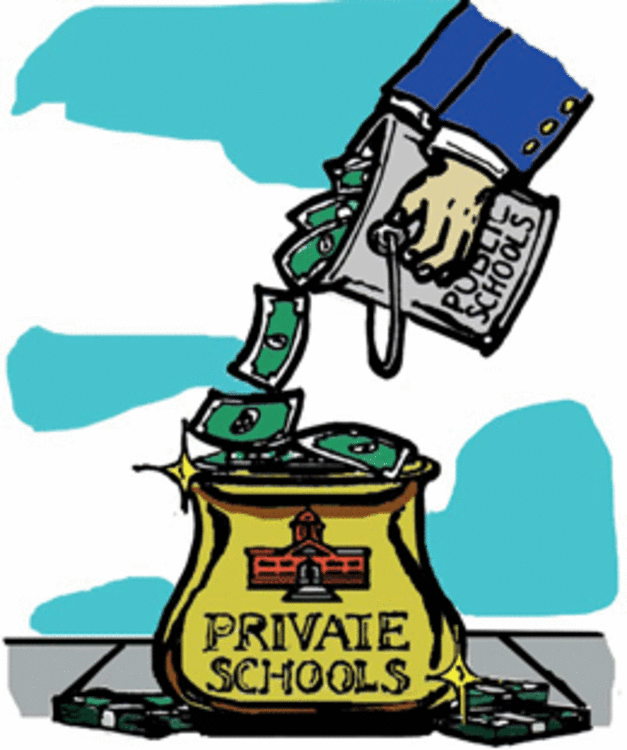
Republicans in the Indiana General Assembly continue to vote to raise the amount the state pays students to go to religious and other private schools...with money diverted from public schools.

From School Matters
Indiana gets a D for effort when it comes to funding public education. Keep that in mind when legislators say there’s not enough money to give schools what they need.

The rating comes from the latest “Making the Grade” report, an annual evaluation of state school funding by the Education Law Center, a New Jersey-based research organization that advocates for equitable funding. Indiana does slightly better, earning a C, for school funding adequacy and fairness.

SCHOOL COUNSELORS NEEDED

School counselors are essential, so let's treat them that way

Here's something that Indiana should spend public tax dollars on instead of diverting money to private and religious schools.

From the Fort Wayne Journal Gazette**
The 2024-25 Indiana School Counselor Survey paints a grim picture of a profession stretched far too thin. Counselors are overburdened, under-resourced, and struggling to meet their students’ growing mental health and academic needs.

Social-emotional challenges among Indiana students remain at critically high levels, with more than half of counselors reporting an increase over the past year. These issues, many of them lingering from the pandemic, are compounded by mounting academic pressures, career readiness hurdles, and a deluge of administrative tasks. Counselors are drowning in paperwork instead of sitting across from the students who need them most. The state’s student-to-counselor ratio is 351-to-1 and is well above the nationally recommended 250-to-1. This is a massive barrier to effective support.
**Note: The Fort Wayne Journal Gazette is behind a paywall. Digital access, home delivery, or both are available with a subscription. Staying informed is essential; one way to do that is to support your local newspaper. For subscription information, go to fortwayne.com/subscriptions/ [NOTE: NEIFPE has no financial ties to the Fort Wayne Journal Gazette]

Note: NEIFPE's In Case You Missed It is posted by the end of the day every Monday except after holiday weekends or as otherwise noted.

###

Monday, October 28, 2024

In Case You Missed It – October 28, 2024

Here are links to last week's articles receiving the most attention on NEIFPE's social media accounts. Keep up with what's going on, what's being discussed, and what's happening with public education.

Be sure to enter your email address in the Follow Us By Email box in the right-hand column of our blog page to be informed when our blog posts are published.

QUOTE OF THE WEEK

"Indiana Republicans have expanded school choice so aggressively since 2011 that you’d think there would be almost nothing left to do. We know there will be a push to make the voucher program “universal,” extending public funding for private school tuition to the wealthiest 3% of Hoosier families – a top priority for GOP gubernatorial candidate Mike Braun. But legislators may have other tricks up their sleeves. The 2025 legislative session stars in January, so we’ll find out soon." -- Steve Hinnefeld in School Matters blog, ‘School choice’ backers bankroll Indiana GOP

WHO PAID FOR INDIANA'S REPUBLICAN SUPERMAJORITY?

‘School choice’ backers bankroll Indiana GOP

The "Hoosiers" behind school "choice" funding are not all from Indiana.

From School Matters
Why is “expanding school choice” always at the top of Indiana Republican’s policy agenda even though few Hoosiers are clamoring for it? The old saying holds true: Follow the money.

Hoosiers for Quality Education, which advocates for private school vouchers and charter schools, is one of the top contributors to Republican legislative candidates’ campaigns. It gave GOP candidates and committees nearly $250,000 in the past six months.

The group gave $150,000 to the House Republican Campaign Committee, far more than any other PAC. (Indiana Realtors were in second with $40,000). It also gave generously, as much as $10,000, to individual candidates.

While the group calls itself “Hoosiers,” nearly all its money comes from out of state. This year, it got $375,000 from Walmart heir Jim Walton of Bentonville, Arkansas. In the past five years, Jim Walton and his sister, Alice Walton, have given the group over $1.2 million.

Hoosiers for Quality Education, the political arm of a nonprofit called the Institute for Quality Education, gave far more to Republican legislative candidates than groups that are often thought of as GOP cash cows, like the Indiana Chamber of Commerce, the Insurance PAC and the Builders’ Association. Only the Realtors gave significantly more, and some of its contributions went to Democrats.

And it’s not the only group that’s pushing school choice at the Statehouse. Hoosiers for Great Public Schools, organized by former Democratic Indianapolis Mayor Bart Peterson, spent $151,000, nearly all of it in contributions. Reed Hastings, co-founder of Netflix, has bankrolled the group with $1.2 million since 2020.

Hoosiers for Quality Education and Hoosiers for Great Public Schools donate exclusively to Republican candidates...

EDUCATION TOPICS - PRESIDENTIAL ELECTION

Support public education in this year's election.

Children and the Presidency: X-Rated or Fine for Prime Time?

From Nancy Bailey's Education Website
As the election approaches, the stakes of how and what children learn, what they see and hear from both Presidential candidates, couldn’t be more different and critical for the future of America’s children. Breaking it down for kids, one candidate is X-rated, and the other is fine for prime time!

For years, former President Trump’s behavior has created problems in how parents and teachers teach children good behavior and respect for one another. His vulgar ramblings often have nothing to do with policy.

The other candidate, VP Kamala Harris, reaches out to voters even if one has some policy differences and speaks respectfully. The TV can be left on when children are in the room. She appears to genuinely care about people.

There have been concerns about how Trump’s behavior affects America’s children and schools.

Anti-Public Schools

Trump said he’d defund public schools, democratic schools owned by Americans, if school officials don’t do as he says. How must this sound to a child who likes attending their public school?

His claims are often outlandish. He has accused teachers of doing sex change operations!

Has Donald Trump ever visited any public schools?


Kamala Harris Is the Right Choice. She Would Be an Education President

From Jan Resseger
Trump’s Election Would Endanger the Public Schools

First Focus on Children’s education policy director, Lily Klam defines core principles that have long been understood as the foundation of the institution of public schooling: “The purpose of public education has always been to give the nation’s children the knowledge, skills, tools, and development they need to thrive as individuals and as citizens of our democracy.” Klam describes the federal government’s role: providing “strong federal oversight of education to ensure that all children—including those from low-income families, those with disabilities, those experiencing homelessness, English language learners, and other underserved student groups—have the same access to the resources they need to thrive, regardless of their family status, the state in which they live, or other disparities. In addition to serving the needs of students across diverse parts of the country, our federal education infrastructure also houses the Office for Civil Rights, making it the nexus of student protection.”

Trump has already declared his support for several of the dangerous policies described in Project 2025, a proposal developed by the Heritage Foundation and many former Trump administration officials. If Trump is elected and follows through on his education promises, Klam fears the implications: “One of the (Project 2025) agenda’s most alarming proposals advocates for giving all parents ‘the option to direct his or her child’s share of education funding through an education savings account (ESA)’… (T)axpayer dollars will be used to subsidize the private, oftentimes religious, education of wealthy students, at the expense of the nearly 90% of U.S. students who attend public schools. It’s hard to overstate the destruction that this plan would inflict on the U.S. public education system. Directing each child’s education funding share to an ESA would rob public schools across the country of the funding they need to operate and would force tens of thousands of them to shut down or drastically reduce education services to children. This scenario has already played out in many states that have enacted school voucher and privatization schemes. Executed at the national level, these schemes would radically exacerbate existing inequities, cause extreme teacher shortages and layoffs, and create huge disparities in access to a quality education… The largest federal education (funding) streams, including Title I and IDEA, were created to ensure greater equity for students with disabilities and students in low-income families. The Project 2025 agenda is designed to do the exact opposite: Use government funds to create more inequity in education, especially for the most underserved students.”

STATE POLICIES MATTER

Policies Matter

Down ballot races matter, too. State and local elected officials have an impact on education.

From Sheila Kennedy
[An] article...from the American Prospect—focuses on educational vouchers, a policy choice I frequently discuss. The article warns that Red state expansion of universal school vouchers is likely to have profound impact on the lives of young people.
As states race to pay for families to send their kids to private schools, blowing up state budgets in the process, the schools attended by the vast majority of kids will be left with far fewer resources, blunting their prospects. By design, funds are being shifted away from students in poor and rural areas and into the pockets of affluent parents, entrenching inequality in the process.
Among the other detriments of these programs is an almost-total lack of oversight. In Arizona, for example, parents are allowed to direct education funds, not just to the school of their choice, but to anything they might call “education.”

ANOTHER CHARTER CLOSES ABRUPTLY

D.C.: Celebrated Charter School Closes Its Doors Abruptly

Choose public schools for stability.

From Diane Ravitch
A charter school in D.C. that opened in 2003 and had a reputation built on its services to students with disabilities suddenly closed, with minimal notice to students, teachers, and parents.

Its finances had been shaky for a long time, and its enrollment had declined. Yet no one anticipated its sudden closure.

As it happens, the Network for Public Education reported only days ago on the frequency of charter school closures. Its report is called Doomed to Fail. It’s sad but true that charter schools have an unusually high record of transience. Parents can’t be sure that the charter school they chose will keep its doors open for more than a year, or three, or five.

Note: NEIFPE's In Case You Missed It is posted by the end of the day every Monday except after holiday weekends or as otherwise noted.

Monday, July 1, 2024

In Case You Missed It – July 1, 2024

Here are links to last week's articles receiving the most attention on NEIFPE's social media accounts. Keep up with what's going on, what's being discussed, and what's happening with public education.

Be sure to enter your email address in the Follow Us By Email box in the right-hand column of our blog page to be informed when our blog posts are published.
QUOTE OF THE WEEK

"Imagine there is no public schooling and a candidate in 2024 runs on a great new idea: “Let’s provide universal free K-12 for all students and tax ourselves to pay for it!” What was established 150 years ago would seem outrageous today, especially in an environment strongly influenced by wealthy donors who want to do away with public programs. We take for granted the fact that in all of our communities, we have tuition-free schools that welcome all of our children—it’s a natural feature of the landscape. The system isn’t perfect and often disappoints us. But we need to remember that the core features of this system—that it is publicly governed, taxpayer-supported, open access, and used to advance the common good—are actually pretty remarkable. Moreover, our public education system has made our country far more equal than it was in the past. If we dismantle public education, it would be difficult if not impossible to bring it back." -- from NEA Today, What do Book Bans and Vouchers Have in Common?

THE WAR AGAINST PUBLIC SCHOOLS

What do Book Bans and Vouchers Have in Common?

A new book from the Have You Heard podcasters...coming on July 2.

From NEA Today
In their latest book The Education Wars, journalist Jennifer Berkshire and education scholar Jack Schneider explain the sudden obsession with race and gender in schools and the ascendancy of book bans. It offers analysis of school vouchers and the impact they’ll have on school finances and explores the movement for “parents’ rights,” explaining the rights that students and taxpayers also have.

NEA Today spoke to Berkshire and Schneider about the new book and some of the alarming findings. We also asked about the path forward...

...Can a family with an LGBTQ+ student attend private school with a voucher? What about students with disabilities?...

JB and JS: LGBTQ+ students would be embraced by a Quaker school, but those are a small percentage of the faith-based schools that dominate the private sector. Most LGBTQ+ students would face resistance at a religious private school or, worse, intolerance and exclusion. So vouchers may offer options, but they don’t protect students’ rights. They can deny admission and equal treatment based on their “religious freedom.”

Students with disabilities will face similar obstacles. We recently did a podcast on threats to special education in a voucher system. A mother of a student with disabilities from Tennessee read 20 different rejection letters she got from 20 different schools. In a privatized system, a school can say “no, we don’t have the facilities or the personnel to accommodate your child.” And there will be no incentive to do so. The Individuals with Disabilities Education Act (IDEA), which turns 50 next year, would not apply as it does in our public school system. Again, vouchers provide some options, but no rights, which leaves a large population with no options.

READING WARS

The Comprehension Problem with New Reading Programs: Ignoring the Books Children LIKE to Read!

The Science of Reading leaves out one essential aspect...the joy of reading.

From Nancy Bailey's Education Website
I’m not a gambler, but if I were, I’d bet that a lot of parents whose elementary school-age children are getting explicit phonics instruction, memorizing rules, and who can define words like diphthong and schwa will be disappointed when their children get to high school and couldn’t care less about reading.

New reading programs promising the Science of Reading don’t cover what children need to become good readers. What’s missing are reading comprehension and the incentive to read because it’s fun and interesting.

When critics of public schools and teachers debate how to teach reading comprehension today, they chatter about knowledge building (of course, previous knowledge is important) and raise questions like, should you teach a child about the main idea? (of course, you should), as if teachers haven’t taught children to read (and write) in the past.

The difference is that, today, they often ignore the main star: books children like to read.

VIRTUAL CHARTER REPORT

New Indiana virtual charter school report shows $60M in funding for 2022-23

The annual report also gives other data on class sizes and teacher-student ratios across the state’s seven virtual charters.

From the Indiana Capital Chronicle
More than $60 million in state tuition funding went to Indiana’s virtual schools during the 2022-23 academic year, according to a new report.

In all, those dollars covered roughly 8,500 students — a majority of those attending a handful of virtual charter schools operating in the state.

Each year, virtual charter schools are required by law to submit data to the Indiana Department of Education (IDOE) with the number of student-teacher meetings conducted in-person or via video conference, classroom size, the ratio of teachers per class, as well as state funding totals.

The newest numbers were submitted to the Indiana State Budget Committee last week.

POLITICS AND EDUCATION

New Hampshire: Why the GOP Is Determined to Destroy Public Schools

This is an important article for everyone to read, no matter where you live. It explains succinctly the true goals of the privatization movement.

From Diane Ravitch
A responsible citizen is an informed citizen, and that appears to be the problem today. Too many people interested in power instead of governing don’t want a truly informed public. Instead, they want enough of the public spoon fed “alternative facts,” conspiracy theories, and outright lies to ensure they retain power although they have views that are both harmful to the majority of citizens and allow the tyranny of the minority to overturn the will of the majority.

At the heart of the minority’s transformation plan is the destruction of the public school system.

Indiana’s attempt to take shortcuts on education is costing us.

It’s time for the State to stop trying to privatize schools and start investing in our public school system.

From Masson's Blog: A Citizen's Guide to Indiana
Ball State economist, Michael Hicks, has a column about Democratic run areas of the country getting richer while Republican run areas are getting poorer. He notes that the U.S. is seeing its best economic performance in the last half century but the benefits are not being distributed uniformly. He doesn’t lay the blame on one party or another because some of the underlying reasons were a long time in the making. But he does underscore the significance of educational attainment in the dynamic.
It is difficult to lay the blame for worsening economic conditions at the feet of one party or the other. For the past 50 years, there was considerable overlap in state policies, so conservative Democratic states behaved a lot like more progressive Republican states in tax, education and economic development policy.

...The 15 states that have seen the biggest relative drop in educational attainment are all solidly Republican states—and poor. Indiana ranks 10th on this list...
LOCAL NEWS

FWCS board unanimously approves $55M loan for Snider stadium

From WANE.com
At Monday’s meeting, the Fort Wayne Community Schools Board welcomed a new member and approved financing of the upcoming Snider football stadium.

The FWCS Board unanimously approved the financing of the new Snider Stadium alongside other improvements in the district. The cost will come as a loan of $55,650,000 from general obligation bonds and building corporation property tax first mortgage bonds.

FWCS Board President Maria Norman assures that the project will not raise property taxes.

Snider’s new 4,000-seat stadium will utilize a large portion of the loan. The remaining money will be used to update athletic equipment, scoreboards, and other FWCS facilities such as restrooms and offices.

Note: NEIFPE's In Case You Missed It is posted by the end of the day every Monday except after holiday weekends or as otherwise noted.

###

Monday, June 17, 2024

In Case You Missed It – June 17, 2024

Here are links to last week's articles receiving the most attention on NEIFPE's social media accounts. Keep up with what's going on, what's being discussed, and what's happening with public education.

Be sure to enter your email address in the Follow Us By Email box in the right-hand column of our blog page to be informed when our blog posts are published.

QUOTE OF THE WEEK

"The expansion in voucher programs is part of a broader move in some states toward more government-sponsored religion inside public schools. New laws allow schools to hire chaplains for counseling…. In West Virginia, a new law allows teachers to discuss alternative theories to evolution. Seven states have passed measures mandating elective courses focused on the Bible… In Oklahoma, the state Supreme Court in April considered what would be an unprecedented step toward the mingling of church and state in education, weighing whether the state could directly fund what would be the nation’s first religious charter school." -- Washington Post writers, Laura Meckler and Michelle Boorstein quoted in Erasing the Line that Separates Church and State in Education

SEPARATING CHURCH AND STATE IN EDUCATION

Erasing the Line that Separates Church and State in Education

The Indiana voucher plan is essentially a money laundering scheme for religious schools. The state supreme court claimed that since the tax money used for vouchers really belongs to the parents of children, there is no conflict between church and state. However, the parents don't see the money from the voucher. The so-called "money from the parent" goes directly from the state treasury to the private school.

From Jan Resseger
It has become acceptable for states to award tax funded tuition vouchers to private schools that teach religious doctrine. In recent decades, the U.S. Supreme Court has ignored the First Amendment Establishment Clause and declared that if states permit private schools in general to accept state funded tuition vouchers, the state’s exclusion of religious private schools would violate the free exercise of religion.

The shifting legal prioritization of the Free Exercise Clause over the Establishment Clause has not happened by accident. Activists have worked with far-right legal firms to bring a succession of legal challenges, with each lawsuit designed to shift the Supreme Court’s interpretation a little farther away from protecting the separation of religion and government. In an earlier report this spring, Meckler laid out some of this history: “In recent years, religious activists have succeeded in tearing down what had been a clear delineation between public funding and religious education. In three (of the most recent) significant rulings, the U.S. Supreme Court found that religious institutions may not be excluded from taxpayer-funded programs that were available to others. In a 2017 case, the high court ruled that a church-run preschool in Missouri was entitled to a state grant that funded playgrounds. In 2020, the court ruled that Montana… include religious schools in a program giving tax incentives for supporting private-school tuition scholarships. And last year, the court said that a Maine voucher program that sent rural students to private high schools had to be open to religious schools.”

Peter Greene: Putting Chaplains in Schools is a Very Bad Idea

The current majority on the Supreme Court seems to deny that the First Amendment contains an "Establishment Clause."

From Diane Ravitch
Peter Greene describes the new movement to place chaplains in schools to act as mental health counselors. The politicians behind this demand want Protestant evangelical chaplains, no doubt, but the schools will have requests for all sorts of religions. Not only from the myriad Protestant sects, but from Catholics, Muslims, Jews, Mormons, Unitarians, Buddhists, Hindus, and many others. There would certainly be a need for three Jewish chaplains: Reform, Conservative, and Orthodox. And every other religion will have divisions that must be addressed. Will there also be mental health counselors for kids who don’t want a chaplain?

CHARTER DISTRICT FAILS

All Charter District Opens Public School

Just because you went to school doesn't mean you know how to teach. Just because your community had a school doesn't mean that you know how to run a school. There is a reason that educators are trained in schools of education.

From Tom Ultican at Tultican
Desires of New Orleans residents were ignored. Neoliberal billionaires were in charge. In all the excitement, few noticed that these oligarchs had no understanding of how public education functions. They threw away 200 years of public school development and replaced it with an experiment. The mostly black residents in the city were stripped of their rights.

Thousands of experienced black educators were fired and replaced by mostly white Teach For America teachers with 5 weeks of training. Instead of stable public schools, people were forced into unstable charter schools. Instead of professional administration, market forces drove the bus!

Clearly, the all charter school system is a failure.

TAX MONEY, MY MONEY

Whose Money Follows The Child?

"...everyone in the country benefits from sharing space with educated co-workers, neighbors, and pretty much everyone else we have to deal with. Everyone shares the cost..." Everyone reaps the benefit.

From Peter Greene at Curmudgucation
The suggestion that vouchers are simply a means of giving parents back their own money to spend on education as they see fit--that's absurd. Our entire public education system is funded on the theory that everyone in the country benefits from sharing space with educated co-workers, neighbors, and pretty much everyone else we have to deal with. Everyone shares the cost.

It's odd that so much of the voucher crowd is also the "taxation is theft" crowd, because voucher funding requires the voucher holders to take tax dollars from their neighbors while stripping those neighbors of any say in the kind of education those dollars will be spent on. That includes spending my neighbor's tax dollars on a school that would forbit, bar, eject, and demonize those neighbors and their children.

Your money should follow my child.

"Just give us back our tax money, and I'll get my kids the education I want and everyone else can get the kind of education they want," is top-grade bullshit. The only people who it even sort of works for is the folks living in very expensive houses. For everyone else, the end result is some kind of lower tier cheap crappy school--or getting your neighbors to chip in.

Your money should follow my child.

Or maybe we could pool all our money and set up a system to take care of all the children.

LOCAL NEWS

Fort Wayne Community Schools board begins interviews to fill vacancy

Rohli Booker gave up her seat on the FWCS school board to claim a City Council seat. The FWCS board is interviewing for her replacement.

From the Fort Wayne Journal Gazette**
The Fort Wayne Community Schools board Tuesday began interviews with four candidates seeking to serve the remainder of former member Rohli Booker’s term.

Antonette Payne was the only applicant for the open District 4 seat to be publicly interviewed Tuesday night...

SACS board responds to questions about proposed superintendent contract

From 21 Alive
Southwest Allen County Schools is one of the largest districts in our area and the SACS Superintendent is a high-profile job.

Tuesday night, leaders moved one step closer to filling that critical position.
**Note: The Fort Wayne Journal Gazette is behind a paywall. Digital access, home delivery, or both are available with a subscription. Staying informed is essential; one way to do that is to support your local newspaper. For subscription information, go to fortwayne.com/subscriptions/ [NOTE: NEIFPE has no financial ties to the Fort Wayne Journal Gazette]

Note: NEIFPE's In Case You Missed It is posted by the end of the day every Monday except after holiday weekends or as otherwise noted.

###

Monday, April 15, 2024

In Case You Missed It – April 15, 2024

Here are links to articles from the last two weeks receiving the most attention on NEIFPE's social media accounts. Keep up with what's going on, what's being discussed, and what's happening with public education.

Be sure to enter your email address in the Follow Us By Email box in the right-hand column of our blog page to be informed when our blog posts are published.

QUOTE OF THE WEEK

"...a voucher by any other name still smells the same. It’s a payoff to parents so that they’ll exit public education, a false promise of education choice, a redirection of public taxpayer dollars into private pockets, an outsourcing of discrimination, a public subsidy for private religious choices, a means of defunding and dismantling public education as we understand it in this country, a transformation of a public good into a market-based commodity. Call it what you like. There isn’t enough air freshener in the world to make it smell like a rose." -- Peter Greene, quoted by Diane Ravitch in Peter Greene: A Voucher By Any Other Name Is Still a Voucher and a Hoax

VOUCHERS

Peter Greene: A Voucher By Any Other Name Is Still a Voucher and a Hoax

Voucher supporters won't use the word "vouchers."

From Diane Ravitch quoting Peter Greene
Voucher supporters have one major problem: school vouchers are unpopular.

The term doesn’t test well. Measure of public support is iffy– if you ask people if they would like every student to have the chance to ride to a great school on their own pony, people say yes, but if you ask a more reality-based framing (“should we spend education dollars on public schools or subsidies for some private schools”) the results look a bit different.

But one clear measure of public support for vouchers is this; despite all the insistence that the public just loves the idea, no voucher measure has ever been passed by the voters in a state. All voucher laws have been passed by legislators, not voted in by the public.

Voucher supporters have developed one clear strategy– call them something else.

Bad Governance with Education Vouchers

Public dollars should be accountable to public scrutiny.

From Tultican
February 26, a Maricopa County Grand Jury indicted six people, including three employees of Arizona’s education department, for forgery, fraud and money laundering. The forty counts charged were related to stealing from the Empowerment Scholarship Account (ESA) program. Attorney General Kris Mayes claimed the fact that three department of education employees were involved indicates a lack of adequate fraud prevention but ESA advocates say new guardrails are not needed.

Before arriving into the 21st century, protecting against malfeasance with tax-generated dollars was considered fundamental to good governance. Arguably, voucher programs violate this basic tenet.
CHARTERS

Oklahoma Supreme Court Justices Appear to Question Constitutionality of Religious Charter School

Public funds should be for public schools, not religious schools.

From Jan Resseger
On Tuesday, the Supreme Court of the state of Oklahoma heard oral arguments in a case filed by Oklahoma Attorney General Gentner Drummond versus the Oklahoma Virtual Charter School Board, which approved a religious charter school last June. The case challenges whether the establishment of St. Isidore of Seville Catholic Virtual Charter School can be legal under the provisions of the Oklahoma Constitution. If the school is permitted to open in August, it will be operated by the Roman Catholic Archdiocese of Oklahoma City and the Diocese of Tulsa.

The Oklahoman’s Murray Evans reports that during oral arguments on Tuesday, “Drummond told justices he sued the virtual-school board ‘to defend the separation of church and state’… Drummond said Article 2, Section 5 of the Oklahoma Constitution was at the heart of his case: ‘No public money or property shall ever be appropriated, applied, donated, or used, directly or indirectly, for the use, benefit, or support of any sect, church, denomination, or system of religion, or for the use, benefit, or support of any priest, preacher, minister, or other religious teacher or dignitary or sectarian institution as such.'”

There are two issues being tested in two cases challenging the establishment of St. Isidore of Seville Catholic Virtual Charter School: (1) protecting children from a charter school’s imposition of religious practice in violation of the constitutional protection of religious liberty, and (2) ensuring that government is not sponsoring charter schools that can select students according to the school’s religious affiliation or discriminate against students whose LGBTQ status (or other characteristic) may violate church strictures.

Indianapolis charter school seeks to go private so it can accept vouchers

From Chalkbeat Indiana*
An Indianapolis charter school with a checkered track record wants to become a private school that accepts students who use state vouchers.

The Genius School, a K-6 school on the city’s east side, is petitioning the State Board of Education for accreditation as a non-public school. State law requires private schools that accept vouchers to be accredited by the State Board of Education or a recognized accreditation agency.

The board has the item on its agenda for a meeting on Wednesday.

Following a meeting of the school’s board of directors on Thursday, Genius School Head of School Shy-Quon Ely II confirmed that the school is exploring its options as a “non-public” school.

The move is the latest attempt by the school to stay open despite its rocky history. It would allow the school to operate without the oversight of a separate entity — its charter authorizer — tasked with holding the school accountable. The Genius School’s decision also comes as the number of students eligible for and using private school vouchers has grown dramatically in the state.

KEEP RELIGION OUT OF SCIENCE CLASSES

New Law Allowing Religion into Science Classrooms Is Dangerous for Everyone

Religion belongs in Sunday School...or private schools. Public schools must teach science, not religious dogma.

From Scientific American
I grew up a creationist in the rural southeastern U.S. I am now a scientist, educator, wife, mother and person of faith. Regardless of whether you practice religion, you should fight to prohibit the teaching of nonscientific alternative ideas in science classrooms and use your vote and your voice to prevent the inclusion of religious beliefs in public education. A recently signed law in West Virginia illustrates why.

I often hear lamentations about the removal of God from public schools. These sentiments are based on a misinterpretation of the principle of the separation of church and state. In the U.S., religious beliefs and practices are protected and situated in their rightful place within people’s homes and communities so that individuals can choose what to teach their children regarding religion. Kids can still pray whenever they wish, gather with their peers, create faith-based groups or even nondisruptively practice their faith in school. Separating state and church means young people cannot be compelled to engage in religious actions by someone in a position of power, such as a teacher, administrator or lawmaker. Separation of church and state is as critical to people of faith as it is to those who do not practice faith traditions. The protection of personal religious freedoms was a vital component of the foundation of our nation.

On March 22 West Virginia governor Jim Justice signed a bill that purports to protect the ability of the state’s public school educators to teach scientific theories. There is no actual problem that the new law would solve, however; none of its supporters produced a teacher who plausibly claimed to have been oppressed. But the legislative history of the bill, known as Senate Bill 280, makes it clear that its real aim is to encourage educators to teach religiously motivated “alternatives” to evolution. As introduced, SB 280 would have expressly allowed the teaching of “intelligent design” in West Virginia’s public schools.

FWCS--TEACHER JOB FAIR

Fort Wayne Community Schools seeks teachers at job fair

From the Fort Wayne Journal Gazette**
Aspiring Fort Wayne Community Schools educators could get an interview with a principal this month just by showing up at North Side High School.

The district will host a teacher job fair from 3:30 to 6 p.m. April 16 at the school, 475 E. State Blvd., as it seeks to fill about 100 vacancies for next academic year.

The number of openings isn’t unusual, said Kody Tinnel, human resources manager of strategic projects. Compared to this time last year, he said Wednesday, “the need is about the same.”

FWCS employs more than 4,000 people, including nearly 2,000 teachers, according to its website.

Special education and English language-learner positions are the areas of highest need, Tinnel said, but openings include “a little bit of everything.”
*Note: Financial sponsors of Chalkbeat include pro-privatization foundations and individuals such as Bloomberg Philanthropies, Gates Family Foundation, The Walton Family Foundation, and others.

**Note: The Fort Wayne Journal Gazette is behind a paywall. Digital access, home delivery, or both are available with a subscription. Staying informed is essential; one way to do that is to support your local newspaper. For subscription information, go to fortwayne.com/subscriptions/ [NOTE: NEIFPE has no financial ties to the Fort Wayne Journal Gazette]

Note: NEIFPE's In Case You Missed It is posted by the end of the day every Monday except after holiday weekends or as otherwise noted.

###

Monday, February 12, 2024

In Case You Missed It – February 12, 2024

Here are links to last week's articles receiving the most attention on NEIFPE's social media accounts. Keep up with what's going on, what's being discussed, and what's happening with public education.

Be sure to enter your email address in the Follow Us By Email box in the right-hand column of our blog page to be informed when our blog posts are published.

QUOTE OF THE WEEK

"For GOP lawmakers who view public education as a quasi-socialist project, the gaping hole in state budgets left by subsidizing private school tuition is a feature, not a bug." -- by Jennifer Berkshire and Jack Schneider in In Red States, the Bill for School Voucher Bait-and-Switch Is Coming Due

VOUCHERS BAIT AND SWITCH

In Red States, the Bill for School Voucher Bait-and-Switch Is Coming Due

The Indiana voucher program was supposed to save the state money and improve student achievement. Vouchers were supposed to "save children from 'failing schools.'" Sadly, the program doesn't do any of those things. The Bait-and-Switch is coming due.

From The Nation
Bait-and-switch is an old retail tactic. You lure customers in with promises of a deep discount, only to inform them that the deal has a catch. The real price tag, it turns out, is quite a bit more.

Though it took supporters of school vouchers a while to catch on, they’ve learned quickly that the trick works just as well in education policy as it does in retail sales. Pick a price that will get people in the door, and then break the news once you’ve got them where you want them.

In Arizona, taxpayers are now staring down a $400 million shortfall, with an even bigger bill coming due next year. How did the Grand Canyon State go from sitting on a huge cash reserve to facing a rising tide of red ink? Simple. Voucher proponents suggested that paying for private school tuition would cost taxpayers $65 million a year; but as it stands, the program is on track to cost roughly 15 times that. All told, Arizona taxpayers are likely to spend close to a billion dollars reimbursing the cost of tuition and luxury expenses—including ski resort passes, pianos, and theme park tickets—for families whose children were never enrolled in the public schools.

It isn’t just Arizona’s problem. Over the past two years, multiple states have enacted universal or near-universal voucher programs that far exceed initial cost projections...

FORT WAYNE AND INDIANA NEWS

Child labor is an education issue

Indiana Republicans want to weaken child labor laws.

From School Matters
UPDATE: Senate Bill 146 was amended Feb. 5 on the Senate floor to remove provisions that conflict with federal child labor law.

Indiana legislators seem determined to roll back regulations that protect children from exploitative work conditions, even if it means clashing with the federal Fair Labor Standards Act.

One anti-regulatory bill, House Bill 1093, has been approved by the House and sent to the Senate. Another, Senate Bill 146, is up for second-reading amendments in the Senate today. Both measures would significantly ease restrictions on the hours that minors can work in Indiana.

They mark a turning away from a 100-year commitment by state and federal governments to protecting children and enabling them to get an education without being burdened by working for wages.

Homestead High School project needs $18.9 million more

From The Fort Wayne Journal Gazette**
Southwest Allen County Schools expects an additional $18.9 million will be enough to complete the final stages of Homestead High School’s multiyear transformation – a construction project initially said to cost $169 million.

The board Tuesday approved four resolutions allowing the district to proceed with two taxable general obligation bonds totaling $12.7 million.

A $6.2 million first mortgage bond is anticipated to provide further funding, said Mark Snyder, director of business. That doesn’t require board action because of previous board approval when SACS first sold bonds to pay for the Homestead additions and renovations project.
Indiana senators want to put school boards in charge of approving lessons on sexuality

The move to restrict sex education is growing again with the rise of Moms for Liberty.

From The Fort Wayne Journal Gazette**
Indiana lawmakers are considering legislation that would require school boards to approve all lessons and materials on sexuality and require schools to publicly post a list of the teaching material on their websites, prompting concerns about who has the final say in sex education and the definition of sexuality.

State senators passed the bill Tuesday by a vote of 38-10. It now moves to the House for consideration, where Republicans also hold a supermajority.

The bill would require school boards to approve by July 1 all materials used to instruct students on “human sexuality,” author of the bill and state Sen. Gary Byrne told lawmakers Tuesday. Byrne told senators he intended to make sex education more transparent for parents.

Schools would also be required to post a list of the materials to their websites and the board must approve what age students will receive instruction, whether students will be taught in a co-ed setting and whether the lesson will be provided by a male or female instructor.

Rokita’s new ‘Eyes on Education’ portal prompts pushback from Indiana school officials

Indiana's Attorney General enlists the public to make allegations against public schools without any proof.

From the Indiana Capital Chronicle
A new dashboard unveiled Tuesday by the Indiana Attorney General’s Office makes public more than two dozen allegations of “potentially inappropriate materials” in Hoosier schools, like critical race theory materials and gender identity policies.

But numerous local officials told the Indiana Capital Chronicle they weren’t made aware of the complaints and contend the allegations were not properly vetted before the portal went live.

Attorney General Todd Rokita referred to “Eyes on Education” as a transparency tool that intends to “empower parents to further engage in their children’s education” and provide “real examples of indoctrination.”

The portal accepts submissions pertaining to K-12 classrooms, colleges, universities and “other affiliated academic entities in Indiana.” But it is unclear how, or if, they are vetting the accuracy of the allegations.

Indiana officials say they want more information about what fees schools are charging families

From the Indiana Capital Chronicle
Indiana’s K-12 schools are spending more than state leaders expected on student textbooks — and some are still sending bills to students’ families — prompting lawmakers to request additional information about what’s being expensed.

The questioning comes a year after the General Assembly dedicated $160 million in the current state budget to eliminate textbook and curriculum fees for Hoosier families, starting with the 2023-24 academic year.

Based on the funds available in May 2023, the Indiana Department of Education (IDOE) estimated the per student reimbursement amount to schools would be approximately $151.88. Based on spending in the current academic year, however, the actual per student reimbursement amount came out to $158.21.

Still, IDOE data obtained by the Indiana Capital Chronicle shows the state reimbursed 395 traditional K-12 districts and charter schools a total of about $159 million for the current academic year — about a million dollars below what was appropriated.

What’s not clear, though, is the amount each school actually spent on textbooks and other materials overall, or how much individual districts requested in reimbursements from the state.
**Note: The Fort Wayne Journal Gazette is behind a paywall. Digital access, home delivery, or both are available with a subscription. Staying informed is essential; one way to do that is to support your local newspaper. For subscription information, go to fortwayne.com/subscriptions/ [NOTE: NEIFPE has no financial ties to the Fort Wayne Journal Gazette]

Note: NEIFPE's In Case You Missed It is posted by the end of the day every Monday except after holiday weekends or as otherwise noted.

###

Monday, January 29, 2024

In Case You Missed It – January 29, 2024

Here are links to last week's articles receiving the most attention on NEIFPE's social media accounts. Keep up with what's going on, what's being discussed, and what's happening with public education.

Be sure to enter your email address in the Follow Us By Email box in the right-hand column of our blog page to be informed when our blog posts are published.
QUOTE OF THE WEEK

"'The primary role of chaplains is to provide pastoral or religious counseling to people in spiritual need,' the American Civil Liberties Union of Indiana said in a statement. 'Allowing them to assume official positions — whether paid or voluntary — in public schools will create an environment ripe for religious coercion and indoctrination of students.'

"...Chaplains are trained and certified to provide spiritual and emotional support. Lawmakers should leave mental health care services to the professional school counselors qualified to do that job."
-- Editorial in the Fort Wayne Journal Gazette**

SCHOOL CHAPLAINS INSTEAD OF COUNSELORS?

Not content with diverting tax dollars meant for public schools to religious and private schools, Indiana Republicans are now trying to open the door to religious proselytization in public schools. Write or call your local legislators and tell them NO! to chaplains in public schools.

Bills to employ school chaplains, allow religious instruction move forward in Indiana legislature

From Indiana Capital Chronicle
Lines between church and state blurred at the Indiana Statehouse on Wednesday as lawmakers gave the go-ahead for two education bills that seek to increase students’ access to faith leaders and religious instruction.

One proposal, House Bill 1137, would require schools to approve parental requests for students to leave school during the day for religious instruction. A separate measure, Senate Bill 50, could bring paid chaplains into Indiana’s public schools. Both bills advanced from their assigned committees and now head to the respective chambers for further consideration.

Faith-based school chaplains would test First Amendment

From the Fort Wayne Journal Gazette**
Indiana’s student-to-counselor ratio ranks worst in the nation, according to the 2023 State of the Indiana Girl Report published in September.

Two bills introduced in the General Assembly — one in the House, the other in the Senate — seek to fill the counselor void, but critics say their solution is unconstitutional and could end up further harming some children’s emotional and mental health.

House Bill 1192 and Senate Bill 50 would allow public and charter schools to employ chaplains, or approve them as volunteers, to counsel students and staff. Though school chaplains wouldn’t be required to divulge privileged or confidential communications, the bills are written to invite skepticism as to the ultimate goal of allowing pastoral care.

The Senate version, authored by Sen. Stacey Donato, R-Logansport, says a chaplain may only provide secular assistance, unless the student (or their parent or guardian) gives consent for religious advice, guidance and support services. The House proposal of Rep. Doug Miller, R-Elkhart, does not include such language.

“The primary role of chaplains is to provide pastoral or religious counseling to people in spiritual need,” the American Civil Liberties Union of Indiana said in a statement. “Allowing them to assume official positions — whether paid or voluntary — in public schools will create an environment ripe for religious coercion and indoctrination of students.”

Without any oversight to prevent chaplains from imposing their own religious viewpoint on the children they counsel, HB 1192 and SB 50 could undermine the religious freedom of students of all faiths and no faith.

KINDERGARTEN FOR KINDERGARTENERS!

Nancy Bailey: It’s Time to Take Back Kindergarten!

Play is children's work...for better health, better learning, and happier children!

From Diane Ravitch
Nancy Bailey is a retired educator who has seen the damage wrought by No Child Left Behind, Race to the Top, and the nonsensical grandchild called Every Student Succeeds Act. We can say now with hindsight that many children were left behind, we did not make it to the Top, and every student is not succeeding.

Nancy knows that the greatest casualty of these ruinous federal laws and programs are young children. Instead of playing, instead of socializing, instead of living their best lives as children, they are being prepared to take tests. This is nuts!

Nancy explains in this post (originally from 2021 but nothing has changed) why the status quo is harmful to small children and how it should change...
INDIANA POLITICS

NPE Action endorses Jennifer McCormick for Governor of Indiana.

Jennifer McCormick, former Indiana State Superintendent of Public Instruction, gets NPE-Action's endorsement for Indiana Governor.

From the Network for Public Education Action
The Network for Public Education Action gives its strongest endorsement to Jennifer McCormick for Governor of Indiana. Jennifer is a lifelong educator and native of Indiana. 

Jennifer is a former teacher, principal and school superintendent. She served as State Superintendent of Public Instruction from 2017 to 2021. During that time she took on the legislature, eventually changing political parties. 

Jennifer told us that as governor, she “will focus on aggressively funding the expansion of quality and affordable childcare as well as universal PreK so all children have the foundational skills necessary to succeed in the K12 environment. She said she “will appoint a Secretary of Education and members of the state board of education that understand the ever-evolving needs of Indiana students and implement programs that develop the skills critical to thrive in a changing world and prepare Hoosier kids for careers, college, and life after high school.”

FORT WAYNE AREA NEWS

We have lots of news from Allen County and Fort Wayne this week. See the link to subscribe to the Fort Wayne Journal Gazette at the end of this post.

Implications are imposing for education overhaul bills

From the Fort Wayne Journal Gazette**
Lawmakers are throwing everything at the wall to see what sticks in their quest to educate more Hoosiers — whether through job training or traditional college.

But some of the discussions carry concerning consequences. Two major proposals this year deserve in-depth examination that a short session likely can’t provide.

First up is an effort by House Republicans to allow key higher education scholarships and grants to be used for job training instead of toward full-time college credits.

The legislation impacts the 21st Century Scholars program, Freedom of Choice Grant and the Higher Education Award. Collectively, the current budget includes about $330 million annually in state funding for that aid.

Each program has slightly different rules, but generally there are GPA and credit completion requirements. And all specify that students must be attending a two-year or four-year program on a full-time basis...

...The second major proposal is Senate Bill 8, which will blur the line between two- and four-year degree institutions that was set up 20 years ago.

At that time, under Gov. Mitch Daniels, a study by the Government Efficiency Commission recommended establishing Ivy Tech as a true community college system, and phasing out associate degree programs at other campuses.

That’s because it would be cheaper to earn an associate degree at Ivy Tech the first two years then transfer to a traditional four-year school for bachelor’s and graduate degrees.

Indiana education secretary says schools can get started on proposed literacy initiatives

From the Fort Wayne Journal Gazette**
Will Hoosier schools have the funds to launch new literacy mandates proposed by state lawmakers? Indiana Secretary of Education Katie Jenner this week maintained they do – at least for now.

She said Thursday the Indiana Department of Education has enough holdover dollars to roll out additional reading tests and expanded summer school options laid out in Senate Bill 1, which is under consideration at the Statehouse.

And more state funds are expected to be requested in the 2025 budget session.
FWCS to offer employees child care stipend with $750,000 grant

From the Fort Wayne Journal Gazette**
Fort Wayne Community Schools will use $750,000 in state funding to help employees pay for child care.

The program’s implementation should provide the district with information it doesn’t have about its 4,050 workers, said Mitch Sheppard, philanthropy director.

“If you were to say, ‘What do our employees need? How severe is the child care need?’ We really don’t know,” she told the school board Monday.

The one-time grant from the Family and Social Services Administration will be distributed on a reimbursement basis to employees using state-licensed child care facilities. The program will launch as soon as possible, Sheppard said.

Remote learning challenges: What school officials in Allen County are considering

From WANE.com
Area school district officials told WANE 15 Tuesday they are learning as they go as winter weather challenges have led to more remote learning days.

WANE 15 spoke with Mark Daniel, superintendent of Fort Wayne Community Schools (FWCS), and Park Ginder, superintendent of Southwest Allen County Schools (SACS), and Tamyra Kelly, the Public Information Officer at East Allen County Schools (EACS) to see how remote learning days have gone so far...

...At FWCS, Daniel said there’s a lot of room for improvement. He said they want students more engaged and interactive.

“Remote learning days are not the same as being in school in person,” Daniel said. “So we know that we’re trying to be flexible, but at the same time, we need our students and our parents and our staff to fully engage.”

Each school year, each district gets 3 e-learning days where students work independently, but remote learning days that require students to Zoom with a teacher are unlimited.

Daniel said if things don’t improve, there could be changes.

Northwest Allen County Schools sees challenges due to property tax cap

From WANE.com
Northwest Allen County Schools (NACS) is seeing the effects of a property tax cap passed by the Indiana General Assembly in 2023.

House Bill 1499 capped property taxes at 4% to provide relief for homeowners as home values were skyrocketing over the past few years. That cap has resulted in less money than anticipated being funneled into Indiana schools. Most districts are faring well because their growth in student population is stable. But NACS is an outlier, said Superintendent Wayne Barker.

According to Barker, the rapidly growing district is losing out on around $1.2 million in tax money over two years due to this cap. As the more people move into the district limits, the district needs more buses, drivers, faculty and staff. All of that requires money. This means other projects will have to wait, Barker said.

FWCS board accepts $500,000 for $14.7 million early learning center, more fundraising expected

From the Fort Wayne Journal Gazette**
A formal campaign should be announced soon for a $14.7 million early learning center benefiting teen parents in Fort Wayne Community Schools, the district’s philanthropy director said.

About $4 million in contracts and soft commitments has been raised so far, Mitch Sheppard told the school board Monday while presenting a $500,000 Early Learning Indiana grant for approval.

“We’re bringing this one forward because the donor has asked us to get the grant on the books,” she said. “You’ll be hearing a lot more about (the project) soon as we’ll have some donations of land and significant additional fundraising to back it up.”

Southwest Allen County Schools receives Juul settlement payments

From the Fort Wayne Journal Gazette**
Southwest Allen County Schools’ participation in a nationwide lawsuit against electronic cigarette giant Juul Labs Inc. has started paying off.

The district’s nine traditional schools received a collective $43,193 boost from the settlement’s first installment. The school board approved the distributions Tuesday as part of its consent agenda.

SACS, Fort Wayne Community Schools, East Allen County Schools and Northwest Allen County Schools were among entities nationwide that accused Juul of designing and marketing its products to appeal to youth.

Fort Wayne Community Schools to limit students' access to cellphones

From the Fort Wayne Journal Gazette**
Fort Wayne Community Schools leaders agreed Monday to spend $120,864 on equipment limiting students’ access to their cellphones during the school day.

The district will pilot the use of magnetic lock-and-release student phone pouches at four middle and high schools beginning this academic year, although the exact timing is unknown, said Jack Byrd, chief systems officer.

The sealed magnetic devices will allow students to keep their phones in their possession throughout the school day, but the phones will be inaccessible until they can be unlocked by specialized magnets.

**Note: The Fort Wayne Journal Gazette is behind a paywall. Digital access, home delivery, or both are available with a subscription. Staying informed is essential; one way to do that is to support your local newspaper. For subscription information, go to fortwayne.com/subscriptions/ [NOTE: NEIFPE has no financial ties to the Fort Wayne Journal Gazette]

Note: NEIFPE's In Case You Missed It is posted by the end of the day every Monday except after holiday weekends or as otherwise noted.

###