Showing posts with label TFA. Show all posts

Monday, August 14, 2023

In Case You Missed It – August 14, 2023

Here are links to last week's articles receiving the most attention on NEIFPE's social media accounts. Keep up with what's going on, what's being discussed, and what's happening with public education.

Be sure to enter your email address in the Follow Us By Email box in the right-hand column of our blog page to be informed when our blog posts are published.
QUOTE OF THE WEEK

"Because America’s schools are so highly segregated by income, race, and ethnicity, problems related to poverty occur simultaneously, with greater frequency, and act cumulatively in schools serving disadvantaged communities. These schools therefore face significantly greater challenges than schools serving wealthier children, and their limited resources are often overwhelmed. Efforts to improve educational outcomes in these schools, attempting to drive change through test-based accountability, are thus unlikely to succeed unless accompanied by policies to address the OSFs that negatively affect large numbers of our nations’ students. Poverty limits student potential; inputs to schools affect outputs from them." -- David Berliner in Poverty and Potential: Out-of-School Factors and School Success, March 2009.

POVERTY IS THE UNDERLYING PROBLEM

Enough Tinkering. To Improve Education for All, Attack Inequity Not Teachers or Public Schools

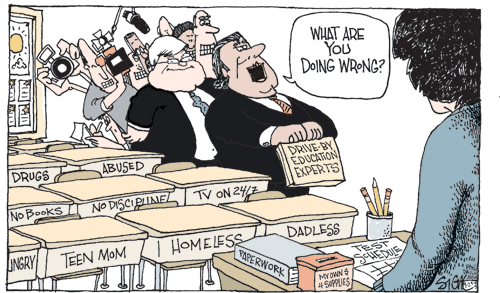
Poverty effects student achievement. The 2009 report by David Berliner, Poverty and Potential: Out-of-School Factors and School Success, listed a number of "out of school factors" associated with poverty that had an impact on school achievement.

In 2007, Education Policy Researcher Gerald Bracey wrote, "When people have said 'poverty is no excuse,' my response has been, 'Yes, you're right. Poverty is not an excuse. It's a condition. It's like gravity. Gravity affects everything you do on the planet. So does poverty.'"

More than twelve million American children live in poverty. No amount of tinkering with charter schools, vouchers, testing, or any other privatization scheme will help improve students achievement until we address the underlying problem.

From DAILY KOS
Government support for charter schools and vouchers fosters an out-for-yourself destiny rather than one of mutual benefit. Personal choice as a governing principle for an education system promotes escape from a network of mutuality, setting people against one another in a divisive winner-and-loser competition.

Only an unequivocal explicit rejection of the ideology of privatization will stop the erosion of democracy and the advance of inequity, resegregation, and divisiveness. More transparency and the banning of for-profit charter schools are insufficient. Neither is evidence of less-than-stellar achievement results for charter schools and voucher-funded private schools. Fewer, but still consequential, state-level tests, are not enough. None of those measures will turn around the wrong turn of bipartisan education policy of the last several decades because they all fail to challenge and replace underlying inequitable anti-democratic principles

TEACH FOR AMERICA FAILED

Teach for America Promised to Fix the Teacher Exodus Before Anyone Even Noticed There Was One. Now It’s Choking on Its Own Failure

It turns out that five weeks of training isn't enough training for someone to become a competent teacher.

From Steven Singer at Gadfly on the Wall Blog
Teach for America (TFA) was a solution to a problem it helped create.

Educators have been leaving the profession for decades due to poor salary, poor working conditions, heavy expectations and lack of tools or respect.

So Wendy Kopp, when in Princeton, created a program to fast track non-education majors into the classroom where they would teach for a few years and then enter the private sector as “experts” to drive public policy.

These college graduates would take a five week crash course in education and commit to at least two years in the classroom thereby filling any vacant teaching positions.

Surprise! It didn’t work.

In fact, it made things worse. Apparently deprofessionalizing education isn’t an incentive to dive into the field.
ALL PUBLIC SCHOOLS LOSE MONEY TO VOUCHERS

‘We’re under attack’: Public school officials alarmed over rise of school vouchers that will have biggest year ever

Public schools cannot choose their students. Private schools can. Public schools must report to the state and account for every penny they get in tax money. Private schools don't have to.

From WANE.com
...Public schools must account for every penny.

“In the voucher program, no dollars are accounted for,” Downs said. “Each district in Indiana is governed by a school board that must publicly report every expense.”

With the religious schools, it’s anyone’s guess where the money is spent, although some have noted large scale building programs that came about after the voucher program was introduced.

“If you get federal dollars for say, special education. Those dollars are supposed to support your existing programs you are legally responsible to provide. It cannot supplant. What that means is you can’t take that money, pay for things you’re already paying for and use that money somewhere else,” Downs explains.

“So if we’re going to look at how these religious organizations or private schools are using tax dollars, it’s important to know we need to be able to see if those dollars are supplanting dollars that are going to something else that taxpayers may not be in favor of.

“The solution is anybody who receives these dollars needs to open up their records and show us how their money is being used like any school district. Every school district has monthly meeting where every penny is reported in an open board meeting and the board has to vote to approve and accept those expenses,” Downs said.

“And that is every expense.”

SHAKESPEARE IS TOO RAUNCHY FOR SCHOOL

"There's some raunchiness": Florida crackdown on books comes for Shakespeare

From Salon
...rather than read titles like "Romeo and Juliet" or "Macbeth" in full, students will be assigned excerpts from the works. District officials stated that students seeking to read the classics in full may do so if they obtain copies; however, teachers have been cautioned to heed the excerpt-only guidelines, as they could face parent complaints or disciplinary action for going against them.

The decision was made "in consideration of the law," according to school district spokeswoman Tanya Arja. "There's some raunchiness in Shakespeare. Because that's what sold tickets during his time," said Joseph Cool, a reading teacher at Gaither High School. "I think the rest of the nation — no, the world, is laughing us," he added. "Taking Shakespeare in its entirety out because the relationship between Romeo and Juliet is somehow exploiting minors is just absurd." When asked by the Tampa Bay Times if he felt students could glean the same experience from reading play excerpts as one might from the full works, Cool replied, "absolutely not."
MOMS FOR LIBERTY HAVE JOINED IN THE CHORUS BASHING PUBLIC EDUCATION AND TEACHERS

The Real Agenda of Moms for Liberty

From The Nation
...top education officials from four states—Florida, Arkansas, Oklahoma, and South Carolina—took the stage with Moms for Liberty cofounder Tiffany Justice. Their goal seemed to be to disparage public schools, painting a picture of a “literacy crisis” that they blamed on teachers’ unions and the encroachment into the classroom of “woke nonsense.” “These are folks that want to destroy our society; they want to destroy your family, and they want to destroy America as we know it,”

SCHOOL MATH

Gary Rubinstein: Is the Math Taught in School Useful? No.

From Diane Ravitch
Part of my evolution in thinking about these ideas comes from watching my own kids who are now 15 and 12 go through the standard math curriculum. They have had decent teachers throughout the years and have always gotten 4s on the New York State tests so you would think that I’m thrilled but when I look at the things that they learned (because they were part of the curriculum) and the things that they have not learned (because they were not part of the curriculum) it frustrates me. Many parents who are not math teachers might feel the same way when they look at what their children are learning in math but they don’t dare question it. It reminds me of The Emperor’s New Clothes, nobody wants to seem like they aren’t smart enough to know why we have to learn how to multiply mixed numbers with different denominators. But as a math teacher who thinks about things like ‘what is the goal in learning this concept?’, ‘Is this concept needed to learn a more difficult concept?’, ‘Does this topic provide opportunity for the students to have ‘aha’ insights for themselves?’, I am constantly critiquing what I see my children learning about. And within my own teaching I am always trying to teach whatever topics are in the curriculum in a way that gives my own students an experience where they get to use their reasoning skills and not just blindly follow an algorithm.

WELCOME TO THE NEW YEAR - ISTA

Celebrating public schools at the start of a new year

ISTA (Indiana State Teachers Association) President, Keith Gambill opens the new school year.

From Indiana Capital Chronicle
Our dedicated public school educators work tirelessly to provide an unparalleled educational experience for every child, regardless of their background, ZIP code or circumstances. They’re not just conveyors of knowledge; they’re the architects of inspiration. They ignite the flames of curiosity, encouraging our students to ask questions, challenge assumptions, and explore the world around them. By cultivating critical thinking and problem-solving skills, our educators equip our children with the tools they need to succeed.

Beyond academics, our public schools are vibrant communities that celebrate diversity and promote inclusivity. In the classroom, students from various backgrounds come together, learning side by side, fostering empathy, and developing a deeper understanding of one another. These interactions lay the foundation for a future where compassion and cooperation transcend social barriers, creating a more united Indiana.

As we embrace the joy of returning to school, it’s essential to recognize that education goes beyond the classroom. Our schools play a pivotal role in nurturing the physical and emotional well-being of our students. School-based programs ensure that children have access to nutritious meals, mental health support, and a safe haven where they can flourish.

WELCOME TO THE NEW YEAR - FWCS

Fort Wayne Community Schools staff celebrates new academic year

Fort Wayne Community Schools starts a new year.

From the Fort Wayne Journal Gazette**
Standing at Parkview Field’s home plate, Rhonda Eitsert faced her Fort Wayne Community Schools co-workers Tuesday and described her childhood fraught with upheaval and insecurity.

More than 4,000 employees – who filled the stands from third base to first base – listened to Eitsert and others during a morning event celebrating the start of the new academic year.

...Eitsert, a nutrition services dietitian, told the crowd she spent two years in foster care. During her middle school years, she lived in seven homes, attended six schools and acted like a fool in class as a survival strategy.

She said she was fortunate to have educators, including eighth grade science teacher Roy Williams, who challenged her to “dig deep” and find her own path. Williams told her he knew she could be successful and that he would be proud of her if she could achieve that potential in his class – a message that resonated with her.

Eitsert would later become the first person in her family to graduate from college, and she would raise three college-educated children. She shared her story to remind educators how they can affect students.

“It’s a testament to a teacher with a superpower – the power to influence a life,” Eitsert said. “While you may not remember all of your students, many of them will remember you. You never know when you might become someone’s Mr. Williams, leaving an indelible mark on their journey.”

MORE THAN JUST POLICE

School resource officers offer more than policing for local schools

Local school resource officers bring more than just a badge to their schools.

From the Fort Wayne Journal Gazette**
“I believe that it takes a village to raise a child and you can count me as being part of your village,” the Allen County Sheriff’s Department officer said in describing his approach with Southwest Allen County School students. His strategy includes mentoring and coaching.

Kirkland said he wants to pay forward the support he had from school resource officers growing up.

“There was a resource officer in my path – multiple resource officers actually, men and women in law enforcement – that were able to guide and mentor me,” he said. “I just want to do the same for others.”

The Allen County Sheriff’s Department employs 14 school resource officers who are assigned throughout the county. The Fort Wayne Police Department places school resource officers across six city middle schools.

**Note: The Fort Wayne Journal Gazette is behind a paywall. Digital access, home delivery, or both are available with a subscription. Staying informed is essential; one way to do that is to support your local newspaper. For subscription information, go to fortwayne.com/subscriptions/ [NOTE: NEIFPE has no financial ties to the Fort Wayne Journal Gazette]

Note: NEIFPE's In Case You Missed It is posted by the end of the day every Monday except after holiday weekends or as otherwise noted.

###

Monday, April 18, 2022

In Case You Missed It – April 18, 2022

Here are links to last week's articles receiving the most attention on NEIFPE's social media accounts. Keep up with what's going on, what's being discussed, and what's happening with public education.

Be sure to enter your email address in the new Follow Us By Email box in the right-hand column to be informed when our blog posts are published.

THIS WEEK

Two Allen County school boards are in the news with articles about public comments and a superintendent search.

We also report about Teach for America, prayer in school, charter schools, and a national report card in which Indiana earned a grade of "F".
SACS SCHOOL BOARD CHANGES COMMENT PROTOCOL

Comment. Period.

A new Indiana law requires school boards (but not other governing agencies like city councils) to allow time for public comments. Southwest Allen County Schools (SACS) has opted to put the time for public comments at the beginning of each board meeting.

From the Fort Wayne Journal Gazette**
During Southwest Allen County Schools' board meeting March 15, parent Shawn McCarthy asked members to consider putting public comments at the start of meetings instead of holding them for the end. The suggestion was warmly received.

"I'm going to tell you, you're right," board president Brad Mills told McCarthy last month. "I want to address it."

The board did. Public comment will now occur at the beginning of meetings, after the Pledge of Allegiance and "communications" : an agenda item the district uses to highlight student and staff achievements.

Superintendent Park Ginder said Mc-Carthy's feedback and a new state law concerning public participation at school board meetings spurred the change. That law takes effect July 1 and mandates all public and charter school boards offer an oral public comment period at all public and virtual meetings.

Currently, the public is allowed to attend board meetings, but boards haven't been required to allow people to speak at most sessions.

The legislation was proposed after confrontational and disruptive school board meetings over the past year, sparked by COVID-19 protocols, saw some boards suspend or restrict public comments.

NACS NEEDS A SUPERINTENDENT

Poor precedent: Superintendent search stall would ill serve NACS

Indiana's Republican supermajority was unsuccessful when they tried to pass a bill forcing candidates for school boards to declare a political party affiliation. A candidate for the Republican Convention suggested that the board wait till after the election to name a new superintendent to replace Chris Himsel, who was hounded from his position as superintendent by right-wing parents. This would give the voters the opportunity to replace board members up for reelection with people who are against masks (aka following the state's guidelines during a pandemic).

From the Fort Wayne Journal Gazette**
[The post of superintendent is] a nonpartisan office. [Board President] Felger's correct when he said the district doesn't function well without a superintendent.

They had an excellent one in Himsel, whose endeavors during the years earned him the 2017 state superintendent of the year designation and a reputation as an outstanding educator.

After enduring months of ridicule from a faction of parents enraged over the mask mandate, Himsel took a leave of absence earlier this year before retiring last month.

TEACH FOR AMERICA LOSING GROUND

Gary Rubinstein: Whatever Happened to TFA?

They're not gone yet, but the number of Teach For America "teachers" has been dropping. It's true that many college graduates join Teach For America for altruistic reasons. They may truly want to help kids before they move on to other careers...but that doesn't eliminate the problems with the program.

Do we mourn the loss of teachers who are poorly trained, led by ineffective leaders, and who joined forces with teacher-bashing reformers?

Or do we cheer?

From Diane Ravitch
You might think that, with teacher shortages in many districts, this would be a golden moment for Teach for America. But it is not. Gary Rubinstein, one of the original members of TFA in the early 1990s and now a career teacher in New York City, surveys the current woes of Teach for America in this post. He identifies three reasons for the downturn in TFA’s fortunes. He begins:
Teach For America has an operating budget of $300 million. Their main responsibility is to recruit and prepare corps members to teach for a minimum of two years in low-income communities. They started in 1990 with 500 corps members. In 1991 they grew to 750 corps members. By 2005 they had 2000 corps members and they peaked in 2012 with 6000. Now, according to Chalkbeat, They are at a 17 year low, back to 2000 recruits.

CHARTER SCHOOL MYTHS

Top 5 Charter School Myths Debunked

Do charter schools save us money? Do they provide a better academic program than traditional public schools? Are they actually public schools?

Steven Singer, who blogs at Gadfly on the Wall, gives us answers to five myths about charter schools.

Spoiler Alert: The answer to the above questions is "no!"

From Gadfly on the Wall Blog
If there’s one thing people love to argue about, it’s charter schools.

Go to any school board meeting, PTA forum or editorial page, and you’re bound to see folks from all different walks of life getting red in the face over these institutions.

But what are they anyway? And why do they generate so much passionate disagreement?

To answer these questions and many more, I’m going to examine five of the most pernicious myths about charter schools, debunk the fallacies and come to the simple truths.

1. Charter Schools are Public Schools...

QUICK ANSWER: NO.

NPE GRADES THE STATES: INDIANA GETS AN "F"

Public Schooling in America: Measuring Each State’s Commitment to Democratically Governed Schools

The grades in this report indicate each state's commitment to public education. Indiana, as one might have guessed, earned an "F" rating.

From NPE, the Network for Public Education
In 2018, the Network for Public Education and the Schott Foundation issued a report entitled Grading the States. That report examined America’s commitment to democracy by grading each state and the District of Columbia on the number of publicly-funded but privately governed educational “choice” programs it had and whether those programs had sufficient safeguards to protect students’ well-being and civil rights. Since then, the march to privatize one of our country’s most precious institutions—our public schools—has continued. Indeed, it has intensified.

SCHOOL PRAYER CASE GOES TO SCOTUS

SCOTUS Will Take On School Prayer

The Supreme Court will decide whether a public school coach can pray publicly while "on duty" as an agent of the school. Does this cross the First Amendment line of "establishment of religion?"

One wonders whether the case would have gotten this far if the coach insisted on a Muslim prayer at the end of each game.

From Curmudgucation
Later this month, the Supreme Court will take on the case of Kennedy v. Bremerton School District. If you have not been paying attention to this case of the praying coach, you should take a look, because once again the court is contemplating smashing holes in the wall between church and state.

The case comes from Washington State, where high school football coach Joe Kennedy made a practice of taking a knee for a brief prayer at the end of games. He started the practice when he was hired in 2008, along with motivational prayers for the team, and the district let it go while it was small and quiet. But then he started taking his knee in the middle of the football stadium, while players were still on the field and fans were in the stadium. It became quite a Thing, with players (sometimes from both teams) joining him for the prayer and, reportedly on one occasion, so many folks rushing the prayer that they knocked over marching band members. The district told him to knock it off and tried to find a compromise (he was offered another location), but Kennedy decided he would Take A Stand and keep at it anyway...
**Note: The Fort Wayne Journal Gazette has changed its online access and is now behind a paywall. Digital access, home delivery, or both are available with a subscription. Staying informed is important, and one way to do that is to support your local newspaper. For subscription information, go to fortwayne.com/subscriptions/

###

Monday, June 22, 2020

In Case You Missed It – June 22, 2020

Here are links to last week's articles receiving the most attention in NEIFPE's social media. Keep up with what's going on, what's being discussed, and what's happening with public education.

Be sure to enter your email address in the Follow Us By Email box in the right-hand column to be informed when our blog posts are published.


SHORT OF MONEY? ORDER MORE TESTS

The last thing schools need to spend money on is tests. States are going to be very short of cash due to the lack of leadership by the federal government. Education funding ought to go to the classroom, not the corporate board room of a multinational testing company.

Leonie Haimson: NYC DOE Finds $6 Million for Pearson

From Diane Ravitch
Leonie Haimson, executive director of Class Size Matters, reports that the NYC Department of Education plans to award $6 million to testing giant Pearson, despite the pandemic and looming budget cuts.

PENCE TOUTS "SCHOOL CHOICE" AS THE ANSWER

Pence’s ‘school choice’ in Indiana

As governor of Indiana, Mike Pence was a fan of private education paid for with public funds. He never missed a chance for a private school photo-op...and generally ignored public education. Now, as VP he -- and his boss -- want to bring the money wasted on privatization to the federal level. With Betsy DeVos and a newly packed federal judiciary leading the charge, he just might be able to do that.

That would be a mistake.

From School Matters
Asked a simple question Tuesday about race in America, Vice President Mike Pence deflected to a soliloquy about all the Trump administration has done for African Americans, including the way it has “stood strong for school choice.”

Pence was following the script laid out by the president, who said that school choice is “the civil rights (issue) of all time in this country.”

How does that look from Indiana, where Pence was governor for four years before he hitched his wagon to Trump’s star? Frankly, not so good.


UNCERTAINTY FOR TEACHERS AND SCHOOLS IN 2020

No one knows what will happen this fall when it's time for schools to open. Will COVID-19 still be a threat? Will students have to work from home? Attend school in shifts? Wear masks?

It’s mid-June and schools still aren’t sure how they will open for 2020-21. Here’s why — and what’s likely to happen.

From the Answer Sheet
It’s mid-June and most school district superintendents still haven’t announced exactly what schools will look like when they open for the 2020-21 school year. In many places, reopening will be in August, which doesn’t give them a lot of time to decide and put the plans in motion.

But we do know that just about every aspect of schooling will be different than it has been in the past. Protective measures will be in place to prevent the spread of the novel coronavirus, and a “hybrid” model of in-person and remote learning will become commonplace in many, if not most, districts.

Teachers Face A Summer Of Soul Searching. What Do They Do In The Fall?

From Peter Greene in Forbes
Teachers know, in their guts, where this is headed. They have seen versions of this movie before. For instance, in 1975 Congress passed the Individuals with Disabilities Education Act (IDEA) which promised every student with disabilities a free appropriate public education. Knowing that meant extra expenses for school districts, Congress promised funding to back IDEA. They have never, in 45 years, honored that promise, and schools have just had to find their own way to meet that unfunded mandate.


JIM BANKS (IN-03) SAYS SCHOOLS MUST START OR NO MONEY

GOP Legislators To Schools: Re-Open Or Else.

One size does not fit all.

Indiana's third district US Congressman, Jim Banks, and a Wisconsin colleague have decided that the health of those who attend school, work in schools, or are related to those who attend or work in schools doesn't matter.

In a blatant attempt at extortion, Rep. Banks and Tom Tiffany (R-WI) have introduced a bill that would require schools to open for in-person instruction by September 8, 2020, or face the loss of federal education dollars. It doesn't matter what the local pandemic conditions are. It doesn't matter what the local health risks are. "Damn the torpedoes. Full speed ahead."

From Peter Greene in Forbes
Representative Jim Banks of Indiana and freshly-elected Representative Tom Tiffany of Wisconsin have decided to throw some weight behind the push to re-open schools in the fall by creating the granddaddy of all unfunded mandates.

The Reopen Our Schools Act sends a pretty simple message to schools—open up in the fall, or we will cut off your federal funding. I’ve seen the text of the bill—it’s 37 lines long, including the section of definitions. Its purpose is listed as “To prohibit the Secretary of Education from providing funding to certain educational institutions unless the institutions return to in-person instruction, and for other purposes.“

CHARTERS ARE PRIVATE BUSINESSES

Charter Schools, Some With Billionaire Benefactors, Tap Coronavirus Relief

Are charter schools public schools or are they private businesses? It depends on which way the money flows. When states began funding charters with public dollars, then they decided that charters are public schools. When the US Congress offered small business relief during the coronavirus pandemic, those same charter schools turned towards the money and claimed to be private businesses. They can't -- or shouldn't -- have it both ways.

From the New York Times
Charter schools, including some with healthy cash balances and billionaire backers like Michael Bloomberg and Bill Gates, have quietly accepted millions of dollars in emergency coronavirus relief from a fund created to help struggling small businesses stay afloat.

Since their inception, charter schools have straddled the line between public schools and private entities. The coronavirus has forced them to choose.

And dozens of them — potentially more because the Treasury Department has not disclosed a list — have decided for the purpose of coronavirus relief that they are businesses, applying for aid even as they continue to enjoy funding from school budgets, tax-free status and, in some cases, healthy cash balances and the support of billionaire backers.


TFA OPTS FOR EVEN LESS TRAINING THAN BEFORE

Teach for America’s 2020 Trainees to Enter the Classroom with Only Tutoring Experience

Teach for America had never given their "teachers" much training. Five weeks in the summer was enough because since everyone has gone to school everyone can teach, right?

There's a reason it takes actual teachers four years to complete a teacher training program. Teaching children in public schools is more than just presenting information. If you don't know that -- and TFA trainers apparently don't -- then you shouldn't be in the classroom.

From deutsch29: Mercedes Schneider's Blog
In this time of school closures and social distancing, teacher temp agency, Teach for America (TFA), has decided to “train” its 2020 corps members online.

As former TFAer-gone-career teacher, Gary Rubinstein, writes, pre-COVID, TFA trainees actually teach on average one hour per day over the course of four weeks during the summer, in classrooms which they share with four other TFA trainees.

As such, TFA trainees have no experience teaching even one entire school day in a classroom in which the trainee is responsible for all instruction.

And now, with the social restrictions and classroom complexities introduced by the coronavirus, TFA’s 2020 trainees will have no experience being in charge of a classroom– not even an entire classroom online.

###

Monday, July 1, 2019

In Case You Missed It – July 1, 2019

Here are links to last month's articles receiving the most attention in NEIFPE's social media. Keep up with what's going on, what's being discussed, and what's happening with public education.

Be sure to enter your email address in the Follow Us By Email box in the right-hand column to be informed when our blog posts are published.

ICYMI will return to its weekly format beginning July 8, 2019.

* Editor's Choice


EARLY CHILDHOOD EDUCATION

FORT WAYNE LOCAL SCHOOLS


FUNDING, MONEY IN POLITICS/EDUCATION


INDIANAPOLIS LOCAL SCHOOLS

POLITICS


PRIVATIZATION


SEGREGATION

STANDARDIZATION

STATE TAKEOVERS

U.S. ED DEPT


THE WAR ON TEACHERS

WRAP-AROUND SERVICES
###

Monday, November 19, 2018

In Case You Missed It – Nov 19, 2018

Here are links to the articles receiving the most attention in NEIFPE's social media. Keep up with what's going on, what's being discussed, and what's happening with public education.

Be sure to enter your email address in the Follow Us By Email box in the right-hand column to be informed when our blog posts are published.

VOUCHERS BY ANY OTHER NAME

Kentucky: Beware Voucher Fraud!

From Diane Ravitch
When proposals for vouchers (or scholarships that allow public money to be spent for religious or private schools) is on the ballot, the voters say no. They said NO last week in Arizona by a vote of 65-35%.

EdChoice and the Goldwater Institute are based in Arizona. The Koch brothers and DeVos’ American Federation for Children supported the voucher referendum (called Empowerment Scholarship Accounts), and despite the money and the euphemism, it was defeated overwhelmingly.

Watch out, Kentucky. The voucher zombies are coming for you.


NO MONEY FOR SCHOOLS, BUT PLENTY FOR TFA

Kansas Will Pay TFA $270,000 for Recruiting 3 Teachers

From Diane Ravitch
You read that right. Kansas is a state that has cut taxes and cut its education budget repeatedly and whose teachers are paid poorly. It is under court order to finance its schools adequately. You may recall that former Governor Sam Brownback imposed a far-right policy of cutting taxes to “grow the economy” while starving the schools and other public services. The experiment failed. Trump appointed him the
“Ambassador-at-Large for International Religious Freedom.”

So now, because of low salaries, Kansas has teacher shortages. The remedy? A lavish contract with TFA to bring in temp teachers.


VIRTUAL SCHOOLS EARN AN "F"

Hardly any kids passed ISTEP at one of Indiana’s largest schools. Here’s why it’s not getting an F

Wouldn’t it be nice if our legislators would quit throwing our tax dollars away?

From Chalkbeat
With such high enrollment numbers, Indiana Virtual School and Indiana Virtual Pathways Academy could together bring in upward of $35 million from the state for this school year, according to funding estimates from the Legislative Services Agency.

At the state’s other full-time virtual charter schools — including those billed as alternative schools like IVPA — state grades are rising as enrollment grows. Indiana Connections Academy is up to a D this year from an F, and Insight School of Indiana is up to a C from an F. For grades under Indiana’s federal plan, the schools received an F and D, respectively.

Indiana Connections Career Academy enrolled about 70 students last year and received no grade, but education department officials say that is because it had too few students to calculate one, despite testing more than 95 percent of them. It’s not uncommon for small schools — especially high schools that have just one tested grade — to not get a grade. This year, the school’s enrollment is up to about 300 students.


PRIVATIZATION FAILS

Restore Reason: What Happens When Government Services Are Privatized

From Diane Ravitch
...I began to think how this privatization story was paralleling that of education’s. In both cases, those in the public sector are in it for the mission, not the money. In both cases, the private sector only “wins” if the public sector “loses”. In both cases, it is in the interest of the private sector to facilitate the failure of the public sector or make it look like it is failing.

Just as private and charter schools profit when district schools are perceived to be of lower quality, Barry Myers has worked hard to make government provided weather services look inferior to that which the private sector can provide. As Lewis points out, “The more spectacular and expensive the disasters, the more people will pay for warning of them. The more people stand to lose, the more money they will be inclined to pay. The more they pay, the more the weather industry can afford to donate to elected officials, and the more influence it will gain over the political process.”


A TEACHER IS MORE THAN HER STUDENTS' TEST SCORES

Northwestern University Economist Uses Data to Prove Students’ Test Scores Fail to Measure Quality Teaching

From Jan Resseger
“These results confirm an idea that many believe to be true but that has not been previously documented—that teacher effects on test scores capture only a fraction of their impact on their students. The fact that teacher impacts on behavior are much stronger predictors of their impact on longer-run outcomes than test-score impacts, and that teacher impacts on test scores and those on behavior are largely unrelated, means that the lion’s share of truly excellent teachers, those who improve long-run outcomes—will not be identified using test-score value added alone… This analysis provides the first hard evidence that such contributions to student progress are both measurable and consequential.”


TECH DOESN'T OVERCOME POVERTY

Nellie Bowles: In America’s Schools, the Rich Get Teachers, the Poor Get Computers

From Diane Ravitch
The parents in Overland Park, Kan., were fed up. They wanted their children off screens, but they needed strength in numbers. First, because no one wants their kid to be the lone weird one without a phone. And second, because taking the phone away from a middle schooler is actually very, very tough.

“We start the meetings by saying, ‘This is hard, we’re in a new frontier, but who is going to help us?’” said Krista Boan, who is leading a Kansas City-based program called START, which stands for Stand Together And Rethink Technology. “We can’t call our moms about this one.”

For the last six months, at night in school libraries across Overland Park, a suburb of Kansas City, Mo., about 150 parents have been meeting to talk about one thing: how to get their children off screens.


SCHOOL GRADES MIRROR TEST SCORES: NEITHER TELLS THE WHOLE STORY

Many Indiana schools receive F grades for how they serve students of color and those with disabilities

It is folly to evaluate schools by test scores. It’s also quite unfair that private schools and charter schools that serve few students with disabilities or those in need of 2nd language services get higher scores because they aren’t required to, and for the most part, don’t serve those students. We also need to remember that when your legislators use your tax dollars to fund charters and privates, they are taking needed dollars for resources from the public schools that do serve all students with any needs that they may have.

From Chalkbeat
Schools grades are highly reflective of state test scores, which have a well-documented history of gaps between certain groups of students. Although state test scores tend to make up a smaller overall piece of the federal grades than state grades, it is still the single largest factor, which raises some important caveats, experts say. Differences in test scores between groups of students, often called achievement or opportunity gaps, don’t reflect students’ innate abilities to learn. Nor do they always mean schools are doing a poor job educating different students. Rather, gaps can be attributed to any number of factors, including test question biases, parents’ education, students’ early childhood education, stress, trauma, and more.

Gaps in grades, in this case, could point out areas of inequities between schools, such as differences in teacher quality, curriculum quality, and availability of honors courses. The gaps also show the extent to which income disparities and poverty are present in a school. Students who come from low-income families and those who switch schools frequently tend to do worse on standardized exams, which would result in lower grades.


YET ANOTHER RICH NON-EDUCATOR WITH "ALL THE ANSWERS"

Laurene Powell Jobs Wants YOU to Run for School Board and Implement Her XQ Program

From Diane Ravitch
Laurene Powell Jobs is urging her allies to run for the local school board and become advocates for her ideas about the importance of reinventing high schools along the lines that she and Arne Duncan have chosen.

She has even provided a handy kit about how to do it.


MUST BE NICE...

If People Talked to Other Professionals the Way They Talk to Teachers

From McSweeney's
Ah, a zookeeper. So, you just babysit the animals all day?”

- - -

“My colon never acts this way at home. Are you sure you’re reading the colonoscopy results correctly? Did you ever think that maybe you just don’t like my colon?”


ENDANGERED CHARTER SCHOOLS

New York: With Republican Loss of State Senate, Charter Schools Endangered

Instead of spending money on privately run, lack-of-accountability charter schools, we should be using tax dollars to improve struggling public schools.

From Diane Ravitch
Since 1998, Senate Republicans continued to support the publicly funded, but privately run schools. Many Democrats say charter schools unfairly compete for students, and the state and local aid attached to them. Advocates of charter schools, including some urban Democrats, say they are a needed alternative to failing traditional schools. Charter schools, for example, are free of some regulations, which allows them to experiment with instruction models such as longer school days. Supporters point to long waiting lists for these schools as proof of their value.


FWCS TEACHER CONTRACT NEWS

Incentives added to teacher contract

From The Fort Wayne Journal Gazette
Becoming a mentor, committing to certain buildings, and writing and piloting new curriculum are ways teachers in Fort Wayne Community Schools can earn more cash.

The school board Monday approved bonuses and stipends tied to these and other efforts as part of an amendment to the master teacher contract ratified last year with the Fort Wayne Education Association.


THE TRUTH ABOUT CHARTER SCHOOLS

José Espinosa: The Truth About Charter Schools That Boast About a 100% College Acceptance Rate

From Diane Ravitch
While 100 percent of charter seniors get accepted to college as required, the public has a right to know the percentage of charter students who didn’t make it to their senior year.

Ed Fuller, Pennsylvania State University professor, found in one of his studies of a particular charter network that when considering the number of students starting in the ninth grade as a cohort, the percentage of charter cohort students who graduated and went on to college was at best 65 percent.

In other words, 35 percent of ninth-graders at a charter network didn’t make it to their graduation….

Just like the BBB, it is our duty to alert the public.


###

Sunday, August 7, 2016

The Teach For America Bait and Switch

Reposted from Alternet. Published with permission of the author

The following guest post is an excerpt from Teach For America Counter-Narratives: Alumni Speak Up and Speak Out

About the book

From the publisher's overview
In its twenty-five years of existence, Teach For America (TFA) has transformed from an organization based on a perceived need to ameliorate a national teacher shortage to an organization that seeks to systematically replace traditional fully-certified teachers while simultaneously producing alumni who are interested in facilitating neoliberal education reform through elected political positions. From its inception, TFA has had its share of critics; yet criticism of the organization by its own members and alumni has largely been silenced and relegated to the margins.

The Teach For America Bait and Switch: From 'You’ll Be Making a Difference' to 'You’re Making Excuses'

by Jessica Millen

[Jessica Millen graduated from the University of Notre Dame in 2013, majoring in sociology with a minor in education, schooling, and society. She was a 2013 Teach For America (TFA) corps member in New Orleans, where she taught third grade. She currently works as a field organizer for the campaign All IN 4 Pre-K, advocating for increased access to high quality preschool in the state of Indiana.]

The Bait

On the urging of a friend and campus recruiter, I applied to join TFA in October of my senior year at the University of Notre Dame. After a multipart interview process, I was accepted into the program’s Greater New Orleans region. Soon afterwards, TFA began to effectively use social networks to bolster my desire to join. Former classmates and undergraduate campus recruiters reached out and stressed how wonderful it was that I had gotten into such a selective organization. My interviewer called to congratulate me on a job well done. After being bombarded with so many congratulations, I couldn’t help but feel proud that I had passed through such a selective hiring process.

The official TFA recruiter on my campus held events for accepted corps members after each hiring deadline, offering free drinks and appetizers at an on-campus restaurant. I found it strange how much money TFA, a nonprofit organization, spent on us. We wore name tags, ate food, and discussed our excitement about the upcoming school year. Our recruiter, like the other TFA corps members and staff who had reached out to me, stressed the “prestige” of the program and how much TFA would help us in the future. He himself was a former TFA corps member who taught for 3 years before joining the recruiting arm of the organization. I found his enthusiasm for TFA contagious as he pointed out TFA’s connections with graduate schools and the numerous opportunities that would be afforded to us post-TFA.

At the time, I was impressed by how many corps members were still involved in public education. According to TFA, more than 775 alumni were in school leadership positions at schools across the country (Teach For America, 2012a). I was glad to hear that TFA wasn’t always just used as a stepping stone to more lucrative careers; information on the TFA website boasted that as of August 2013, 78% of alumni from the Greater New Orleans region were still in education (Teach For America, 2012b). I didn’t bother to look up the evidence behind TFA’s claims. I trusted that the information from this professional organization that seemed to care so much about children was ethically collected, compiled, and reported. I now know that the organization’s assertion that “Teach For America corps members help their students achieve academic gains equal to or larger than teachers from other preparation programs, according to the most recent and rigorous studies on teacher effectiveness” (Teach For America, 2012c) is, at best, extremely misleading. Reviews of the research cited by TFA to back its claims of corps member effectiveness ultimately reveal a less favorable picture; the majority of studies listed by TFA are not peer-reviewed, are problematic, and/or produced mixed results (Kovacs & Slate-Young, 2013; Vasquez Heilig & Jez, 2014).

But taking TFA’s claims of effectiveness at face value, I continued to be wooed by the organization. Besides the free events hosted by the campus recruiter, TFA offered additional financial incentives to make the bait even sweeter. I remember gushing to my parents that I would not only receive a full teacher’s salary, but also get funding to cover the transitional costs of moving and living during the summer before I began teaching. As an indebted college student, it seemed that, on top of using my skills and education to serve in public education, I was making a solid financial decision in joining TFA. Such tantalizing benefits convinced me that not only was I making a strong move for my future, but I would also be “making a difference” in the lives of low-income and minority students. As a young, well-educated, idealistic student, I took the bait—hook, line and sinker.

The “Training”

After a 7-hour drive to TFA’s summer training Institute in Atlanta, I was excited to begin. Although I had been warned that Institute could be an overwhelming experience, the intensity of our schedule was still surprising. Breakfast at 5:30 am, followed by a full day at our school sites, a quick dinner, additional training sessions in the evening, and then trying to complete the next day’s lesson plans was the perfect recipe for sleep deprivation, and left little time to process all this new information.

During this training, the organization’s “you’ll be making a difference” message became more insistent. Each morning, after being bused to our school site in the early morning, we were greeted by our school director. After signing in, we all gathered in our school site’s library to begin our morning with an inspirational video. Over the course of those 5 weeks we watched what seemed to be every single well-known, inspirational education video on YouTube. We saw Kid President’s “Pep Talk to Teachers and Students!”, listened to Taylor Mali tell us “What Teachers Make,” watched Sir Ken Robinson’s animation video “Changing Education Paradigms,” and many, many more.

Their model was working! At the time, I was inspired and eager to be in the classroom. Here I was, part of this great movement that was going to make a difference! So swept up in the staff members’ fervor, I did not stop to think about why we were being shown all these inspirational and emotionally charged messages, or what they would ultimately contribute to my ability to be a competent, caring, and effective teacher.

It didn’t end with just morning bursts of “let’s change the world.” Throughout our training sessions, we were often shown videos of real TFA teachers working in their classrooms. They were always uplifting clips, showing well-behaved students and enthusiastic teachers. We were told they had started just like us at one point in time, although the teachers’ educational backgrounds were never divulged. We were never shown any videos of “bad” teachers or teachers who were struggling, nor did we see how teachers deal with students who are challenging behaviorally, or even defiant. And we were certainly never shown how to handle students’ physical altercations or emotional breakdowns.

I had expected more hands-on training throughout the program. But with only a half hour to an hour and half in front of students each day, I found that we spent more time talking about how we were going to be make a difference rather than learning how to be effective teachers who could ultimately “make a difference.”

In addition to watching inspirational videos, we listened to many TFA staff members give talks about the rewarding nature of teaching. They showed us pictures of themselves and their students and told stories of how they had impacted their students’ lives. These peppy speakers were extremely positive, only occasionally using vague phrasing to describe teaching as “the hardest thing you’ll ever do.” There was no delving into why it was the “hardest thing I would ever do.” nor was there space to ask the speakers to elaborate. While I recognize that it might be difficult to convey the specific challenges that come with the first year of teaching, when such uplifting testimony is paired with only examples of successful TFA teachers, it was easy and safe for me to assume that I would soon begin “making a difference” once I entered the classroom on my own.

The “making a difference” message was not limited to our sessions in classroom management and pedagogy. During our training, we attended two huge pep rallies, one at the beginning and one at the end of Institute. As the Atlanta Institute hosted multiple TFA regions, the auditorium was packed. At the opening rally we were greeted by a huge PowerPoint slide declaring “One Day,” highlighting TFA’s mantra that “One day all children will have access to an excellent education.” The title of the evening’s program was “Your Role in the Movement for Educational Equity.” After listening to speakers thank us for undertaking the journey we were about to begin, I felt excited. It seemed like TFA was an organization that was actually making a tangible difference in communities across the United States.

Before the closing pep rally, each school site’s corps members created a chant to be shared with the full assembly. Most corps members had purchased t-shirts for their school sites, and as we filed in to our assigned school site spaces, the chanting began. Huge groups of matching corps members were on their feet, yelling at the top of their lungs the cheers they had written. Soon, the TFA staff running the rally began to moderate the cheering, shouting each school site’s name and encouraging each group to be louder than the rest. After more peppy speakers, a student brass band played the corps members out, matching the same frenzied enthusiasm that the hundreds of young, soon-to-be teachers had displayed. In retrospect, the techniques used at these rallies made it feel more like a multilevel marketing convention than a gathering of thoughtful educators. It is strange that TFA felt the need to use such manipulative methods of drumming up enthusiasm on a group of well-educated individuals already committed to their organization.

The Switch

After those 5 weeks of training, I was alone in a classroom with 27 eight- and nine-year-olds. I had no idea what to do with the rigorous and inflexible curriculum modalities that dictated what I taught and when. There was nothing in our training that indicated our teaching lives would be so scripted and controlled. Moreover, I was confused by strict administrative policies that were completely developmentally inappropriate; for instance, my third graders were allowed only 20 minutes of recess, once a week. Again, there was no mention of what to do when school-wide policies were completely incongruent with what I knew at this point to be developmentally appropriate practices.

Trying to balance the demands and expectations of both my school and TFA was challenging, especially when both parties were extremely focused on data and standardized testing to the detriment of what my young students needed. This made it difficult for me to realize my vision of schooling. While I understood the necessity of assessment and its usefulness in gauging how much students know, and therefore in future lesson planning, both my school and TFA’s focus on testing overshadowed my legitimate concerns for students’ emotional and social well-being and academic growth beyond what could be measured in omnipresent assessments. I had to prepare my students for weekly and quarterly testing, on top of looming state-mandated tests that would also measure my success as a teacher. The pressure from both the state and district to raise student test scores manifested in my administration’s extreme concern with test scores and maximizing instructional time not only in specific subjects but also to specific isolated skill sets, always to the detriment of exploring other important areas of elementary education, such as exposure to culture, creative and scientific thinking, music, and art.

Armed only with TFA’s strictly behaviorist methods of classroom management, I was unprepared for many of the issues I faced, and my classroom quickly spiraled out of control. From my 5 weeks of training, I was knowledgeable only about behaviorist management methods that focused on giving clear directions, narrating student behavior when they were following directions, and then giving consequences to those students not complying. These management methods were presented as best practices during our training; no other alternatives were mentioned.

After attempting to use TFA’s preferred classroom management system in my own classroom, I realized that the behaviorist theory of management was not working for my students or for me. When I expressed these feelings to TFA staff members, however, my concerns were ignored and brushed aside. In one meeting with my real-time coach from TFA, who had 4 years of teaching experience, I expressed how uncomfortable I was with forcing my students to remain seated all the time. My coach insisted that students learn best when they are seated. He then noticed that, according to the scripted conversation template from TFA, we had gone over the allotted time for this portion of our meeting. Rather than continuing a conversation that could have helped me understand TFA’s position, he decided that following the prescribed conversation model was more important and ended the discussion. Looking back, it is easy to see why I felt that I was not being supported or listened to by TFA staff. Suddenly, I found myself hearing a different story than the one I was told during the application and training process. Now, instead of “making a difference,” I was told I was “making excuses,” by not believing in myself enough and not being the leader of my classroom.

I met with my TFA manager of teacher leadership development (MTLD) every so often for a check-in. It is interesting to note here that corps members are “managed” by TFA, as if they were commodities, rather than “guided” or “mentored.” At one of these meetings, my MTLD told me she wanted me to have lunch with all my students, so that I could work on “building relationships.” I had already begun to have lunch with small groups of students occasionally, but I was having trouble finding the time to eat with students every day, given the other demands on my time as a new educator. When I brought up what I thought were legitimate concerns—the fact that I had only 25 minutes for lunch, which included dropping off/picking up my students at the cafeteria, and that my administration had concerns about me “rewarding” students who often were not following school rules (eating with students was seen as a reward, not simply a good practice to develop relationships)—my TFA manager told me, “I’m hearing a lot of excuses from you.”

In addition to telling me that I was making excuses, my manager also said that I did not believe in myself enough. As a confident young woman who had had a successful experience at Institute, where I was told, “Your students are going to be so lucky to have you” and “You’re doing so well,” I knew I could be an excellent teacher. I believed in my students and their potential, and had a wealth of knowledge about education, children, and learning, largely from my undergraduate studies. My end-of-Institute award was for “believing in your students.” To be told I didn’t believe in my students or myself was insulting, and not the type of support I expected to receive from TFA staff members.

TFA staff members repeatedly told me that I was not being the leader of my classroom, in the sense that I did not have strict control over my students’ bodily movements. Within TFA’s model of behavioral control, I was expected to have all of my students sitting in their seats at all times, and to accomplish this particular aspect of classroom management by consistently giving consequences. On an intellectual level, I recognized that giving consequences was a necessary part of their management system. It was not that I was incapable of giving my students consequences; the problem was that my vision of schooling did not include a classroom where the teacher is all-powerful, all-knowledgeable, and in strict control at all times. What I was beginning to understand was that there was no room in their model for my vision; in fact, my vision was completely contrary to their understanding of how schooling should be conducted and why. TFA’s Teaching as Leadership model is based upon the idea that teachers are responsible for everything that happens inside of the classroom, regardless of whether or not you agree with the techniques and content you are being forced to adopt (Farr, 2010).

My frustration deepened when TFA staff ignored the fact that there were other factors at work in and out of my classroom that affected student behavior and achievement. I was unable to choose curriculum or what was taught when. TFA’s model of behavioral control and TFA staff instructed me to use extremely scripted sets of phrases, limiting my freedom to develop my own style of classroom instruction that suited my unique context. In addition to this, TFA staff ignored the life circumstances of many of my students. I could not change the circumstances that led Jerome to bring a roach-infested notebook to school, or the fact that Peter’s mother told him to “get his lick back,” meaning that if someone hits him, he should hit back. Whenever I tried to bring up the lived realities of my students’ lives and the real challenges they faced, once again, I was told I was “making excuses.” Despite my having personal knowledge of my students and their families, my voice and ultimately my potential to use alternative methods and ideas for creating a more learner-centered, productive environment was repeatedly pushed aside, as it contradicted TFA talking points.

In the end, I decided to leave. I could not, in good conscience, continue to work for an organization whose guiding educational philosophy varied so greatly from my own. It was not a decision I made lightly, leaving the very students I was trying to love and teach. But after I decided to leave, there came a small moment when I knew I had made the right choice. As I was waiting on duty for the last of the buses to arrive, Sarah caught my eye. She and her younger brother were role-playing the teacher-student relationship and the words coming out of Sarah’s mouth broke my heart: “You’re receiving a consequence! You have earned a lunch detention. You get a consequence!” These are the words and phrases she had heard me use repeatedly, again and again, over and over, as I strove to enact my MTLD’s mandate to give lots of consequences. I had spent 3 months with this child and all I taught her about what it means to be a teacher is that a teacher gives consequences. This was devastating to me, and it was then that I realized that the bait and switch was complete.

For more of this essay, and many other perspectives on the Teach For America experience, you can purchase the complete book of essays here.

To learn more about ALL IN 4 Pre-K click here.

###