Showing posts with label Curriculum. Show all posts

Monday, December 30, 2024

In Case You Missed It – December 30 2024

Here are links to last week's articles receiving the most attention on NEIFPE's social media accounts. Keep up with what's going on, what's being discussed, and what's happening with public education.

Be sure to enter your email address in the Follow Us By Email box in the right-hand column of our blog page to be informed when our blog posts are published.
QUOTE OF THE WEEK

"There’s no reason to push children to read early. Their brains have not evolved to the point where they must read at age three or five." -- Nancy Bailey in Give the Gift of Removing Reading Pressure on Kindergartners!

LATEST TIMMS SCORES SHOW DECLINE FOR U.S.

Tom Loveless: What We Learned from the 2023 TIMSS

Was the U.S. score decline caused by the pandemic? The answer is unclear.

From Diane Ravitch
Two trends stand out.

1. Larger negative effects in math than in other subjects. The most prominent explanation is that learning math is more dependent on formal instruction in schools.

2. Gaps increased between higher and lower scoring groups along several demographic dimensions, including race, ethnicity, socioeconomic status, and the 90th and 10th percentiles (high and low achievers).Note that many of the gaps began widening before the pandemic, but Covid seemed to exacerbate the trends.

A GIFT FOR KINDERGARTENERS

Give the Gift of Removing Reading Pressure on Kindergartners!

Kindergartens should return to providing a developmentally appropriate curriculum.

From Nancy Bailey’s Education Website
This holiday season, give children the gift of reading. One of the best ways to do that is to relieve the pressure of insisting they read early. Some children might pick up reading when they’re very young, but others will learn a little later, and there’s nothing wrong with this.

However, children who are made to feel like failures at this age if they are not reading yet will have a more challenging time learning to read later.

Sadly, examples of kindergarten reading pressure can be found everywhere. A recent Business Insider report describes a mother saddened that their child had to repeat kindergarten because they couldn’t read or write!

Expecting children to read in kindergarten and putting this increased pressure on them became politically motivated with NCLB

TRUST THE EXPERTS

Unintended Consequences

Just because you attended school doesn’t mean you are an education expert or know anything about child development.

From Sheila Kennedy
Rothstein eventually concluded that lower average achievement of these pupils wasn’t due to deficits of instruction, but to the
social and economic challenges that children brought with them to school—for example, greater rates of lead poisoning that resulted in damaged cognitive function; living in more polluted neighborhoods that led to a higher incidence of asthma that kept children up at night wheezing and coming to school drowsier the next day; lack of adequate heal[th care, including dental care, that brought more children to school with distracting toothaches, and on and on...

WE NEED SOME HYGGE IN OUR CLASSROOMS

We Need Hygge Classrooms in America

It would be nice if Americans embraced contentment and connection.

From Teacher in a Strange Land Blog
In Iceland, books are exchanged as Christmas Eve presents, then you spend the rest of the night in bed reading them and eating chocolate. The tradition is part of a season called Jolabokafload, the Christmas Book flood, because Iceland, which publishes more books per capita than any other country, sells most of its books between September and November, due to people preparing for the upcoming holiday.

PUBLIC MONEY SHOULD GO TO PUBLIC SCHOOLS

D for effort

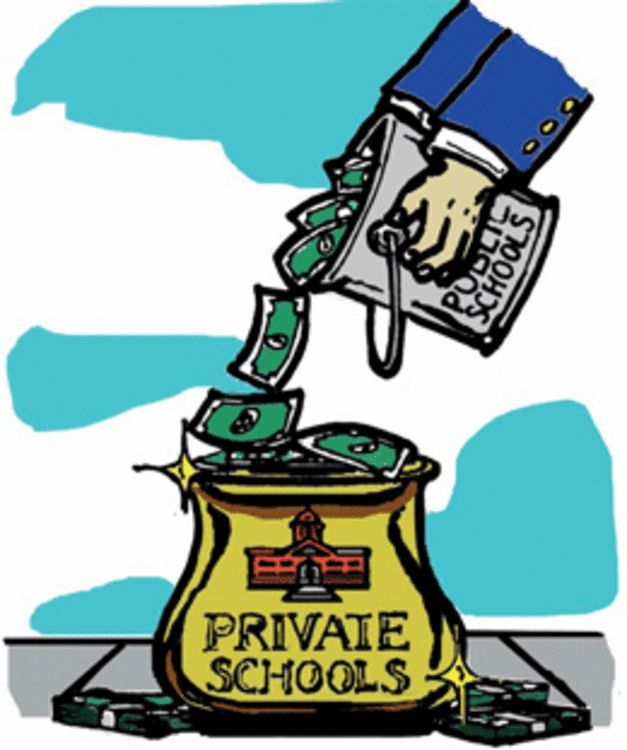
Republicans in the Indiana General Assembly continue to vote to raise the amount the state pays students to go to religious and other private schools...with money diverted from public schools.

From School Matters
Indiana gets a D for effort when it comes to funding public education. Keep that in mind when legislators say there’s not enough money to give schools what they need.

The rating comes from the latest “Making the Grade” report, an annual evaluation of state school funding by the Education Law Center, a New Jersey-based research organization that advocates for equitable funding. Indiana does slightly better, earning a C, for school funding adequacy and fairness.

SCHOOL COUNSELORS NEEDED

School counselors are essential, so let's treat them that way

Here's something that Indiana should spend public tax dollars on instead of diverting money to private and religious schools.

From the Fort Wayne Journal Gazette**
The 2024-25 Indiana School Counselor Survey paints a grim picture of a profession stretched far too thin. Counselors are overburdened, under-resourced, and struggling to meet their students’ growing mental health and academic needs.

Social-emotional challenges among Indiana students remain at critically high levels, with more than half of counselors reporting an increase over the past year. These issues, many of them lingering from the pandemic, are compounded by mounting academic pressures, career readiness hurdles, and a deluge of administrative tasks. Counselors are drowning in paperwork instead of sitting across from the students who need them most. The state’s student-to-counselor ratio is 351-to-1 and is well above the nationally recommended 250-to-1. This is a massive barrier to effective support.
**Note: The Fort Wayne Journal Gazette is behind a paywall. Digital access, home delivery, or both are available with a subscription. Staying informed is essential; one way to do that is to support your local newspaper. For subscription information, go to fortwayne.com/subscriptions/ [NOTE: NEIFPE has no financial ties to the Fort Wayne Journal Gazette]

Note: NEIFPE's In Case You Missed It is posted by the end of the day every Monday except after holiday weekends or as otherwise noted.

###

Monday, September 16, 2024

In Case You Missed It – September 16, 2024

Here are links to last week's articles receiving the most attention on NEIFPE's social media accounts. Keep up with what's going on, what's being discussed, and what's happening with public education.

Be sure to enter your email address in the Follow Us By Email box in the right-hand column of our blog page to be informed when our blog posts are published.
QUOTE OF THE WEEK

"Fourteen states and counting have now passed legislation creating voucher (or education savings account) programs that share some key properties. They are universal (or nearly universal), meaning that all families are eligible. They involve no meaningful public accountability or way to judge their success. They allow private schools to charge tuition over and above the voucher amount. And, finally, they are flexible in that funds can be used even to cover homeschooling expenses and other educational goods and services, such as computers and tutoring." -- in The new and radical school voucher push is quietly unwinding two centuries of U.S. education tradition by Douglas N. Harris at the Brookings Institute.

VOUCHERS HURT PUBLIC SCHOOLS

The Evidence Continues To Mount

"[The] majority of the families in the Indiana voucher program today were previously paying for private school on their own...Yet the state stepped in to offer a financial subsidy to parents who didn’t need it ― a costly decision critics say is hurting public schools, which educate more than 90% of the approximately one million K-12 students in Indiana."

From Sheila Kennedy
Inequality.org recently took an in-depth look at the Right-wing’s increasingly successful effort to destroy public education. In an article titled “Private Fortunes Vs. Public Education,” the article began
The United States essentially invented public education. Back in the 1780s, notes the Center on Education Policy, federal legislation “granted federal lands to new states and set aside a portion of those lands to be used to fund public schools.” By the 18th century’s close, most Americans had embraced the notion of “using public funds to support public schooling for the common good.”

In the mid-20th century, amid growing levels of economic equality, that public financial support for public schools would expand mightily. The results would be impressive. By 1970, graduation rates from American high schools — institutions, notes historian Claudia Goldin, themselves “rooted in egalitarianism” — had quadrupled over 1920 levels.

But that era of growing equality and expanding public education would start fading in the 1970s. Over recent years, a new U.S. Senate report makes clear, that fade has only intensified.
The article went on to report that, during the last decade, funding for the nation’s public schools has “barely increased,” while “state spending on tax breaks and subsidies for private schools has skyrocketed by 408 percent.”

A report from the Brookings Institution found that universal voucher programs “are unwinding two centuries of tradition in U.S. public education” and that the programs “violate basic traditions of church-state separation, anti-discrimination, and public accountability.” As the researcher concluded, even if the courts -ignoring over fifty years of precedents–rule that these voucher programs are constitutionally permissible, “we should assess them against our principles as a nation.”

HOW MUCH DID VOUCHERS HURT YOUR PUBLIC SCHOOL?

Voucher Cost to Local Public School Districts

How much money has your local school district missed out on because of vouchers?

From the Indiana Coalition for Public Education
Indiana is a radical state when it comes to education funding. It now offers a handful of different types of K-12 education vouchers. The Indiana Choice Scholarship—a subsidy for families by which they use public funds to help pay for private school tuition—is the largest and oldest voucher in the state (existing since 2011).

IF the state K-12 funding had remained the same and IF this large voucher program didn’t exist, how much additional funding would your community school district have had?

FEDERAL ROLE IN PUBLIC EDUCATION

In 2020, President Trump Set Out to Impose His Own Preferred U.S. History Curriculum on All U.S. Public Schools

Can a President who tried to rewrite the public school history curriculum can be trusted today to avoid adopting Project 2025’s radical destruction of the federal role in education?

From Jan Resseger
In a blockbuster story last week, the Washington Post’s Laura Meckler recounts how Donald Trump’s anger about Nikole Hannah-Jones’ 1619 Project—emphasizing the history of slavery as part of the nation’s founding—grew into Trump’s infatuation with the political possibility of appointing his own commission to develop the kind of national public school history curriculum Trump believed his supporters would prefer. This is clear case of a politician creating public policy as an ideological reaction to our society’s growing acceptance of our nation’s diversity.

Meckler quotes Trump in a pre-July 4th speech in 2020, lashing out at the way public schools were teaching American history: “Our nation is witnessing a merciless campaign to wipe out our history, defame our heroes, erase our values and indoctrinate our children… Children are taught in school to hate their own country and to believe the men and women who built it were not heroes but… villains.”

Meckler reports: “During most of his presidency, Trump had showed little interest in education, but now, as he campaigned for a second term, he cast the movement (spawned by the 1619 Project and the reaction to George Floyd’s murder in Minnesota) as something sinister infecting American education. He began to describe schools as ground zero in the fight over how to see America and its history.” Meckler adds that in the fall of 2020, Trump appointed his own 1776 Commission, declaring: “Many of America’s schoolchildren are tragically being taught to hate our founding, hate our history and hate our country. This must stop… The 1776 Commission will help ensure that every American child learns that they live in the greatest and most exceptional nation in the history of the world.”

Trump’s Secretary of Education, Betsy DeVos, disdained by public school supporters for her devotion to and massive personal investment in promoting school privatization, stood behind the principle that public schools are established in the state constitutions and operated by locally elected school boards, and that the President and the federal government cannot impose a national curriculum. Meckler quotes Betsy DeVos recounting her conversation with Trump in the summer of 2020: “I had to remind him that the United States does not have a national curriculum, and for good reason… The federal government can’t ban the 1619 Project.”

THE THEORY IS SCIENCE

Teaching evolution is still constitutional in Indiana

What is a theory?

"...A theory is a well-substantiated explanation of an aspect of the natural world that can incorporate laws, hypotheses and facts. The theory of gravitation, for instance, explains why apples fall from trees and astronauts float in space. Similarly, the theory of evolution explains why so many plants and animals—some very similar and some very different—exist on Earth now and in the past, as revealed by the fossil record."

From the National Center for Science Education
The plaintiffs contended that the district schools teach "the state-sponsored, atheistic, religious Theory of Evolution ... under the guise that that it is 'science,'" that what they regard as various components of evolutionary theory have been scientifically disproven, and that "the atheistic Theory of Evolution specially attacks the Judeo-Christian origin story."

...The court found that the plaintiffs failed to allege an Establishment Clause violation because, in the words of McLean v. Arkansas (1982), "it is clearly established in the case law, and perhaps also in common sense, that evolution is not a religion and that teaching evolution does not violate the Establishment Clause."

ABSENTEE RATES ARE IMPROVING

Indiana officials say chronic absenteeism rates are improving, but there’s still more work ahead

From the Capital Chronicle
Indiana’s top education officials applauded the state’s improved chronic absenteeism rates on Wednesday but conceded that too many Hoosier students are still missing a “significant” number of school days.

The latest attendance numbers released by the Indiana Department of Education reported that 17.8% of K-12 students — roughly 219,00 kids — were “chronically absent” during the most recent 2023-24 school year, meaning they missed at least 18 days.

It’s the second year in a row that the number of chronically absent students went down, dropping from 19.2% in 2023, and 21.1% in 2022.

“It’s an improvement — and we always want to celebrate improvements and data moving in the right direction— but we still have some work to do,” said John Keller, IDOE’s chief information officer, during Wednesday’s State Board of Education meeting.

LEGISLATORS AND CONSTITUENTS MUST COMMUNICATE

Education policy is missing feedback and collaboration

Educator and former State Representative Melanie Write explains how basic communication skills are missing between our legislators and constituents.

From Melanie Wright in the Capital Chronicle
Meaningful dialogue with education experts: superintendents, administrators and educators is essential to identifying issues that should be addressed in schools. Fewer debates and forums occur during the election process. Once elected officials are established, they are hesitant to meet with educators due to contentious bill policy. Bills tend to be passed in Indiana before input is sought. When the Indiana State Board of Education attempts to implement policy, stakeholders testify with concerns. By no longer having an elected Superintendent of Public Instruction, the Department of Education struggles to find neutrality while navigating proposed legislation and what will truly benefit our students.

The Science of Reading was recently passed as a method to ensure that Indiana students could be kept on grade level. After a drastic and last-minute strategy, it was set to roll out this past summer. Without input from stakeholders, the various course offerings were put into place. Many educators had to readjust summer plans to acquire the training, some needed to complete the training for financial and/or licensure opportunities and some were so frustrated by this that they opted to wait and see if it would change, as education policy does so often.

Simple conversations within House and Senate districts could have prevented such turmoil. Instead, schools are once again greeted with the implementation of new laws, but very little guidance on how to achieve such.


JOIN US

An Evening with Jennifer McCormick

NEIFPE is proud to co-sponsor this event featuring Jennifer McCormick, candidate for Governor of Indiana. We hope you can attend.

Click HERE to register for the September 25th event:


Note: NEIFPE's In Case You Missed It is posted by the end of the day every Monday except after holiday weekends or as otherwise noted.

###

Monday, July 31, 2023

In Case You Missed It – July 31, 2023

Here are links to last week's articles receiving the most attention on NEIFPE's social media accounts. Keep up with what's going on, what's being discussed, and what's happening with public education.

Be sure to enter your email address in the Follow Us By Email box in the right-hand column of our blog page to be informed when our blog posts are published.
QUOTE OF THE WEEK

"The people of America deprive us of every privilege—they turn round and taunt us with our inferiority!—they stand upon our necks, they impudently taunt us, and ask the question, why we don’t stand up erect? they tie our feet, and ask us why we don’t run? that is the position of America in the present time, the laws forbid education, the mother must not teach her child the letters of the Lord’s prayer; and then while this unfortunate state of things exist they turn round and ask, why we are not moral and intelligent; and tell us, because we are not, that they have the right to enslave [us]." -- Frederick Douglass

FLORIDA: WHERE HISTORY GOES TO DIE

Florida Governor Ron DeSantis claimed that he "wasn't involved" in writing the state's 2023 Social Studies standards, but he defended them nonetheless. In response, former U.S. Rep. Will Hurd of Texas tweeted that slavery "wasn't a jobs program that taught beneficial skills."

Florida Attempting to Revive the “Happy Slave” Myth as Real History

Beneficial skills don't matter when you don't "own your own body."

From Gadfly on the Wall Blog
Frederick Douglass was widely considered the most photographed American in the 19th century, though he never smiled in a single portrait.

He stares out of the frame with a look of quiet dignity, but never joviality or contentment.

The reason for this is simple – he didn’t want to perpetuate the myth of the “Happy Slave.”

Douglass was born into bondage until he fled to the North at age 20. He was considered a fugitive for nine more years until 1845 when English friends raised $711.66 to buy his freedom. He was already a famous orator, author and abolitionist.

But he knew the power of a picture and how a still image of him grinning ear-to-ear might be used by slaveholders to indicate that people of color enjoyed their own servitude.

Now 158 years after the Civil War, the Florida Department of Education is trying to perpetuate that same myth with its new guidelines for Black history curriculum in public schools.

Among other things, the guidelines suggest that American slavery was not all bad because enslaved people developed skills that “could be applied for their personal benefit.”

Letters from an American: July 22, 2023

Heather Cox Richardson analyzes the new Florida Social Studies standards.

From Letters from an American by Heather Cox Richardson
The Florida Board of Education approved new state social studies standards on Wednesday, including standards for African American history, civics and government, American history, and economics. Critics immediately called out the middle school instruction in African American history that includes “how slaves developed skills which, in some instances, could be applied for their personal benefit.” (p. 6). They noted that describing enslavement as offering personal benefits to enslaved people is outrageous.

But that specific piece of instruction in the 216-page document is only a part of a much larger political project.

Taken as a whole, the Florida social studies curriculum describes a world in which the white male Founders of the United States embraced ideals of liberty and equality—ideals it falsely attributes primarily to Christianity rather than the Enlightenment—and indicates the country’s leaders never faltered from those ideals. Students will, the guidelines say, learn “how the principles contained in foundational documents contributed to the expansion of civil rights and liberties over time” (p. 148) and “analyze how liberty and economic freedom generate broad-based opportunity and prosperity in the United States” (p. 154).

TIME TO END TESTING

Bob Shepherd: Past Time to End Our Obsession with Standardized Testing

The entire post is below...

From Bob Shepherd, quoted by Diane Ravitch
"I have come to believe that there is one way and one way only that we will eliminate the federal testing mandate, which has had such blood-sucking costs over the years, direct costs and opportunity costs in loss learning, and which has brought about a dramatic devolution in our curricula and pedagogy.

"The tests will remain in place until the national teachers’ unions take up the cause of ending them, until they call a national strike to do that. This would take real guts, real leadership. But until the teachers’ unions do that, until they institute a national action to end the testing, they are COMPLICIT IN CHILD ABUSE. I mean that. It’s not hyperbole. The testing is child abuse. It robs kids of large percentages of the time that they could be spending learning. And it robs them of coherent curricula and pedagogy. Instead, they get random exercises on random “skills” from the puerile Gates/Coleman “standards” bullet list and its progeny around the country.

"ENOUGH. It’s been an utter failure. It’s been devastating. Time to end it."

NACS BOARD FEARS CONTENT OF LIBRARY CONFERENCE

Northwest Allen County Schools board pauses vote on library conference attendance request

The last sentence in the quote below says it all. School Board members are afraid of what a keynote speaker might say. As they see it, it's their job as "thought police" to protect staff members from wrong thinking which they might bring back to students. The professionalism of the employee doesn't matter.

We agree that there are professional conferences that the School Board might question paying for. Still, with the recent history of this board, and the current "culture war" atmosphere in Indiana and around the nation, there's reason to believe that the refusal to pay for this conference might be based on political rather than educational reasons.

From the Fort Wayne Journal Gazette**
The Northwest Allen County Schools board wants more information about a November library conference before voting on an employee’s request to attend.

The board tabled Terri Uchtman’s professional development proposal in a 3-1 vote Monday. Members said they wanted more information about the activities planned for the Indiana Library Federation’s annual conference in Indianapolis.

The agenda posted online includes information about some speakers and indicates details about the 12 breakout sessions will be available soon.

“We don’t even know what the content is going to be,” member Darren Vogt said. “For me to approve something where I don’t know what the content is, I’m going to vote no.”

...This isn’t the first time a professional development request has divided the board. A split vote in January 2022 denied staff from attending a conference about students’ emotional well-being. Members feared what a keynote speaker might say, particularly about critical race theory.

FWCS BOARD OKs $10 MILLION IN IMPROVEMENTS

Fort Wayne Community Schools board OKs financing for $10 million in improvements

From the Fort Wayne Journal Gazette**
Fort Wayne Community Schools’ plan to finance about $10 million in safety and accessibility improvements with general obligation bonds got the board’s final blessing Monday.

The elected leaders also agreed to hire two businesses to provide services for the accessibility projects, which will affect 11 buildings.

The pre-construction services contract with FCI Construction totals $28,125. The design services agreement with Martin Riley Architects and Engineers is estimated at $449,400.

The work will be funded with general obligation bonds – a common tool districts use to pay for projects outside the operations fund.

The accessibility upgrades have an overall construction budget of $6 million. They will affect Young Early Childhood Center; Adams, Harrison Hill, St. Joseph Central and Weisser Park Elementary Schools; Jefferson, Kekionga, Lane, Northwood and Portage Middle Schools; and the Center for Academic Success at Nebraska.

**Note: The Fort Wayne Journal Gazette is behind a paywall. Digital access, home delivery, or both are available with a subscription. Staying informed is essential; one way to do that is to support your local newspaper. For subscription information, go to fortwayne.com/subscriptions/ [NOTE: NEIFPE has no financial ties to the Fort Wayne Journal Gazette]

Note: NEIFPE's In Case You Missed It is posted by the end of the day on Mondays except after holiday weekends or as otherwise noted.

###

Monday, September 3, 2018

In Case You Missed It – Sep 3, 2018

Here are links to the articles receiving the most attention in NEIFPE's social media. Keep up with what's going on, what's being discussed, and what's happening with public education.

Be sure to enter your email address in the Follow Us By Email box in the right-hand column to be informed when our blog posts are published.


TEACHER SHORTAGE CLOSE TO HOME

57 vacancies: FWCS hit by national teacher shortage

From The Fort Wayne Journal Gazette
Fort Wayne Community Schools is entering its fourth week of the academic year but is still short an essential school supply: teachers.

As of last week, it had 57 teacher vacancies, including 11 elementary positions posted the second week of class due to increasing enrollment at some schools, spokeswoman Krista Stockman said. The district has about 1,800 teachers.

It's not alone in starting the year short-staffed. Schools nationwide are feeling the effects of a teacher shortage.

“We still have districts that have positions that are open. We're well aware of that,” Jennifer McCormick, state superintendent of public education, said last month at the annual meeting of the Indiana Coalition for Public Education.

LEAD IN THE DRINKING WATER

NACS, SACS find drinking fixtures with lead levels that exceed EPA limit

From Fort Wayne NBC
Northwest Allen County Schools says 21 of it 516 drinking and cooking water fountains in the district exceed the EPA limit on lead, while Southwest Allen County Schools reports 77 fixtures that needed to be repaired or replaced for the same reason.

NACS sent home a letter to parents on Aug. 29 detailing its findings.

The district said it voluntarily took part in a state program that tests the schools' drinking water for lead.


FWCS CURRICULUM CHANGES

FWCS tries to allay angst on curriculum

From The Fort Wayne Journal Gazette
Smith, whose children attend Snider High School and Blackhawk Middle School, has heard frustrations from various people. Students, he said, feel like their teachers are reading scripts.

FWCS spokeswoman Krista Stockman likened the script claim to how other programs are run, such as Project Lead the Way, New Tech and Advanced Placement. Each uses specific language, content and order, she said, much like the new curriculum.

Robinson understands why teachers – who are still adjusting – might read from provided information: they want to get it right. Reed agreed, adding that the situation reminds her of her first year as a teacher, when she relied on a teacher's manual.

There's still room for teacher creativity, administrators said.

NATIONAL POLITICS IMPACTS STUDENTS

Student arrested for snatching classmate's MAGA hat, slapping teacher, police say

From The Chicago Tribune
The profanities flew in the classroom, and so did the hat.

Something about President Donald Trump's slogan incensed a California high school student on Monday. She yelled at a classmate in English class who was wearing a hat emblazoned with "Make America Great Again" and threw it to the ground, authorities said.

The teacher banished her from the class at Union Mine High School in El Dorado.

But she returned and snatched the hat a second time, and she slapped the teacher's arm away when he tried to keep her from the other student, authorities said.


NEW LAW CONTRIBUTES TO UNION BUSTING MOVE BY MUNCIE SCHOOL BOARD

Muncie School Board ends collective bargaining with teachers

From The Muncie Star Press
During a question-and-answer session with the media at the end of this week's Muncie Community School Board meeting, board President Jim Williams was asked whether the district would start collective bargaining with teachers in September.

"No," he answered.

Why not?

"The Legislature has given, specifically in House Enrolled Act 1315, that we would have to specifically opt in, and frankly, everything is on the table, and right now this board is not in a position to opt in," Williams said.

Have you discussed this with the Muncie Teachers Association?

"No."

ISTEP - PROBLEMS, AGAIN

Grading problems delay release of 2018 ISTEP results

From Chalkbeat
Technical problems with the grading of this year’s ISTEP exams will delay the release of test scores, Indiana Department of Education officials announced Thursday.

Pearson, the testing company that has administered ISTEP since 2016, reported issues involving the grading of a graphing question on the 10th-grade math test and another problem with matching student data between tests in grades 3-8 and 10.

Education department spokesman Adam Baker said only a small percentage of students were expected to be impacted by the problems, and the state was working with Pearson to fix the data.


US DEPARTMENT OF ED PUTS HOWARD U ON LIST

Big trouble for Howard University: DeVos’s Education Department puts it on list it doesn’t want to be on

From The Answer Sheet
Howard University is regarded as the most prestigious historically black institution of higher education in the country. But the operations of the school in the nation’s capital have long been troubled in areas such a s budget, financial aid, student housing, security, building maintenance and transparency. Now Howard is facing a huge new problem: The U.S. Education Department has placed Howard on a list that it really doesn’t want to be on.

Education Secretary Betsy DeVos’s staff informed the school in an Aug. 13 letter that it had been moved to what is called HCM2, or “heightened cash monitoring,” status regarding federal financial aid funds. That means the school will no longer get millions of dollars in financial aid in advance to award to students but, instead, will have to give it to students and then seek reimbursement from the federal government.
###