Showing posts with label MentalHealth. Show all posts

Monday, December 30, 2024

In Case You Missed It – December 30 2024

Here are links to last week's articles receiving the most attention on NEIFPE's social media accounts. Keep up with what's going on, what's being discussed, and what's happening with public education.

Be sure to enter your email address in the Follow Us By Email box in the right-hand column of our blog page to be informed when our blog posts are published.
QUOTE OF THE WEEK

"There’s no reason to push children to read early. Their brains have not evolved to the point where they must read at age three or five." -- Nancy Bailey in Give the Gift of Removing Reading Pressure on Kindergartners!

LATEST TIMMS SCORES SHOW DECLINE FOR U.S.

Tom Loveless: What We Learned from the 2023 TIMSS

Was the U.S. score decline caused by the pandemic? The answer is unclear.

From Diane Ravitch
Two trends stand out.

1. Larger negative effects in math than in other subjects. The most prominent explanation is that learning math is more dependent on formal instruction in schools.

2. Gaps increased between higher and lower scoring groups along several demographic dimensions, including race, ethnicity, socioeconomic status, and the 90th and 10th percentiles (high and low achievers).Note that many of the gaps began widening before the pandemic, but Covid seemed to exacerbate the trends.

A GIFT FOR KINDERGARTENERS

Give the Gift of Removing Reading Pressure on Kindergartners!

Kindergartens should return to providing a developmentally appropriate curriculum.

From Nancy Bailey’s Education Website
This holiday season, give children the gift of reading. One of the best ways to do that is to relieve the pressure of insisting they read early. Some children might pick up reading when they’re very young, but others will learn a little later, and there’s nothing wrong with this.

However, children who are made to feel like failures at this age if they are not reading yet will have a more challenging time learning to read later.

Sadly, examples of kindergarten reading pressure can be found everywhere. A recent Business Insider report describes a mother saddened that their child had to repeat kindergarten because they couldn’t read or write!

Expecting children to read in kindergarten and putting this increased pressure on them became politically motivated with NCLB

TRUST THE EXPERTS

Unintended Consequences

Just because you attended school doesn’t mean you are an education expert or know anything about child development.

From Sheila Kennedy
Rothstein eventually concluded that lower average achievement of these pupils wasn’t due to deficits of instruction, but to the
social and economic challenges that children brought with them to school—for example, greater rates of lead poisoning that resulted in damaged cognitive function; living in more polluted neighborhoods that led to a higher incidence of asthma that kept children up at night wheezing and coming to school drowsier the next day; lack of adequate heal[th care, including dental care, that brought more children to school with distracting toothaches, and on and on...

WE NEED SOME HYGGE IN OUR CLASSROOMS

We Need Hygge Classrooms in America

It would be nice if Americans embraced contentment and connection.

From Teacher in a Strange Land Blog
In Iceland, books are exchanged as Christmas Eve presents, then you spend the rest of the night in bed reading them and eating chocolate. The tradition is part of a season called Jolabokafload, the Christmas Book flood, because Iceland, which publishes more books per capita than any other country, sells most of its books between September and November, due to people preparing for the upcoming holiday.

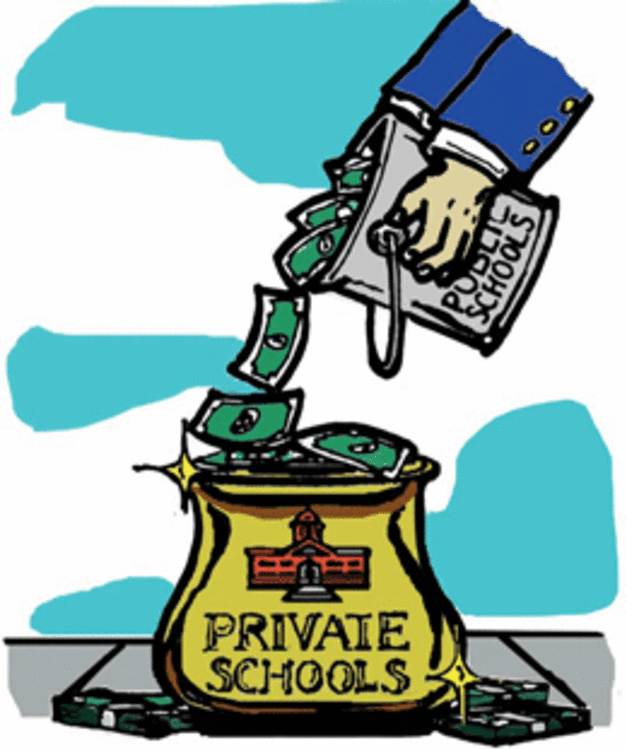
PUBLIC MONEY SHOULD GO TO PUBLIC SCHOOLS

D for effort

Republicans in the Indiana General Assembly continue to vote to raise the amount the state pays students to go to religious and other private schools...with money diverted from public schools.

From School Matters
Indiana gets a D for effort when it comes to funding public education. Keep that in mind when legislators say there’s not enough money to give schools what they need.

The rating comes from the latest “Making the Grade” report, an annual evaluation of state school funding by the Education Law Center, a New Jersey-based research organization that advocates for equitable funding. Indiana does slightly better, earning a C, for school funding adequacy and fairness.

SCHOOL COUNSELORS NEEDED

School counselors are essential, so let's treat them that way

Here's something that Indiana should spend public tax dollars on instead of diverting money to private and religious schools.

From the Fort Wayne Journal Gazette**
The 2024-25 Indiana School Counselor Survey paints a grim picture of a profession stretched far too thin. Counselors are overburdened, under-resourced, and struggling to meet their students’ growing mental health and academic needs.

Social-emotional challenges among Indiana students remain at critically high levels, with more than half of counselors reporting an increase over the past year. These issues, many of them lingering from the pandemic, are compounded by mounting academic pressures, career readiness hurdles, and a deluge of administrative tasks. Counselors are drowning in paperwork instead of sitting across from the students who need them most. The state’s student-to-counselor ratio is 351-to-1 and is well above the nationally recommended 250-to-1. This is a massive barrier to effective support.
**Note: The Fort Wayne Journal Gazette is behind a paywall. Digital access, home delivery, or both are available with a subscription. Staying informed is essential; one way to do that is to support your local newspaper. For subscription information, go to fortwayne.com/subscriptions/ [NOTE: NEIFPE has no financial ties to the Fort Wayne Journal Gazette]

Note: NEIFPE's In Case You Missed It is posted by the end of the day every Monday except after holiday weekends or as otherwise noted.

###

Monday, December 11, 2023

In Case You Missed It – December 11, 2023

Here are links to last week's articles receiving the most attention on NEIFPE's social media accounts. Keep up with what's going on, what's being discussed, and what's happening with public education.

Be sure to enter your email address in the Follow Us By Email box in the right-hand column of our blog page to be informed when our blog posts are published.
QUOTE OF THE WEEK

"Private schools cannot be counted on to protect students’ civil rights...Private schools are always selective. They can select the students they prefer and push out students whose behavior or academic problems challenge staff. Many of the schools created as segregation academies continue to discriminate by race as do many private schools created more recently. Private schools can keep out students whose sexual orientation or gender identity violates the school’s religious preference. Unlike public schools which are required by the Individuals with Disability Education Act to provide services that accommodate the needs of each child, private schools can choose whether to provide appropriate programs and specially trained teachers. Sometimes the schools promise special services but fail to provide qualified staff." -- Jan Resseger in Public Schools: Our Essential Democratic Institution

PUBLIC SCHOOLS: ESSENTIAL TO DEMOCRACY

Public Schools: Our Essential Democratic Institution

Public schools are essential to our democracy. What kind of nation do we want?

From Jan Resseger
For generations, public schooling has been our society’s largest and most widespread civic institution. Back in 1992 when The Good Society was published, Bellah and his colleagues could not have anticipated the widespread expansion of educational individualism in the form private school vouchers state governments are supporting today, but they did notice our society’s ethos of radical individualism as a threat to our essential institutions: “Freedom, for most Americans, is an essential ingredient to a definition of a good society, and one we affirm… But in the great society of today, freedom cannot mean simply getting away from other people. Freedom must exist within and be guaranteed by institutions, and must include the right to participate in the economic and political decisions that affect our lived idea of a good society.” (The Good Society, p. 9)

Most of us who oppose today’s explosion of bills across the states to establish or expand private school tuition vouchers are skilled enough to argue accurately about the practical detriments of private school tuition vouchers as they drive money out of states’ public school budgets. We have learned that today in most states, the students taking the vouchers are already enrolled in a private school and only using the money to discount the tuition their parents are already paying. Researchers have also documented conclusively that on the whole, students lose ground academically when they leave public schools and carry a voucher to a private school. (Chris Lubienski, T. Jameson Brewer, and Joel Malin, “Bait and Switch,” The School Voucher Illusion, pp. 127-147), and (Josh Cowen.) We know that vouchers divert tax dollars away from small towns and rural areas where the population is too small to support any private schools. And we know that many privatized schools fail to provide programming for English learners and special needs students, leaving behind the most expensive students to educate in the public schools.

PLAY IS CHILDREN'S WORK

Is Too Little Play Hurting Our Kids?

This fascinating article on children's mental health is a transcript from the Scientific American podcast, Science, Quickly.

From Scientific American
[Joseph] Polidoro: In the September issue of the Journal of Pediatrics, [Peter] Gray and his co-authors observed a continuous increase in depression, anxiety and suicide rates among children and adolescents since at least 1960. And they link it to a decline in unsupervised play and other independent activities.

[Peter] Gray: Play is how children pursue what’s fun for them. That’s an immediate source of mental health—part of mental health really means “I’m happy” or “I’m most satisfied with my life right now.”

Polidoro: Gray says that play and other independent activities also have far-reaching long-term effects on children’s mental health and resilience.

Gray: I think that the real crisis is that young people are losing a sense of, “I can solve problems, I can deal with bumps in the road of life.” And the way the children learn to do these things is through play where they are responsible to solve their own problems. They negotiate with their peers. They figure out how to solve quarrels among themselves. If somebody gets hurt, they figure out what to do about being hurt.

CARNEGIE UNIT UNDER FIRE

John Thompson: The Carnegie Unit in the Line of Fire

"Given the failed track record of the disruptive change, as well as Petrilli’s advocacy for it, we need to pay attention when he goes on record saying that the under-reported story of ‘multiple pathways—via multiple diplomas' could create 'multiple pitfalls.'"

From Diane Ravitch
John Thompson, historian and retired teacher in Oklahoma, noticed that the Carnegie Unit is under fire. Do you know what a Carnegie Unit is? It’s a measure of time spent learning a subject. Here’s the definition on the website of the Carnegie Foundation for the Advancement of Teaching:

The unit was developed in 1906 as a measure of the amount of time a student has studied a subject. For example, a total of 120 hours in one subject—meeting 4 or 5 times a week for 40 to 60 minutes, for 36 to 40 weeks each year—earns the student one “unit” of high school credit. Fourteen units were deemed to constitute the minimum amount of preparation that could be interpreted as “four years of academic or high school preparation.”

Why is this controversial?

FWCS TEACHER HONOR ROLL

Teacher Honor Roll: FWCS educator collaborates to find best plan for students

Focus on FWCS teacher, Nicole Block.

From the Fort Wayne Journal Gazette**
Why did you become a teacher? I volunteered at my son’s elementary school and his second grade teacher, who later became my best friend and mentor, encouraged me to pursue teaching. As a volunteer, I directly saw the impact teachers have on children and I was inspired to do the same. My family and I relocated to Fort Wayne, I enrolled in a master’s program in special education, and I met (Snider Principal) Chad Hissong at Purdue’s Educator Career Fair. I have never looked back.

**Note: The Fort Wayne Journal Gazette is behind a paywall. Digital access, home delivery, or both are available with a subscription. Staying informed is essential; one way to do that is to support your local newspaper. For subscription information, go to fortwayne.com/subscriptions/ [NOTE: NEIFPE has no financial ties to the Fort Wayne Journal Gazette]

Note: NEIFPE's In Case You Missed It is posted by the end of the day every Monday except after holiday weekends or as otherwise noted.

###

Monday, October 16, 2023

In Case You Missed It – October 16, 2023

Here are links to last week's articles receiving the most attention on NEIFPE's social media accounts. Keep up with what's going on, what's being discussed, and what's happening with public education.

Be sure to enter your email address in the Follow Us By Email box in the right-hand column of our blog page to be informed when our blog posts are published.

QUOTE OF THE WEEK

"In our society, teaching is not a high status position. It used to be considered women’s work, probably still is by many people. How wonderful it would be if we had fully transcended the cruelty of the old joke: “Those who can, do; those who can’t, teach; those who can’t teach, teach gym.” But we haven’t. I regularly hear legislators in my state explaining that if someone who knew what he was doing were put in charge, teachers would be forced to improve test scores immediately. The implication, of course, is that teaching is simply a matter of the production of test scores, and teachers don’t produce.

"The tragedy of this kind of thinking is that the same teachers whom people attack and insult are the human beings to whom we trust the formation of our children. The opinion polls tell us that we handle this contradiction by learning to know, respect, and appreciate our own child’s teacher even as we fail to protest the barrage of attacks on teachers in general." -- Jan Resseger in Sylvia Allegretto Documents Large and Persistent Teacher Pay Penalty

TEACHERS' PAY PENALTY GROWS

Sylvia Allegretto Documents Large and Persistent Teacher Pay Penalty

Why is it okay to pay teachers less than other professionals with similar training? Is it because most teachers are women? Is it because we don't really care about our children after all?

From Jan Resseger
In the introduction to her annual report on the teacher pay penalty, published last week by the Economic Policy Institute (EPI) and the Center for Economic and Policy Research, Sylvia Allegretto acknowledges the challenges teachers face: “Teachers have one of the most consequential jobs in the country—they have the future of the U.S. in front of them every day. But teaching is becoming a less appealing career choice for new college graduates. Not only are levels of compensation low, but teaching is becoming increasingly stressful as teachers are forced to navigate battles over curriculum and COVID-19 related mandates as well as rising incidence of violence in schools. Low pay makes recruiting and retaining highly qualified teachers difficult.

Here are Allegretto’s conclusions about the trend in teachers’ wages and compensation through 2022:
  • “The pay penalty for teachers—the gap between the weekly wages of teachers and college graduates working in other professions—grew to a record 26.4% in 2022, a significant increase from 6.1% in 1996.
  • “Although teachers tend to receive better benefits packages than other professionals do, this advantage is not large enough to offset the growing wage penalty for teachers.
  • “On average, teachers earned 73.6 cents for every dollar that other professionals made in 2022. This is much less than the 93.9 cents on the dollar they made in 1996.”
Allegretto explains: “Because public school teachers must attain at least a bachelor’s degree to teach in the U.S., this research compares teachers with college graduates working in other professions… Over the past two decades, the weekly wages and total compensation of public school teachers have fallen further and further behind… Recent high inflation has significantly reduced the average weekly wages of teachers but has had less of an effect on other college graduates… The erosion of relative weekly wages for teachers continued apace in 2022.” “Teachers generally receive a higher share of their total compensation as benefits than other professionals do, partially offsetting the weekly wage penalty.” But, “the benefits advantage for teachers has not been enough to offset the growing wage penalty.”
SUPPORT PUBLIC EDUCATION

The Plot to Take Down Public Schools

From Diane Ravitch
Recently the Network for Public Education and the Education Law Center sponsored a zoom conversation with Nick Surgey. Nick is an experienced investigative journalist who works with an organization called Documented, which digs into the Dark Money groups undermining Public schools and other democratic institutions. Nick has done the legwork that identified the money and people behind the home schooling movement, as well as the rightwing Alliance for Defending Freedom. He has worked with the Center for Media and Democracy and other pro-democracy organizations.

This is a discussion you should definitely tune into.

INDIANA AND FORT WAYNE LOCAL NEWS

Five of our articles this week come from the Fort Wayne Journal Gazette. Please consider subscribing to this important local source of news and information. Remember "all politics is local," and education is funded through politics. See the link at the end of this post.

FWCS referendum will help in coping with school — and life

FWCS works to help students cope with mental health issues.

From the Fort Wayne Journal Gazette
On Oct. 7, The Journal Gazette’s editorial board questioned the need for Fort Wayne Community Schools’ safety and well-being referendum on the Nov. 7 ballot, asking the question: “Should schools go even deeper into providing for student mental health and wellness?”

The answer from the SAFER FWCS Political Action Committee is simple:

If not us, then who?

The most recent Indiana KIDS COUNT data from the Indiana Youth Institute paints a bleak picture. In 2021, more than 1 in 4 high school students reported having seriously considered attempting suicide, and nearly half of all high school students reported being sad or feeling hopeless every day for at least two weeks.

These statistics are not surprising to educators, who saw a significant decline in student mental health during and after the COVID-19 pandemic. The same report showed teachers at 62% of schools tried to increase student knowledge on suicide prevention in a required course in grades 6-12. That is up from fewer than 20% of schools doing so in 2012.

Should schools be responsible for solving this mental health crisis? Maybe not, but Fort Wayne Community Schools has never been a district to throw up its hands and say, “It’s not our fault. There is nothing we can do. Someone else needs to fix it.”

FWCS is already seeing what its plan can do in a pilot at South Side High School.

In voting to put the referendum on the ballot, the FWCS Board of School Trustees sent a message: Not on our watch. FWCS will not stand by when there are steps that can be taken inside schools to create an even safer learning environment.

New Indiana law stokes worries for LGBTQ+ students

The new laws affecting LGBTQ+ students impact the daily lives of real people.

From the Fort Wayne Journal Gazette
Snider High School’s gay-straight alliance no longer takes attendance or maintains a membership roster, and participants are mindful about what’s visible to their faculty advisers during the club’s weekly one-hour meetings.

Known as the Rainbow Connection, the group wants to reduce the risk of teachers seeing members’ deadnames – names used before a gender transition – because of state legislation that took effect July 1. It requires school districts to notify a student’s parent or guardian if the student requests a name or pronoun change.

The new rule interferes with Rainbow Connection’s priority of keeping members safe and letting them be true to themselves, participants say. Students might have parents who are unsupportive or could potentially endanger them for not being cisgender – a term meaning not transgender – or straight, said Phoenix Bodner, co-president.

“Adjusting to it when the school year started actually delayed Rainbow Connection’s opening by a couple weeks because we needed to find a way to work around the fact that it posed a serious risk to the safety and security of our members,” Bodner said by email.

Critics, including the American Civil Liberties Union of Indiana and the Indiana Educational Equity Coalition, raised such concerns when legislators proposed the bill. It also prohibits schools from teaching human sexuality before fourth grade.
South Side sees success with piloted Safer FWCS initiatives

From the Fort Wayne Journal Gazette
The South Side High School that student Olivia Soto attends as a senior is different from the South Side that welcomed her as a freshman.

The atmosphere has transformed from a place where students would walk through hallways with their heads down – phones out and earbuds in – to a vibrant school where teens smile, wave and high-five others.

“You feel seen and present at the school,” Soto told the Fort Wayne Community Schools board Monday during a presentation about safety updates. “You’re not just there to learn. You’re there making connections, and you’re in this community at South Side.”

Although the safety presentation included districtwide information, South Side received much of the focus because it is piloting elements that FWCS would like to expand to other schools with referendum funding.

Enrollment growth prompts Northwest Allen County Schools to eye redistricting

From the Fort Wayne Journal Gazette
Enrollment growth in Northwest Allen County Schools this fall exceeded a demographer’s forecast by about 35%, and a surge in elementary students has prompted the district to reexamine its attendance areas.

Superintendent Wayne Barker stressed to the school board Monday that the overall 2.7% enrollment increase – an addition of 217 students – is positive, especially considering many Indiana districts are experiencing declining enrollment.

“This is a good thing for Northwest Allen County Schools,” he said.

FWCS proposal would boost teacher pay, including starting salary

FWCS has the lowest starting teacher salaries in the county. Increases would put the largest school system in the county in line with the others.

From the Fort Wayne Journal Gazette
A tentative two-year teachers contract would increase Fort Wayne Community Schools’ starting salary to $46,627 – making the district more competitive with its Allen County neighbors.

As proposed, the salary schedule will increase by 3% this academic year and 1% next year. But depending on how educators progress on the salary schedule – which considers performance and education levels – their pay could increase between 5.8% and 9.9% over two years.

The school board discussed these and other details Monday, two weeks before the elected leaders are expected to ratify the contract.

“I’m happy to pay them every penny we can,” board member Steve Corona said.
October is ADHD Awareness Month. Click for a link to the ADHD Awareness website.

**Note: The Fort Wayne Journal Gazette is behind a paywall. Digital access, home delivery, or both are available with a subscription. Staying informed is essential; one way to do that is to support your local newspaper. For subscription information, go to fortwayne.com/subscriptions/ [NOTE: NEIFPE has no financial ties to the Fort Wayne Journal Gazette]

Note: NEIFPE's In Case You Missed It is posted by the end of the day every Monday except after holiday weekends or as otherwise noted.

###

Monday, May 1, 2023

In Case You Missed It – May 1, 2023

Here are links to last week's articles receiving the most attention on NEIFPE's social media accounts. Keep up with what's going on, what's being discussed, and what's happening with public education.

Be sure to enter your email address in the Follow Us By Email box in the right-hand column of our blog page to be informed when our blog posts are published.
QUOTE OF THE WEEK

“[No Child Left Behind] will test the poor against the rich and then announce that the poor are failing. Federally required tests without federally required equity amounts to clubbing these children over the head after systematically cheating them.” -- the late Minnesota Senator Paul Wellstone quoted in The Education Myth and by Jan Resseger.

END TESTING WASTE

It's Testing Damn Season Again

Yes. States are still wasting hours of instructional time and millions of dollars on useless standardized tests which continue to be used to punish poor children and their teachers. Peter Greene is tired of it.

From Curmudgucation
Do you want extra education time to make up for Learning Loss, or to simply expand educational offerings and opportunities for students? Get rid of the state test.

Do you want to claw back some financial savings and reclaim taxpayer dollars for more educational supports? Get rid of the state test.

Do you want to refocus schools on meeting students needs for education and support instead of focusing on getting the students to provide the test scores the school needs? Do you want to focus on the whole child instead of the test-taking child? Get rid of the state test.

This is such a waste. A waste of time, resources, attention, money and teachers' professional expertise. A bad idea poorly executed. End it.

REMEMBER FAILED REFORM

We Need to Be Sure People Don’t Forget the Recent History of Failed School Reform

The recent culture wars against public education shouldn't keep us from remembering the failure of the last several decades of school "reform."

From Jan Resseger
I was stunned when early in April, the PBS NewHour brought in Margaret Spellings and Arnie Duncan to explain the meaning of a “Learning Heroes” survey showing that while parents think their children are doing fine in school and recovering from the disruption of Covid, standardized test scores show that our kids aren’t doing so well at all.

Nancy Bailey exposes the likely bias of Learning Heroes, a “campaign” funded by the Gates Foundation, Bloomberg Philanthropies and other foundations supporting corporate-style, test-and-punish school reform. Couldn’t this be another attempt to expose so-called “failing schools”?

I suspect that several of us wrote to the PBS NewsHour to challenge the bias of the “experts” they brought in to comment on education policy. I was especially grateful when Diane Ravitch captured the problem in her letter to the NewsHour: “Spellings and Duncan spent years promoting failed policies and are now called upon by PBS to comment on the outcomes of their punitive and ineffective ideas. They are in no position to say where we went wrong, because they were the architects of the disaster. You really should invite dispassionate experts to review their record, rather than invite those who imposed bad ideas.”

INDIANA EMBRACES CENSORSHIP

Book challenge, 'harmful material' language passed in unrelated bill

There was no doubt that Indiana would join in the culture wars against public education sweeping US red states. We are already on board with denying parents the right to decide on their children's medical care.

Now the state has a book-banning bill on deck...because of the huge amount of imaginary pornography in our public schools.

What's the procedure for killing public education and driving educators out of Indiana? The answer is clear to the Republican super-majority in both of Indiana's legislative houses.

From the Fort Wayne Journal Gazette**
Proposed legislation targeting “harmful material” in school libraries appeared to stall several times this session, but Indiana lawmakers revived the language and passed it Thursday in an unrelated bill.

A conference committee added the language to House Bill 1447, which addresses other education issues, including surveys for students. It passed mostly along party lines in both Republican-held chambers.

The bill now would require schools to publish a catalog of books and create procedures for parents or community members to challenge library books that might be obscene or harmful to minors. It would also remove the legal defense that a person provided harmful material to a minor for educational purposes.

Democrats and other critics of the bill say it will have a chilling effect on teachers and librarians.

INDIANA LEGISLATORS GO AFTER TEACHERS UNIONS

“Union busting” bill opposed by Indiana teachers heads to governor’s desk

Somehow the Republican super-majority thinks that not requiring discussion between teachers and administrators will lead to an increased discussion between teachers and administrators.

This is a state that truly hates its public schools and public school educators

From the Indiana Capital Chronicle
Despite weeks of rallying by Hoosier teachers, the Indiana Senate narrowly advanced a hotly-debated “union-busting bill” to the governor’s desk Tuesday.

Educators and union leaders maintain that Senate Bill 486 will “silence teachers” by stripping their rights to discuss concerns over student learning with school administrators.

Specifically, the bill no longer requires school administrators to discuss topics like class sizes, curriculum and student discipline with teachers and their union. State law in place now has required such discussions for the last 50 years.

The bill was approved in a 27-23 vote after more than an hour of debate on the chamber floor. It’s not clear where Gov. Eric Holcomb stands on the issue.

Republican lawmakers in favor of the proposal have said it’s a “deregulation bill” that will empower administrators and educators. They argued the changes will ensure discussions about working conditions are more open to non-union teachers and are not limited to the 16 topics in state law.
INCREASED FUNDING

Chaotic, twelfth-hour push nets $312M increase for traditional K-12

After expanding funding for religious and private schools, Indiana's Republican super-majority was shamed into increasing funding for public schools as well -- a portion of which will also go to religious and private schools.

From the Indiana Capital Chronicle
Late Thursday, legislative leaders announced a last-minute change to the budget, however, in an effort to ease backlash. Multiple lawmakers were also reportedly unhappy to learn that their school districts received so little money after the voucher expansion.

Now, those per-student funding increases have improved somewhat to 5.3% in the first year, and then to 1.8% the next. With the change, schools will see $8.84 billion for tuition support in fiscal year 2024, and $9.03 billion in fiscal year 2025.

That’s $312.1 million more over the biennium — an additional $148 million in year one of the budget, and $164 million the second — compared to the earlier draft of the budget. Since vouchers get a portion of this funding, their spending also increased.

At his own local schools in Fort Wayne, House Minority Leader Phil GiaQuinta said school funding increased by 1.6% the first year and actually decreased by 0.6% in the second year.

“Last week, we find out we have $1.5 billion extra and my school district is losing money. Even with the additional funds (the second year is) negative 0.4%,” GiaQuinta said. “There’s no doubt that played a part into some of the last-minute scrambling over extra dollars.”

FED GRANT FOR FWCS

$10 million grant to benefit Fort Wayne Community Schools mental health services

From the Fort Wayne Journal Gazette**
Fort Wayne Community Schools is getting a nearly $10 million federal grant to boost mental health services.

“This is huge,” board member Steve Corona said Monday to Regan Fry, project director for the competitive grant. “Why didn’t you bring Champagne?”

The board unanimously approved acceptance of the five-year U.S. Department of Education grant, which will expand mental health capacity in 16 secondary schools that collectively serve about 15,000 students.

“That’s where we lack the most mental health support,” Fry said.

An increase of 60 FWCS mental health providers during the next five years would reduce the ratio of mental health providers for middle and high school students from 1 to 2,933 to 1 to 244, according to the grant award description released by the federal government.
**Note: The Fort Wayne Journal Gazette is behind a paywall. Digital access, home delivery, or both are available with a subscription. Staying informed is important, and one way to do that is to support your local newspaper. For subscription information, go to fortwayne.com/subscriptions/ [NOTE: NEIFPE has no financial ties to the Fort Wayne Journal Gazette]

Note: NEIFPE's In Case You Missed It is posted by the end of the day every Monday except after holiday weekends or as otherwise noted.

###

Monday, December 12, 2022

In Case You Missed It – December 12, 2022

Here are links to last week's articles receiving the most attention on NEIFPE's social media accounts. Keep up with what's going on, what's being discussed, and what's happening with public education.

Be sure to enter your email address in the Follow Us By Email box in the right-hand column to be informed when our blog posts are published.
THIS WEEK

Our children and our public education systems are being hurt by bad policies.

DOING DAMAGE TO OUR CHILDREN

The Impact of Active Shooter Drills in Schools

Active shooter drills are hurting our children. We're hurting them by trying to teach them how to avoid being killed by weapons that have no business being on the street. Instead of taking bold action against the easy availability of weapons of war, we're traumatizing our children.

From Everytown
...Active shooter drills in schools are associated with increases in depression (39%), stress and anxiety (42%), and physiological health problems (23%) overall, including children from as young as five years old up to high schoolers, their parents, and teachers. Concerns over death increased by 22 percent, with words like blood, pain, clinics, and pills becoming a consistent feature of social media posts in school communities in the 90 days after a school drill. These findings unveil even more reason to pause before rushing toward active shooter drills as a potential solution to school violence, as evidence suggests that they are causing lasting emotional and physical harm to students, teachers, and the larger community.

PUBLIC ED ON GOP HIT LIST

Why Public Schools Are On the GOP’s Hit List

This is certainly true in Indiana. For the last decade, the Republican supermajority in the General Assembly has targeted public schools. Vouchers and charter schools have drained money from public education. Punitive testing and union-busting actions have driven teachers from the classroom. Privatization is the goal. The complete destruction of public education seems to be the plan.

By Thom Hartman in The Hartman Report [bold in original]
So why would Pompeo, pursuing the 2024 Republican nomination for president, risk triggering an American domestic terrorist to train his sites on [Randi Weingarten, President of AFT]? Why would an educated man have such antipathy toward public school teachers?

Public schools are on the GOP’s hit list, just as they were in Chile during the Pinochet regime, and for the same reasons:

— Fascism flourishes when people are ignorant.

— Private for-profit schools are an efficient way to transfer billions from tax revenues into the coffers of “education entrepreneurs” who then recycle that money into Republican political campaigns (just like they’ve done with private for-profit prisons).

— Private schools are most likely to be segregated by race and class, which appeals to the bigoted base of the Republican party.

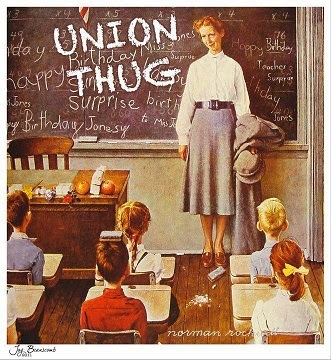
— Most public school teachers are unionized, and the GOP hates unions.

— While public school boards are our most basic and vigorous form of democracy, private schools are generally unaccountable to the public.

— Whitewashing America’s racial and genocidal history while ignoring the struggles of women and queer folk further empowers straight white male supremacy.

— Nothing inspires fear and terror in the minds of parents than a threat to their children, and the GOP — being totally committed to enriching the rich and impoverishing everybody else — has nothing else to sell than fear and hate to win elections. (See item #1: fascism.)

PUBLIC ED AND CULTURE WARS

The Culture War on Public Education

Blogger Peter Greene explains the danger and harm to our schools and our children by ”culture wars.”

From Peter Greene in The Progressive
It seems like ages since so many of us suddenly had to take a crash course in critical race theory (CRT). Then, seemingly five minutes later, just as Christopher Rufo, a fellow at the conservative Manhattan Institute, had promised, the CRT panic broadened into the “culture wars,” fought on a dozen different fronts by educators: “Don’t say gay” laws, “anti-woke” legislation, calls to ban books, gag laws for teachers, and private rights of action, so that parents could sue schools any time they felt a line had been crossed.

Culture wars continue to flare, but we should be discussing their true victims.

OHIO LEGISLATURE WANTS TO CIRCUMVENT THE "WILL OF THE PEOPLE"

Opinion: Ohio lawmakers will 'circumvent the will of the people' with school board bill

Jeanne Melvin is a retired public school teacher who spent 39 years as a central Ohio educator. She is a founding member and president of Public Education Partners, an all-volunteer statewide coalition of parents, grassroots citizen groups, school board members, educators, and school administrators that advocate for high-quality public education in Ohio.

From the Opinion Page in the Columbus Dispatch
Written by guest columnist, Jeanne Melvin
Because of the state [Board of Education]’s influence, it’s very important to have members who are true advocates for public education.

Our elected state school board members serve the will of their constituents. They are not selected to serve at the pleasure of the governor's political party, which is no friend to public education.

INDIANA DOE TO LAUNCH NEW ED DASHBOARD

State prepares to launch new education dashboard

From the Fort Wayne Journal Gazette**
A new state education dashboard is set to launch “very soon,” Indiana Secretary of Education Katie Jenner said Tuesday.

The Indiana Graduates Prepared to Succeed (GPS) website – or at least the first version – is nearing completion and will be discussed during today’s State Board of Education meeting.

While Jenner did not provide an exact launch date during a virtual demonstration of the dashboard, she said it will happen in December “short of anything major happening.”

One of the major goals of the GPS dashboard’s design is to break down data in a way that makes the information accessible to people around the state. It includes year-by-year statistics on various metrics, including the percentage of eighth graders enrolled in the 21st Century Scholars program, the FAFSA completion rate and the median income of graduates, along with data from state assessments like ILEARN and IREAD-3.

The data can be broken down by school and by school district. It can also be viewed by demographic statewide or on a school-by-school basis.


**Note: The Fort Wayne Journal Gazette is behind a paywall. Digital access, home delivery, or both are available with a subscription. Staying informed is important, and one way to do that is to support your local newspaper. For subscription information, go to fortwayne.com/subscriptions/ [NOTE: NEIFPE has no financial ties to the Fort Wayne Journal Gazette]

Note: NEIFPE's In Case You Missed It is posted by the end of the day every Monday except after holiday weekends or as otherwise noted.

###