Showing posts with label Terry Springer. Show all posts

Tuesday, February 18, 2020

Presidents Day Rally, 2020

On Presidents Day, February 17, 2020, NEIFPE joined with the Indiana Coalition for Public Education (ICPE) and other public education advocacy groups in a Public Rally for Education at the statehouse in Indianapolis.

NEIFPE member Terry Springer posted her thoughts about the rally on Facebook.

L-R: NEIFPE member Terry Springer, State
Representative  Melanie Wright (D-35),
NEIFPE members Cindi Pastore and Meg Bloom
After nearly a decade of advocating for public education, I came home from yesterday's Red for Ed Rally energized, somewhat hopeful, but realistic about challenges ahead. Here are my takeaways from the rally:
  • Rather small turnout for this annual rally and no ISTA presence suggests the need for more coordination/collaboration among public education advocacy groups.
  • Fewer people but passion and energy still filled the room
  • Every one of us – parents, teachers, students – represented those who weren’t/couldn’t be there. I don’t think it’s a stretch to say that each one of us provided a voice for at least 10 teachers, students, parents, citizens who weren’t there.
  • Some hopeful signs this session in legislation on reducing regulations and holding schools and teachers harmless, making 15-hour internship optional, decoupling test scores from evaluations
  • Still key issues ignored: teacher pay, lack of accountability for money going to charters and voucher accepting schools, and now providing one more pathway to qualify for a voucher
  • Legislators continue to put private school students before public school students.  
  • Thought-provoking ideas from speakers:
◊ Jennifer McCormick: We are who we vote for.

◊ Emony Calloway shared her experience of being a student in two schools that were closed. “Students in the neighborhood who look like me are getting shifted around. We need schools that do not open and close on a whim.”

◊ Michelle Smith listed the terrible and often horrifying life experiences her students (ELL) have faced before coming to the U.S. and asserts that testing required of these kids has no value for them and getting the test results eight months later is of no value to her as their teacher. She also asserts that legislators ought to understand that she doesn’t need an externship to learn about reality. Her students bring reality to her classroom every day – something I think is true for all teachers.

◊ Phil Downs, Superintendent of SWACS: Funding for schools has not kept up with inflation and schools have less money than a decade ago; public schools have to account for all money they receive – every penny. The same should be true of voucher accepting and charter schools. They need to show how public dollars are used: Every. Single. Penny.

◊ Dr. Ramon Batts, of Concerned Clergy: Schools are a part of the fabric of society. Teachers deserve to get paid for what they do. "If all you wanted was money, you'd do something else."

◊ Gleneva Dunham, AFT, called for all of us to know the position on education for each candidate before we vote.

◊ Cathy Fuentes-Rowher, ICPE: despite some positive movement in the legislature, there has been a great deal of harm done: 85 million dollars flushed down the toilet in Virtual Charter Schools; closing schools and disrupting student learning and siphoning public money to private schools.
  • There is an irony in holding schools and teachers harmless because the harm was the result of the actions of legislators.
  • We all have to keep contacting legislators – educating them – about the effects of their decisions on our kids.
  • We need to force legislators to listen to the professionals and to treat educators as professionals.
  • There are 16 teachers running for election and two running for re-election. We need to learn who they are and vote.
To everyone who attended the Red for Ed Rally in November, your work is not done. You need to take action; get informed contact legislators; talk to everyone - family, friends, colleagues; and vote. Those of us who represented you yesterday cannot do this work without you.
###

Monday, December 2, 2019

In Case You Missed It – Dec 2, 2019

Here are links to last week's articles receiving the most attention in NEIFPE's social media. Keep up with what's going on, what's being discussed, and what's happening with public education.

Be sure to enter your email address in the Follow Us By Email box in the right-hand column to be informed when our blog posts are published.


WHO'S RESPONSIBLE?

Teachers Are Not Responsible for Student Growth or Achievement

While teachers are the most important in-school variable for student success in school, a variety of out-of-school factors can have a much greater impact on student achievement. Legislators should look at their role in those out of school factors.

From Gadfly on the Wall Blog
It doesn’t make that much difference whether you look at growth or achievement. If you’re holding teachers accountable for either, you’re expecting us to be able to do things beyond our powers as mere mortal human beings.

I hate to break it to you, but teachers are not magical.

We cannot MAKE things happen in student brains.

Nothing we say or do can cause a specific reaction inside a human mind.

That’s just not how learning and teaching works.

We can INFLUENCE learning.

We can try to create some kind of optimum condition that is most likely to spark learning.

But we cannot make it happen like turning on a switch or lighting a candle.


TRADING "FAILING" PUBLIC SCHOOLS FOR "FAILING" CHARTER SCHOOLS

Charter Schools USA finds support for charter applications as critics stay silent at public hearing

What IPS has done in the past (pairing up with charters/innovation) has come around to haunt them, and now these parents trust IPS even less than they trust a failing charter company. Very sad.

From Chalkbeat*
Howe, Manual, and Emma Donnan Middle School are expected to exit state takeover at the end of this school year. With that transition about six months away, the futures of the schools are still in limbo.

Monday’s hearing focused on whether the state charter board should grant approval for the schools to continue under the management of a group tied to Charter Schools USA, which would essentially cement their separation from Indianapolis Public Schools. The state charter board is expected to vote on the matter at a December 13 meeting.


NEW ORLEANS: THE COMPLETE CHARTER DISTRICT

New Orleans: Parents and Students at Two Low-Performing Charter Schools Fight to Keep Them Open

From Diane Ravitch
The subtext of this is that there a few charters that began early on that were controlled by black former OPSB teachers and administrators that were islands of local control (MLK in particular) in a white-dominated, outsider controlled charter system. These schools have struggled in part because they would not cherry-pick and force out challenging students (Treme in particular) and have always been resented by the NSNO (New Schools for New Orleans) people. They have also moved toward unionizing lately.

But it is a good example of how some charters build their own constituencies, even if they are failing, because they are perceived as more locally and black controlled. I imagine the school board will give them a pass just to avoid the conflict.

NEIFPE Members in Indy, November 19, 2019. L-R Cathy Fuentes-Rohwer (ICPE), Michelle Smith (ICPE),
Terry Springer (NEIFPE), Jennifer McCormick (Indiana Ed Superintendent), Donna Roof (NEIFPE),
Jenny Robinson (ICPE), Kay Maren (ICPE).

MORE ON INDIANA'S #RED FOR ED RALLY

Teachers' rally exceeds expectations

From the Fort Wayne Journal Gazette
Vicky Lomont, a former FWCS teacher who is now an EACS instructor, sat not far from Thiele. Lomont said she is frustrated with lawmakers, who for years have supported voucher systems while neglecting traditional public schools.

“I would like to see my representative listen to me, rather than his party,” Lomont said.

At the rally, Kathleen Cagle, a math teacher at New Tech Academy at Wayne High School, said testing has become an omnipresent force in schools.

“Every year, we're asked to do more and more and more, and none of it is to help the students,” she said.

NACS teacher Kristen Bowland arrived at the Capitol building around 8:30 a.m. Nov. 19.

“We felt like we were part of history,” she said. “It's worth the fight. I'm doing it for our kids.”


Red for Ed rallying cry: Kids deserve more

The last elected Indiana Superintendent of Public Instruction reminds us that we need to support our public schools through the ballot box. Every time you vote for the governor, a state representative, or a state senator you're voting on school issues. Support public education!

From Indiana Superintendent of Public Instruction, Jennifer McCormick in the Fort Wayne Journal Gazette
Kids deserve educators who take a stand against Indiana's disconnected education policy and the issue of inadequate funding. While many, including myself, have been champions for public education for decades, it took a red wave crashing into the Statehouse to finally catch the attention of the lawmakers inside. Frustrations regarding funding inequities, compensation shortfalls and policies void of practitioner input were vocalized by constituents from all 92 counties.

*Note: Financial sponsors of Chalkbeat include pro-privatization foundations and individuals such as EdChoice, Gates Family Foundation, The Walton Family Foundation, and others.

###

Sunday, December 1, 2019

Lawmakers receive an education

This letter to the editor by NEIFPE co-founder Terry Springer appeared in the December 1, 2019 edition of the Fort Wayne Journal Gazette.

Lawmakers receive an education
The Nov. 19 Red for Ed Rally was an inspiring day. Motivated teachers, parents, administrators, retired teachers and students donned red and gathered at the Statehouse to express their frustration over the conditions the legislature has imposed on them and the children of Indiana.

To be clear to those who think teachers should not have left their classrooms and districts should not have closed, this rally has been a long time coming. It has taken nearly 10 years for the legislation inspired during Mitch Daniels' administration and enhanced during Mike Pence's and now Eric Holcomb's to create the conditions that finally led teachers to say enough is enough. Most teachers would rather be in class with their kids than standing outside for hours on a chilly November day.

Teachers don't rally and protest at the drop of a hat. It has taken nearly 10 years of the punitive system developed by the legislature to push teachers to the point that they pushed back. It has taken nearly 10 years for parents and the community to understand the destructive impact on their public schools and the negative impact on their children.

Public schools are struggling to provide the best education for all children. No matter how the governor and legislators extol the “historic” funding for education in Indiana in the latest budget, the spin does not accurately reflect how little relief it provides to replace the dollars communities around the state are losing because of vouchers or the millions spent on ineffective and harmful testing.

The conditions that inspired Red for Ed won't change unless we take action – everyone who went to Indianapolis, everyone who demonstrated in Fort Wayne, everyone who participated in a walk-in at a school, everyone who wore red on Tuesday in support of teachers and schools must keep the legislators' focus on education in Indiana.

We need to get informed and educate our legislators about the consequences of their lawmaking.

Terry Springer

Fort Wayne
###

Monday, April 1, 2019

In Case You Missed It – Apr 1, 2019

Here are links to last week's articles receiving the most attention in NEIFPE's social media. Keep up with what's going on, what's being discussed, and what's happening with public education.

Be sure to enter your email address in the Follow Us By Email box in the right-hand column to be informed when our blog posts are published.


VIRTUAL PRESCHOOL FOR N. CAROLINA

The latest ‘shockingly bad’ education idea in North Carolina

Upstart is already running in Indiana.

From the Answer Sheet
...It’s the latest shockingly bad idea out of North Carolina.

This week state legislators filed a bill which would create a three-year year pilot program to deliver pre-kindergarten education at home via computer to what it terms “at risk” children.

The program, called UpStart, would cost a mere $500,000 per year. It would be available to families living below the federal poverty line and children of active duty military personnel and would provide both Internet access at home to families that can’t afford it and technical support to help them operate the software...

I can’t believe I am actually writing these words, but the idea of having 4-year-olds going to preschool by looking at a computer in their home is horrendous...

VOUCHERS

Voucher myths

School Voucher Advocates Peddle Lots Of Myths. Six Of Them Are Debunked Here.

From Americans United
Voucher advocates rely on a number of fallacious arguments. Here are six of the most common ones debunked...

People who send their children to private schools are taxed twice, once to pay for public schools and once for the private school tuition they pay.
Private school tuition is not a tax; it’s an extra expense some people have chosen to bear. You don’t get a tax break because you’ve chosen to patronize a private provider for a service the government makes available. If that were the case, people could demand tax breaks because they buy books from Amazon and don't use the public library, because they built their own swimming pool and don’t go to the municipal one or because they own a car and don’t rely on mass transit. There are certain public services we are all expected to support, even if we don’t use them directly. An educated citizenry benefits us all. That’s why most of us pay taxes to support public schools, including people who don’t have children and people whose children are no longer in school...

Voucher school condemned

Muncie, Indiana: Voucher School for 6 Students Condemned, Deplorable Conditions

From Diane Ravitch
Fire and building inspectors condemned the Delaware Christian Academy after entering the building and finding its six students huddled around a heater for warmth. Betsy DeVos always says that parents always know best, but why did these parents send their children to school in an unsafe building?

”Fire and building inspectors say they found six students at the private Delaware Christian Academy “huddled around a kerosene heater in blankets trying to stay warm” one morning last week.

“Authorities ordered the building — the former Riley Elementary School on North Walnut Street — to be vacated. The children’s teacher took them home.

“Meanwhile, the city building commissioner on Wednesday condemned the structure, finding it unsafe for occupancy.


BETSY DEVOS

DeVos is the worst of a bad lot.

The miseducation of Betsy DeVos, the Cabinet's worst

From the Fort Wayne Journal Gazette
Picking on the Special Olympics is minor stuff for DeVos. She's an education hobbyist. Neither she nor her children ever attended a public school, but this doesn't stop DeVos from thinking she knows the answers. She's a longtime advocate of taking taxpayer money out of the public system to support charter and religious schools.

But it's when it comes to college that DeVos really earns her dubious honor. Helping students who racked up tens of thousands of dollars in student loans attending for-profit colleges that lured them in with phony come-ons and job placement statistics?

Not on DeVos' watch. The Education Department stalled rules intended to make it easier for these people to receive relief...

DeVos wants to allow discrimination

DeVos, testifying before Congress, refuses to say whether schools should be allowed to discriminate on basis of sexual orientation or gender identity

From the Answer Sheet
Education Secretary Betsy DeVos was asked repeatedly Tuesday by a member of Congress whether she believes schools should be allowed to discriminate against students based on their sexual orientation or gender identity. She did not directly answer.

DeVos and her bad record.

Betsy DeVos and her No Good, Very Bad Record on Public Education

From Education Votes
As President Donald Trump’s secretary of education, Betsy DeVos has worked to subvert public education. She has promoted the privatization of public schools through vouchers, called for deep cuts to federal funding, rolled back protections for vulnerable children, and shilled for the for-profit college industry that has defrauded countless students.

SCHOOL FUNDING

IPS set to lose millions because of pro-privatizer legislation.

IPS sees ‘tremendous market’ for Broad Ripple. First, it needs changes to the law.

“When worlds collide” -- Hoosier legislators would have to give up their 1 dollar give-aways to charter schools in order to serve the business community. Meanwhile IPS students and public schools lose.

From Chalkbeat
Indianapolis Public Schools offered a comprehensive analysis Tuesday, showing strong demand for housing, retail, and office development on the 16-acre site of the closed Broad Ripple High School. But before the district can sell the property on the open market — instead of offering it up to a charter school — it needs the support of state lawmakers.

The future of the Broad Ripple campus has been in limbo for more than a year. That’s when the Indianapolis Public Schools board voted to close that high school and two others because of low district enrollment. The building, which is situated in a thriving and rapidly developing area, is one of the district’s most valuable assets and leaders see it as a potential source of revenue for the cash-strapped school system.

At the time it closed the schools, Indianapolis Public Schools estimated the value of Broad Ripple at $6 million to $8 million, but a district official said that it is based on old analysis and it could fetch more.

The district’s options for selling the property, however, are limited by a state law that requires school districts to make vacant buildings available to charter schools for $1. In order to sell the building to a private buyer, the district would need legislators to amend that law.


Legislature has failed to fund public schools

Time to end public-school funding games

From NEIFPE member Terry Springer
For a decade, legislators have pulled out support for public education. Legislators have failed to fund public schools adequately. They have taken more and more money from the education coffer for vouchers and thus funded religious education with public dollars. They favor private and parochial parents with tax credits not given to public school parents and fail to require transparency of private, parochial schools. They require public schools to do more with fewer resources. They promote privatization though evidence shows for-profit charters and virtual schools fail students and fail as businesses.

As bills in the 2019 session move from committees to the full House and Senate, legislators continue to remove the blocks from the public education tower

Legislature fails schools.

Lakeland School Corp. votes to close 2 elementary schools

From WANE.com
The Lakeland School Corporation will be going from five schools to three, closing down two elementary school sat the end of this year. The school board voted Monday 4-2 in favor of closing the schools.

There is currently one high school, one middle school, and three elementary schools in the district. With declining enrollment, Lakeland leadership said they are expecting an operating loss of nearly $700,000 this year and $900,000 next year. The three-school proposal would save them $1.28 million by the end of 2020. Most of that savings will come from cutting staff.

"CHOICE" DOESN'T YIELD POSITIVE RESULTS

Bad week for ‘school choice’

From School Matters
Last week was a bad one for the claim that school choice can cure whatever ails education in Indiana. Choice doesn’t always lead to good outcomes.

Start with the story of Delaware Christian Academy in Muncie. Although the school has received $1.3 million in state voucher funding over five years, enrollment dwindled to six students. The building was condemned after an inspector found students “huddled around a kerosene heater in blankets.”

Then look to Indianapolis Lighthouse East...

STORIES ABOUT CHARTERS

Politics

Beto O’Rourke’s Wife Works for an Organization that Brings Charter Schools to El Paso

From Diane Ravitch
I was an enthusiastic supporter of Beto O’Rourke when he ran against Ted Cruz. I regularly sent him checks of $50, $100. I would have loved to see Beto beat Cruz. I heard that Beto’s wife Amy was connected to the charter school movement but decided that was less important than beating Cruz.

Now that Beto is running for President, it matters more. I don’t want another Democratic President pushing privatization of public schools and public money.

i won’t support any candidate who supports charters and/or vouchers...


Charter waste and fraud

Report: The Department Of Education Has Spent $1 Billion On Charter School Waste And Fraud

From Peter Greene (Curmudgucation) in Forbes
In 1994, the Charter School Fund was added to the Elementary and Secondary Education Act (ESEA); in 1995 it began dispersing federal funds to states so that states could use the money to pilot charter schools. Since then, the CSP has handed over about $4 billion to support charter schools, and there are supposed to be some federal guidelines attached to the process. But a new report from the Network for Public Education charges that roughly $1 billion of that has been lost to fraud and waste in the charter school sector. Findings of the report were brought to the attention of Secretary of Education Betsy DeVos during this week's hearings; her responses were not encouraging.

Report: U.S. government wasted up to $1 billion on charter schools and still fails to adequately monitor grants

Also: see Diane RavitchBombshell Report: Congress Wastes Nearly $1 Billion on Defunct Charter Schools

From the Answer Sheet
The U.S. government has wasted up to $1 billion on charter schools that never opened, or opened and then closed because of mismanagement and other reasons, according to a report from an education advocacy group. The study also says the U.S. Education Department does not adequately monitor how its grant money is spent.

The report, titled “Asleep at the Wheel” and issued by the nonprofit advocacy group Network for Public Education, says:

• More than 1,000 grants were given to schools that never opened, or later closed because of mismanagement, poor performance, lack of enrollment or fraud. “Of the schools awarded grants directly from the department between 2009 and 2016, nearly one in four either never opened or shut its doors,” it says...

Charter teacher's salary a "vow of poverty"

This Indianapolis teacher said he shouldn’t have to take a ‘vow of poverty’ to stay in the classroom

Even the charter teachers are bailing. Did this teacher not understand that part of the reason teachers are paid so poorly is because our legislators would rather divert funds to charters and vouchers than fully fund public schools which accept all students? You can not split up the pot 3 ways and serve children or pay teachers well. Voters must make our legislators understand this simple math.

From Chalkbeat
His teacher’s salary was already stretched precariously thin to pay rent when Andrew Pillow learned that his school was setting a pencil quota to save money: only one box of pencils per quarter.

But pencils were always disappearing. Pillow, who teaches at KIPP Indy College Prep Middle School in Indianapolis, found himself taking twice-weekly trips to the store to buy enough pencils for his students. Where on earth were they going?

Well, he eventually found out — but not before experiencing the utter humiliation of not having enough money to pay his share of the bill on a first date.

It’s funny now, Pillow said, but then … Not so much. Teachers shouldn’t have to take a vow of poverty to stay in their careers, he said.

Charters on the defensive

Indiana virtual schools granted extra time to defend themselves against troubling allegations

All this mess created by Hoosier legislators! Time to stop using our tax dollars on charters!

From Chalkbeat
The authorizer of two virtual schools accused of mismanaging state tests, student enrollment, and special education services voted Monday night to give the schools more time to defend themselves — even after they missed a key deadline for submitting a written explanation.

The Daleville public school board, the authorizer for Indiana Virtual School and Indiana Virtual Pathways Academy, voted unanimously to push back the public hearing about whether the schools’ charters should be revoked, which could lead to their closure.


Taxpayers still paying for closed charters

Philadelphia: It Takes Years and Millions to Close Failing Charter Schools and the Public Pays for Everything

From Diane Ravitch
Lisa Haver, Parent Activist in Philadelphia, writes here about how it takes years and millions of dollars to close failing charter schools. The public must pay the cost of challenging the charter and pay the cost of defending the charter. The charter operator gets a free ride for failing. Only the taxpayers and students lose.

Why is it easy to close a public school but hard to close a charter school? One guess: charter lobbyists wrote the state law.

Ohio charters fail, and then ask for more money.

Dyer: Ohio’s Failing Charter Sector Wants a 22% Funding Increase

From Diane Ravitch
In Ohio, most charter schools are graded either D or F by the state. This very low-performing sector costs Ohio taxpayers nearly $1 Billion per year.

Now the charters want a 22% increase in funding.

Stephen Dyer explains here why they should get no increase at all.

COMPETITION MAKES WINNERS AND LOSERS

Tony Thurmond: “Without Public Schools, I Might Not Be State Superintendent Today”

From Diane Ravitch
“Here’s my concern: you cannot open charter schools and new schools to serve every single student in our state,” he continued. “If you take the competition approach, that means some students, a lot of students, will be left behind. And again, I don’t believe that that’s what our mission is. I believe that the promise that we make to each other in society is to provide opportunity to get an education, to live a better life, to be able to acquire what you want through your hard work for yourself and your family. So for me that means that competition is OK in some environments, but when it comes to education we’ve got a responsibility to make sure that every single student gets an education.”


###

Friday, March 29, 2019

Time to end public-school funding games

This op-ed by NEIFPE co-founder Terry Springer appeared in the March 29 edition of the Fort Wayne Journal Gazette.

Time to end public-school funding games
Remember Jenga, the game in which wooden blocks are first carefully stacked in alternating layers to create a sturdy tower then removed one by one until the tower collapses? The GOP-led legislature has been playing Jenga with public education since 2009.

For a decade, legislators have pulled out support for public education. Legislators have failed to fund public schools adequately. They have taken more and more money from the education coffer for vouchers and thus funded religious education with public dollars. They favor private and parochial parents with tax credits not given to public school parents and fail to require transparency of private, parochial schools. They require public schools to do more with fewer resources. They promote privatization though evidence shows for-profit charters and virtual schools fail students and fail as businesses.

As bills in the 2019 session move from committees to the full House and Senate, legislators continue to remove the blocks from the public education tower:

• Budgeting only a 2 percent increase for education (no real increase when adjusted for inflation and actually a decrease in per-pupil funding).

• Cutting $100 million from the complexity formula providing funds to help our neediest children.

• Voting against the proposal to increase teacher pay despite a growing teacher shortage.

• Expanding vouchers and allowing public dollars to pay for religious education.

• Failing to prohibit voucher-accepting schools from discriminating on the basis of gender identity and sexual orientation.

• Doubling grants to charter schools to pay for building, technology and transportation.

• Failing to require education experience as a qualification for an appointed secretary of education.

Public education serves the whole community and all children. It is a public good, mandated by the state constitution. A good school district is an asset to a community, to property values and to growth of business.

Of the 1.1 million children enrolled in Indiana in 2018, 94 percent attend public schools. All of their public schools – rural, urban and suburban – are affected by this legislation; all are losing funding. Public schools, even those in the most affluent neighborhoods, are struggling to maintain programs, buildings and transportation as well as attract qualified staff.

In Jenga, the game ends when the tower falls. If we continue to allow the legislature to pull support from public schools, what happens when the education tower falls and districts cannot maintain buildings, supply classrooms materials, and attract good teachers? What happens to our kids?

There are not enough seats in private, parochial schools for a million children. And as school choice has demonstrated, those schools choose which students they accept. So where will we send our kids to school? If a school fails, what happens to property values in that neighborhood? What happens to businesses? What happens to communities?

Jenga is a game; public education is not. The Jenga tower is easily rebuilt for the next round. That is not the case with our public schools.

The consequences of pulling support from public education, intended or not, are far-reaching and long-lasting. Our legislators ought to be wise enough to see that and act accordingly.

Terry Springer is a retired Fort Wayne teacher and member of Northeast Indiana Friends of Public Education.

###

Friday, March 2, 2018

Time to get serious on gun violence

NEIFPE member Terry Springer sent this letter to the editor. In it she expresses her opinion on gun
violence in public schools and elsewhere.

Time to get serious on gun violence

Published: March 2, 2018
Intelligent, reasonable people with the ability to think critically and the willingness to work with others to solve a problem can solve it.

All the condemnation, blame, outrage and name-calling will not make our children, teachers, administrators and school staffs safer.

In a nation as wealthy as ours, our children should be safe in school and in church. Schools and universities should not have to have “active shooter” drills. But as it stands, no child is really safe in school now no matter what their parents' views on gun control are. That is indecent and immoral, and it will happen again unless as a society we take steps to solve the problem.

There is no simple solution. Restricting access to guns alone will not solve it, but reasonable gun regulation may be one part of the solution just as funding a safety net for those who suffer from mental illnesses could help. Anyone who thinks he or she alone has the solution is both foolish and arrogant, and anyone who believes he or she is not in some way responsible wears blinders. This is our society, and our children are not safe in our schools.

We can change that if we want, but all the rants, all the thoughts and prayers, all the official statements of support and the condolences will not move us one step closer to the solution or save our children's lives from the next mad man or terrorist with an assault weapon.

We need to use some common sense, employ reason and be willing to do what is right even if doing so requires a little – just a little – sacrifice or inconvenience for us.

Terry Springer

Fort Wayne

Tuesday, January 24, 2017

The Work is Just Beginning

by Terry Springer

The glow from the marches and rallies yesterday [January 21] has not quite faded. But we should make no mistake in assuming we have done our part. The work is just beginning. Yesterday should have sent a message to the new president. In the inaugural address, he said "Your voice, your hopes, and your dreams will define our American destiny. And your courage and goodness and love will forever guide us along the way." His reaction to yesterday and the stream of words and numbers from Kellyanne Conway's mouth today clearly indicates that he does not understand that the large crowds across the country reflect the voices of Americans too. Yesterday should be as much a message to the legislators in Congress and in our states as to the President. State legislators are making laws that govern our lives in very direct ways: they should be put on notice that we are watching. And so those of us who marched and rallied must watch and work to ensure that laws put in place do ensure that America allows for many hopes and dreams.

One of the great things about our country is the democratic process. It allows us to hold those in power accountable for what they do. It is an ideal, not perfectly realized, and it is up to us to participate in our government in the way we are empowered to be. As the President said, "And this, the United States of America, is your country. What truly matters is not which party controls our government, but whether our government is controlled by the people." In this the President is right, "Now arrives the hour of action." Action is not easy, it is not comfortable; it requires energy and some sacrifice. But we should remember that those who disagree with us are also Americans. We should keep in mind the words of another president in another time. Kennedy asserted, "So let us begin anew--remembering on both sides that civility is not a sign of weakness, and sincerity is always subject to proof. Let us never negotiate out of fear. But let us never fear to negotiate. Let both sides explore what problems unite us instead of belaboring those problems which divide us."

Friday, August 19, 2016

Select Group is Served by Vouchers

NEIFPE member Terry Springer wrote this op-ed for the Fort Wayne Journal Gazette about School Vouchers.

Select group is served by vouchers
Parochial schools less diverse, open

August 19, 2016

As a public school teacher for 36 years and public school advocate, I take issue with the sad and heavy-hearted responses of Tiffany Albertson (Aug. 3) and John Elcesser (Aug. 8) to Phyllis Bush’s July 19 op-ed criticizing school choice.

Albertson, the principal of Bishop Luers High School, and Elcesser, executive director of Indiana Non-Public Education Association, make similar assertions: Bush’s criticisms are unwarranted and divisive because the voucher program is good for students and families. They paint a rosy picture of a program which gives parents choice and supports diversity. The rosy picture dims if you examine the data on vouchers. The data clearly show that the criticisms are justified.

Vouchers did not create school choice. Parents have always had the choice to send their children to public schools or pay the tuition for private school. The difference is that through vouchers, our tax dollars are sent to private schools, which in Allen Country are exclusively parochial schools.

Vouchers were originally promoted as a way for families with limited income to send their children to private schools from failing public schools. After five years, the pretense of providing such opportunity has disappeared. Data from the Indiana Department of Education and the Choice Scholarship Report indicate most voucher students are not leaving failing schools; in fact, 52 percent have never attended public school!

The data from the area parochial high schools that accept vouchers show the increase in voucher students as legislators have changed the qualifying criteria. Between 2011 and 2016, the increase in vouchers is staggering and the percentage of increase jaw-dropping. (See the chart below.)


Obviously, the number of students is not growing at the same rate as vouchers in any of these schools. Education money is paying for students already in parochial schools rather than new students transferring to them.

Voucher money comes off the top of the education budget before money for public schools. In 2015-16, the net cost to taxpayers for private/parochial education through vouchers totaled a whopping $53 million.

Additional data also indicate that not all voucher-accepting schools are what Elcesser calls “beautifully diverse.” Albertson stated that Bishop Luers has a diverse population with 52 percent Caucasian and 48 percent minority, but the 2015-16 data from the DOE shows 62 percent white, 38 percent minority. Despite the 10 percentage-point difference, Luers’ population seems fairly diverse, and these numbers are similar to the diversity of FWCS high schools which range from Northrop’s 61 percent white, 39 percent minority to South Side’s 21 percent white, 79 percent minority.

The same cannot be said of the other schools: Bishop Dwenger (86 percent white, 14 percent minority); Concordia Lutheran High School (78 percent white, 22 percent minority); Blackhawk Christian Middle/High (87 percent white, 13 percent minority). Elcesser might take a closer look at actual data for this area before claiming that vouchers have “opened doors to thousands of children of color.”

Diversity also encompasses economic differences. The proportion of students at FWCS high schools who qualify for free or reduced-price lunch ranges from a high of 79 percent to a low of 49 percent. For the parochial schools, the range is 37 percent to 0 percent, suggesting little correlation between vouchers and poverty in these schools.

Accredited, voucher-accepting schools must comply with many of the same regulations as public schools; however, there is one very significant difference. Public schools are open to all students; parochial schools taking vouchers are not.

To attend the parochial schools in Allen County, students must complete applications that require basic information along with ISTEP scores, letters of recommendation, family financial information, placement exams and interviews by administrators. The parochial schools in our area charge an application fee ($35-$50) and/or registration fee ($100-$165) upon acceptance. And here is the key phrase – upon acceptance. Voucher-accepting schools can and do reject students.

Understandably, voucher parents are taking advantage of a program that benefits them and their children. But if these parents want a different kind of education – a faith-centered education – then they should pay for it. If they cannot afford it, then they should take that up with the religious institution.

Elcesser’s argument that voucher parents are taxpayers and their tax dollars should go to the school of their choice is rather like the argument that my tax dollar should only go to repair the roads and bridges I travel on or to pave my driveway. Public education benefits the whole community; private education does not. The arguments for the money following the child fly in the face of that perspective.

There are 1,046,527 Indiana children in public schools and 84,241 in private, mostly parochial schools. Our tax dollars should work for the public good. We should support public schools that open their doors and educate all children. Our tax dollars should not be used to pay for religious education for the few.

As Indiana’s Constitution states, knowledge and learning are “essential to the preservation of a free government,” and the General Assembly should “provide, by law, for a general and uniform system of Common Schools, wherein tuition shall be without charge, and equally open to all.”

Terry Springer is a retired teacher and member of Northeast Indiana Friends of Public Education.

###

Wednesday, October 21, 2015

More Reactions to Teacher Shortage Hearing

A legislative committee met Monday, October 19, in Indianapolis to consider Indiana's looming teacher shortage. The Fort Wayne Journal Gazette reports that "several education experts spoke" to the committee. Unfortunately, the marathon of "several education experts" took about 5 hours for their part of the meeting. Those teachers and supporters of public education who were waiting for "public input" were forced to wait until late into the evening. By that time many of the legislators had left. At the end of the meeting only six of the sixteen legislators were listening to the public.

Several NEIFPE members spent hours in Indianapolis waiting for their turn to speak before finally giving up and returning home. We have published statements from three NEIFPE members in, Testimony for Teacher Shortage Hearing.

The following is NEIFPE member Terry Springer's reaction to the Teacher Shortage Hearing.
I also attended the hearing on teacher shortages on Monday along with Anne Duff, Phyllis Bush, Kathy Candioto, Julie Hollingsworth, and Becky Hill. I really appreciate school board members taking time to attend. Here is my reaction to that hearing:

Never have the words “supply,” “demand” and “data” been repeated more at any one time and in any one place than at the hearing before the Interim Study Committee on Teacher Shortage on Monday, 10/19. The House of Representatives Chamber was packed: sixteen committee members, 40 or more people waiting to testify, representatives of the press, and other interested observers like me. I did not go to testify before this committee. I went to observe, learn, and support my friends and fellow public ed advocates who planned to testify.

After Sen. Kruse convened the meeting at 1:00, it quickly became clear that the agenda was frontloaded with “experts” in data collection. For nearly five hours, I listened as the “experts” presented data to show whether Indiana has a teacher shortage or not and the reasons it might if it does. With the exception of three speakers – Superintendent of Public Instruction Glenda Ritz, Commissioner for Higher Education Teresa Lubbers, and Angela Minnici of Center for Great Teachers and Leaders, the testimony was all about the numbers – supply and demand as if teachers are a commodity and as if education is an industry rather than an institution that is made up of and serves people – children to be exact. And as I listened to the data spew from the experts – some from outside Indiana and some calling for even more data – I wondered how some of those people came to be on the agenda. I assume the expert from Georgia didn’t just decide on his own to fly to Indiana and testify, nor the woman from Washington D.C. either. So who brought them and who paid their way? I also thought about the kids and teachers in classrooms around the state at that very moment who were doing school as usual in less than ideal learning situations. How quickly would this hearing affect any changes in the challenges they face?

To be fair, some committee member asked good critical questions. Hats off to Rep. Smith, Rep. Austin, Sen. Stoops, and Rep. Cook who asked pertinent questions to challenge the experts. But some members called for more data to be collected.

And so it went for nearly five hours. I waited to hear from the people truly engaged in the reality of the teacher shortage – parents, teachers, administrators, school board members. But these people were relegated to the end of the list and lumped together as a group under “public comments.” My companions and I had to leave before that testimony began. But some people did stay to testify after all the experts – after 6:00 and after most committee members had left the hearing. They had real stories to tell about the reality of teacher shortage and the reasons experienced and new teachers are leaving the profession and the reasons fewer people want to enter it. Hats off to FWCS Board Member, Julia Hollingsworth, to Rep. Ed Delaney and Rep. Melanie Wright, and to Cathy Fuentes-Rohwer and Jenny Robinson, parents from Bloomington for waiting more than six hours to testify and provide much needed perspective on teacher shortages. Unfortunately, most of their stories were not heard by a majority of the Committee.

This committee is scheduled to make recommendations about the teacher shortage. After Monday’s hearing, I have to question their ability to make well-reasoned recommendations.

We have a problem in Indiana. Our schools are in trouble thanks to reform legislation that is punitive and demoralizing for teachers, administrators, and students alike. Through their legislation, policy makers have made it clear that they do not trust teachers nor value teaching as a profession. They have made it clear that they do not see children as people but as products who can be trained to attain the same amount of knowledge and skill at the same time and to perform in the same way. Our children have become data points to measure not their individual growth and achievement but to evaluate the system created by reformers and profiteers. The number of teachers is now a data point as is the number of licenses issued and the number of students enrolled in teacher training programs.

Analyzing teacher shortage in terms of supply and demand will not solve the problem. Teachers are not commodities. If we want good, qualified teachers for our children, we have to pay them a decent salary, we have to show them respect and trust and treat them as professionals. We have to make the learning environment conducive to learning by eliminating the oppressive and punitive pressure of test performance and evaluation. Teacher shortage is but one of the consequences of ed reform in our state. Until we are ready to undo what has been done over the past decade, we will continue to face this problem. And at the end of the day, our children will suffer for our failure.

So while the Committee sits and hears hours of data from experts and considers recommendations, schools and our children experience the impact of teacher shortage every day right now.

###

Saturday, May 24, 2014

Outrageous Shortcut to Teaching

NEIFPE member Terry Springer responds to REPA III.
I am outraged by the proposal to grant a short cut into teaching that the State Board of Education is now considering. I think I speak with some authority since I hold both a B.A. and M.A. in English and also took the education courses required to earn my license as a teacher in Indiana.

Having a B.A. in English gave me knowledge about literature, writing, and grammar, but it in no way prepared me to teach high school students - and especially struggling students - how to read and analyze novels, poems, essays nor to write about them. I loved my college English classes, but they did not teach me how children learn nor what I needed do to facilitate that learning. The education courses including student teaching did. I still struggled the first year because teaching five classes each with 30 or more students is challenging. That is at least 150 individual personalities with different reading skills and interests. In what other profession, is one person expected to meet the needs of that many people in less than 300 minutes a day? But it is the profession I chose fully aware of the challenge I was accepting.

So I am outraged when the State Board of Education may adopt REPA 3 and grant a short cut to people who have a degree and take a test. I know that it sets the scene for our children to be guinea pigs for those who have not demonstrated that they can teach or that they really understand what will be required of them. They will not have to demonstrate that they can work with kids effectively. The premise that underlies such a program seems to be that having content knowledge supersedes being able to communicate it effectively. The people who want to become teachers in this way may be required to get training in the first two years, but that means that on the first day of school and the second and the third, these people will be flying by the seat of their pants.

Should we not question why anyone would want to take this shortcut?
Obviously, teaching was not their first choice in professions, and certainly, most other professions pay better than teaching. So what motivates these people? Is it not being able to find a job in their chosen profession? Is it the result of downsizing in their previous employment?

There is a system in place for people who want to enter the teaching profession after being in a different profession. It's called Transition to Teaching and those with college degrees in other areas can take classes and do student teaching and thus come into the profession with some understanding of what teaching really involves, of how to teach and of how to manage a classroom. In short, they will have gone through the process of becoming a teacher. Isn't that process required in the education of engineers, doctors, lawyers, psychologists, biologists, accountants? Aren't most college students required to do internships in addition to their classes? Who would go to a doctor who has a degree in English who took a test and was awarded temporarily the right to diagnose health problems and prescribe treatment while he or she got the training to read the results of a blood test or an x-ray in night classes?

Should the State Board of Education pass this short cut, there is a simple way to deal with the people who enter teaching under REPA 3. First, don't hire them. Districts can choose to hire only those who possess conventional teaching licenses awarded because of their degrees and certifications earned in accredited universities. Second, parents can demand that the teachers of their children be licensed in this way. Parents should be vigilant and ask for the credentials of their children's teachers. If the teacher does not possess these credentials, parents can demand that their children be placed with a different teacher.

This demand may be difficult; however, under such circumstances, both the State Board of Education and the school district will have failed in the responsibility to insure to the best of their abilities that qualified teachers are in the classroom.
Do you agree? Click to contact Indiana State Board of Education members.

###

Thursday, March 13, 2014

Why We Will Win!

NEIFPE members Phyllis Bush, Terry Springer, and Anne Duff explain WHY WE WILL WIN!
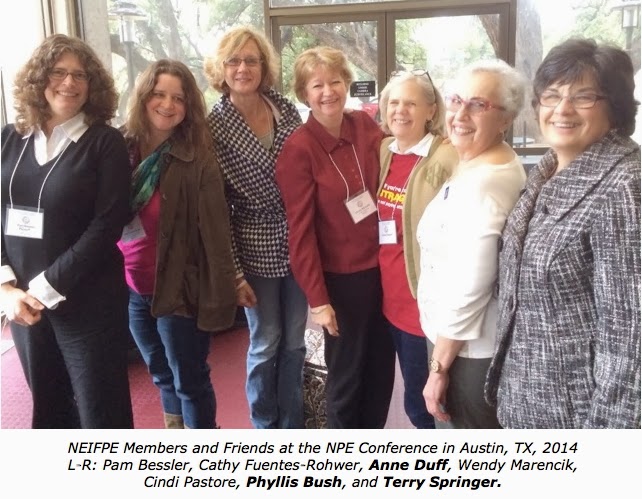
On March 1st and 2nd, a group of education activists from Indiana attended the Network for Public Education (NPE) National Conference in Austin, Texas. The Lady Bird Johnson Auditorium on the campus of the University of Texas at Austin buzzed with energy as people from all over the United States gathered, united by a single purpose – to support public education. Most of them had never met in person; many knew each other only through social media conversations and posts. What could have become a great deal of whining and gnashing of teeth about the sorry state of the corporate education reform was instead a powerful convocation of like-minded advocates and activists.

NPE Board member, Anthony Cody opened the conference welcoming 500 teachers, administrators, parents, school board members, legislators, and students. Cody’s speech emphasized that the entire audience was unified in support of public education and against corporate reform and “hedge fund managers who have discovered a passion for the poor.”

John Kuhn, Superintendent of Perrin-Whitt School District in Texas, and Karen Lewis, President of the Chicago Teachers’ Union, reminded us in their keynote speeches that being a traditional public school teacher is noble and good. In her keynote address, Diane Ravitch movingly listed the heroes of public education, naming students, teachers, legislators, superintendents, and numerous advocates. When she called out the Northeast Indiana Friends of Public Education as heroes, all the letters we have written, all of the calls that we have made, all of the presentations that we have given, all of the testimony we have spoken, all of the frustration and sadness we have felt suddenly seemed worthwhile.

Arising from this message of validation, we (along with the rest of the audience) could feel that there is hope and that the tide is turning. Momentum is building, and it feels as though we are approaching a tipping point. The 500 activists at the conference represent thousands more across the country who are questioning the wisdom and the speed with which education reforms and untested policies have been implemented and which ask for virtually no accountability for charter schools and for voucher-funded parochial schools. Parents and teachers are protesting the vast amount of instructional time devoted to preparing kids to take tests whose only real value appears to be to label students, teachers, schools, and communities as failing.

Parents are questioning how their children's private information is being accessed and sold to the highest bidder, and parents are calling for consent legislation that allows them control of their child's data.

Throughout the country there is a growing sense of outrage over the bill of goods corporate reformers have sold legislators. The primary way in which these reformers have operated is by writing stock legislation that governs legislation at the state level and threatens local districts with punitive action. Throughout the country, there is a growing sense that parents and educators have been right all along; public schools are not failing. The corporate, for-profit reformers view children as data points and test scores; their view is unacceptable. The research shows that this "brave new world" of testing, accountability, charters, and vouchers that Bill Gates, Michelle Rhee, the Koch Bros, the Walton Foundation, and ALEC have promoted is not working.

Parents and teachers know that the joy of learning comes from imagining, creating, playing, thinking, experimenting, problem solving, and being ready to learn. The joy of learning comes when a child has an "aha moment" when he/she finally gets it. Parents know that play contributes to learning; that children need the physical activity at recess and in gym class just as much as they need “rigor” sitting at a desk; that art and music help children learn much more than learning to practice for a test and bubble in an answer sheet.

The momentum to reclaim our public schools is growing, but in order for it to continue, more parents, teachers, administrators, students, grandparents, and concerned citizens need to stand up and voice outrage at the attack on public education by profiteers and power-brokers. Public education is a human institution created for the common good and is an essential factor in our democracy. It should not be a market place commodity. It should guarantee equity for all students rather than be a competition where there are winners and losers. We need to be informed about the legislation that is proposed and to let our legislators know what we want in our schools. We need to speak louder and defy the power and money behind corporate reformers and the legislation proposed by ALEC.

And we can do it. In the words of Diane Ravitch, "We will win because everything these faux reformers are doing is failing or has already failed. You can’t succeed if everything you do fails. . .The walls of Jericho will come tumbling down…. Blow your trumpets. Wake the town. Tell the people. It’s a well-known saying, but I never tire of reading it or writing it: Margaret Mead says, 'Never doubt that a small group of individuals can change the world. That’s the only thing that ever has’."

At the end of the conference, the Network for Public Education called on Congress to investigate high stakes testing. The revision of NCLB is long overdue, but neither the Bush nor Obama administrations nor Congress has done anything except increase the stakes. NPE has issued a call for “formal hearings to investigate the over-emphasis, misapplication, costs, and poor implementation of high-stakes standardized testing in the nation’s k-12 public schools.”

The message of this conference is clear: We can reclaim our schools as kind and friendly places for teaching and learning – not profit centers for corporations, and entrepreneurs, and snake-oil salesmen, and consultants.

As Ravitch concluded, “We are many, and they are few. And this is why we will win.” Winning means preserving public education for the common good and for all our children. It will take more effort, more voices, more action.

Phyllis Bush, Terry Springer, Anne Duff
Members of Northeast Indiana Friends of Public Education and The Network for Public Education

Thursday, December 12, 2013

Letters: NEIFPE Member Responds to Oliver

This morning a letter appeared to the editor of the Fort Journal Gazette from Brad Oliver. Mr. Oliver is a member of the Indiana State Board of Education from Muncie. A link to the letter is below.

Here is a letter from NEIFPE member and co-founder Terry Springer in response to Mr. Oliver's letter.
Dear Dr. Oliver,

I am one of the NEIPFE members you met with in Fort Wayne in the fall. We appreciated your willingness to come to Ft. Wayne to meet with us and share your perspective on how the SBOE was operating and your view of the governor's policies and Glenda Ritz's role. I was hopeful that your appointment to the Board would bring a voice of reason and a champion for children, but I was a wary because of your comments about Ritz's lack of leadership experience. You asserted that your main focus is on what is best for the children of Indiana. Since that time, I believe your actions belie your words. You continue to accuse Superintendent Ritz of a lack of leadership and to blame her for the contentious atmosphere on the SBOE and for taking actions she deems necessary. Do you think anyone watching the behavior of the SBOE and listening to the meetings as they are live-streamed does not know that the problem is not just of Glenda Ritz's making? Do you think that anyone paying attention and watching those meetings sees board members as trying to make the relationship among the members work? Do you think anyone who listens to the governor's announcements and his creation of an unnecessary - and costly- education agency usurping the role of the DOE does not see that public schools dedicated to educating all children in Indiana are in jeopardy? Do you think anyone with an even limited understanding of politics does not see the political influence behind a governor's appointments?

As I think back on all that you told us at that meeting and your words and actions since that time, I now think that you are not truly a supporter of public education. You tried to convince us at that meeting in the fall that the new agency the governor created was not really an agency. Perhaps that is what you believed. Since that time, it has become pretty clear that it is an agency that is costing tax payers money and that it plays a role in undermining the elected superintendent and the DOE. The issues that you bring up in your letter to the editor in this morning's Journal-Gazette about Ritz's casting aspersions on board members or making unsupported claims fall on deaf ears here in light of the Board's behavior during meetings - evident in body language, tone of voice and words. As you note, the governor rejected the design for restructuring the governance of the SBOE; however, the email along with other actions including the governor's 2014 education agenda suggests that plans are well afoot to make significant changes - changes that threaten the existence of public education - changes that privatize education in Indiana - that will serve a few to the detriment of the many - changes that undermine the democratic process in this state.

Thinking back on all that you told us in that fall meeting, I now think you have left the public education arena in terms of the choices you made for your own children and for your career and that you stand with those who are willing to sacrifice public schools for privatized, parochial education in which tax dollars will support religious education in the name of parent choice. It now seems to me that you stand with those who "choose" a parochial education because they don't want their children to go to school with "those" children not like themselves. That you stand on the side of those who are willing to punish schools and teachers and also children by labeling them as failures in a system designed to do just that. Those of us who stayed in public schools and kept our children in public schools - even when everything was not perfect - believe that public education ultimately works for the common good and contributes to our democracy and that reforms should support programs in public education rather than deprive them of funding that makes the work they do only harder. From what I can see the SBOE is not focused on reducing the impact of harmful testing and labeling as you said you wanted to do. Instead, it works behind the scenes in emails to force distribution of grades from a flawed system and then accuses the Superintendent of not doing her job and overstepping her boundaries. I would assert that the SBOE, the governor, and the Republican legislators are more responsible for the dysfunction. I believe in the ability of intelligent, well-intentioned people to overcome challenges and to solve problems. And so I am both disappointed and outraged at the failure of SBOE to overcome political differences and find a common ground to work for all kids in our state.

Read Brad Oliver's letter HERE.